The body as a “place” that expands into other bodies, objects, and places constitutes the central driving force behind the work by Colombian artist Juan Duque (Medellin, 1974). Based on personal experiences marked by geographic and cultural displacements, Duque’s installations and projects become temporal constructions that suggest a continuous relocation between provisional places in order to reflect on notions like the horizon, identity, memory, and permanence. The site-specific performances and interventions that Duque has presented in several countries in Europe, Asia, and America, are the central basis for work focused on “stimulating the performative aspect of time and space that we share with other bodies and objects”1 that establishes singular discursive connections between different mediums and languages—ranging from sculpture, drawing, and photography, to video, collaborative practices and installation—and is continuously playing with the viewers’ senses.
Breathe Your Own Horizon, the first exhibition by Juan Duque at the Galería José de la Fuente in Santander, Spain, features a group of works based on the performative action of the artist’s own body interacting with found objects, situations, and materials. They are the result of recent processes developed in different contexts, in which Duque underscores his interest in the relationships with “otherness” that define the contemporary being, as he proposes an analysis centered on space, body movements, and the interactions established between them and other elements in the world. These are works that seek the visualization of those interstitial spaces between things generated by the interaction with the surrounding space in an “attempt to measure the elasticity of the individual’s horizon of expectations,”2 including the cultural, social, and political dimensions of his behavior.
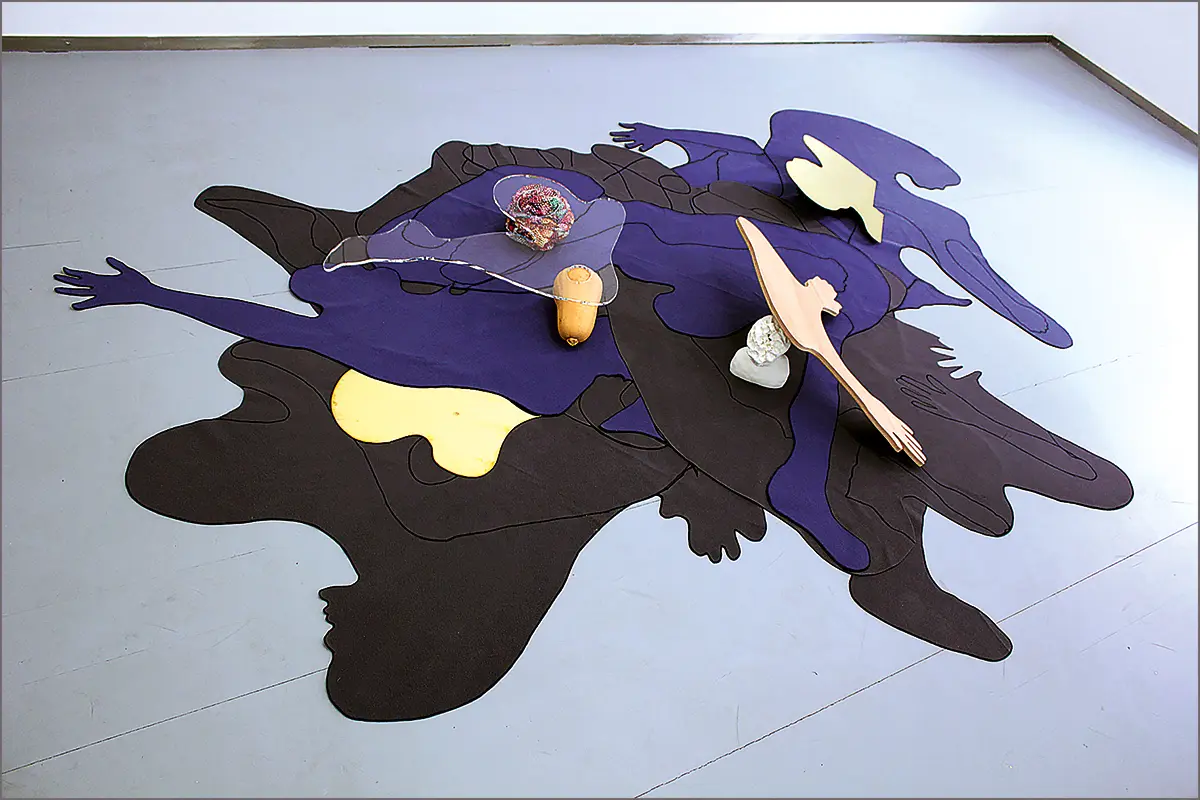
The photograph titled Talones (Heels, 2018) displayed by the gallery entrance conveys the gesture of a forward impulse towards an exhibition that actively involves those viewers already exposed to the sensorial experiments of artists like Lygia Clark and Hélio Oiticica. In Marollen (2018) we sense a human presence amid the urban echoes of the neighborhood in Brussels that the piece is named after, along with a group of weaves describing lines and rhythms of color that evoke the excitement, vitality, and movement found in Oiticica’s Parangolés, in an exploration of the pictorial realm that is also present in the installation entitled Between My Mouth and My Hand (2018). This piece, which consists of methacrylate marks of different colors that form the outline of the artist’s figure and references the work titled From Hand to Mouth (1967) by Bruce Nauman, activates reading of the mysterious mechanism between doing and saying and the importance of the body and its actions as vehicles to communicate and transmit ideas. The intermediate, liminal, spaces generated by the relationships between bodies and objects have also accompanied this artist’s observations about the public space and contemporary life in the cities. The installation entitled Tapando el sol en Madrid (Covering the Sun in Madrid, 2017) “shows the moment actors working as ‘living sculptures’ at the Puerta del Sol public square put on makeup and prepare behind sheets and other covers before ‘appearing’ with other identities in the public space. During the anti-austerity movement in Spain known as 15-M, they were ‘bodies’ that, as a result of their social liminality, could not even be ‘outraged.”3 The image printed on the canvas and mounted on a simple structure placed by a large window facing the street, recreates the idea of urban scaffolding and the fragile state present in everyday survival.
The works Máscara para suelo (Mask for Floor) and Halcón (Falcon), both from 2016, establish a ludic game of appearances and disappearances, presences and absences, which alludes to the identity-forming processes and cultural postures (Eastern-Western) already approached by Duque in earlier works. While the puppet’s head reminds us of our own reflection and of the imperative to be free that drives individuals, the work Halcón, on the other hand, a Gobelins rug found in Brussels with perforations resulting from Duque’s action (playing Pétanque with it), explores the proximity relationships between the different positions of the balls when the rug is perforated while also proposing a new landscape. The horizon is activated by the body and Duque’s experience. While in the video titled Temporary View (2011), the performative gesture appropriated the landscape through his cloths, in Finger Tracing the Skyline of Asia, Standing in Europe, Istanbul (2013), Duque surveys with his finger the outline of a continent as he traces an imaginary line that suggests the idea of territory as cultural and political construct and the need to transgress boundaries and borders through new forms of resistance.
In short, Breathe Your Own Horizon addresses the value of gestures, actions, and the interpersonal spaces that surround us in order to encourage, in Duque’s own words, “a re-positioning of our gaze towards an ecology of mutual understanding.” The photographs Untitled and Between Bodies, both from 2018, along with the installation Precedent Shadows, form 2017—based on the 2017 collaborative performance titled The Time and Space We Share Together—move into the exhibition space silhouettes, shadows, corporal movements, reflections, and sensations experienced by Duque and the other participants, underscoring that interstitial dimension inhabited by gestures and the contact between bodies and things that is capable of transforming the horizon.
NOTES
1. Juan Duque: “Artist-statement” in https://betweencorners.wordpress.com/
2. Linda Rocco: Breathe Your Own Horizon, Galería José de la Fuente, Santander, February 16– March 31, 2018. Foldable brochure.
3. Juan Duque: Notes about the exhibition Breathe Your Own Horizon Galería José de la Fuente, Santander, February 16– March 31, 2018 (unpublished).
WENDY NAVARRO