The recent exhibition of works by Brazilian artist Josely Carvalho at the Museu de Arte Contemporânea da Universidade de São Paulo, titled Diário de Cheiros - Teto de Vidro (Diary of Smells - Glass Ceiling), involved a sensorial denunciation, a visual, tactile, and olfactory investigative journey.
The exhibition was based on the project Diário de Cheiros (Diary of Smells), developed by the artist as an extended investigation into olfactory art; it proposed an aesthetic dialog between registers of the memory of a consequential—and still present—past and a current moment organized around fragments of remembrances split by the contradictions of a period of socio-political upheaval.
Teto de Vidro (Glass Ceiling) materialized an olfactory investigation carried forward by Carvalho as an exercise in sensorial discovery. In her poetics, creating installations with original aromas—named Prazer (Pleasure), Ilusão (Illusion), Persistência (Persistence), Vazio (Emptiness), Ausência (Absence), Afetivo (Emotional)—she guided visitors through chromo-perceptual interactions in an exhibition pervaded with emotion.
Carvalho named aromas dominated by the occurrence of conflict, so frequent in contemporary life, Pimenta (Pepper), Lacrimae (Tears), Anóxia (Anoxia), Barricada (Barricade), Poeira (Dust), and Dama da Noite (Lady of the Night), activating a state of uncertainty in collective memory.
For the exhibition, Carvalho proposed two nodes of works in glass, a solid material of great fragility. She interpreted the presence of chance occurrences, of accidents and breakages, in the life of all utilitarian objects—cups, glasses—as indications of a new destiny for pieces of such high resistance given to the passage of smells.
The first node, which welcomed visitors at the entrance to the exhibition gallery, brought together hundreds of broken items, wine glasses, and fragments with cutting edges, in an installation titled Estilhaços (Shards), a kind of memorial to broken pieces that contain olfactory memories.
The second node brought together two perspectives: an environment with works in blown glass and fragrances—the fruit of Carvalho’s experience at the Brooklyn-based Urban Glass Studio—and an installation titled Resiliência (Resilience), a sharp-edged, vertical, mobile structure with three large splintered pieces of glass, imposing in their discursive version in the exhibition space.
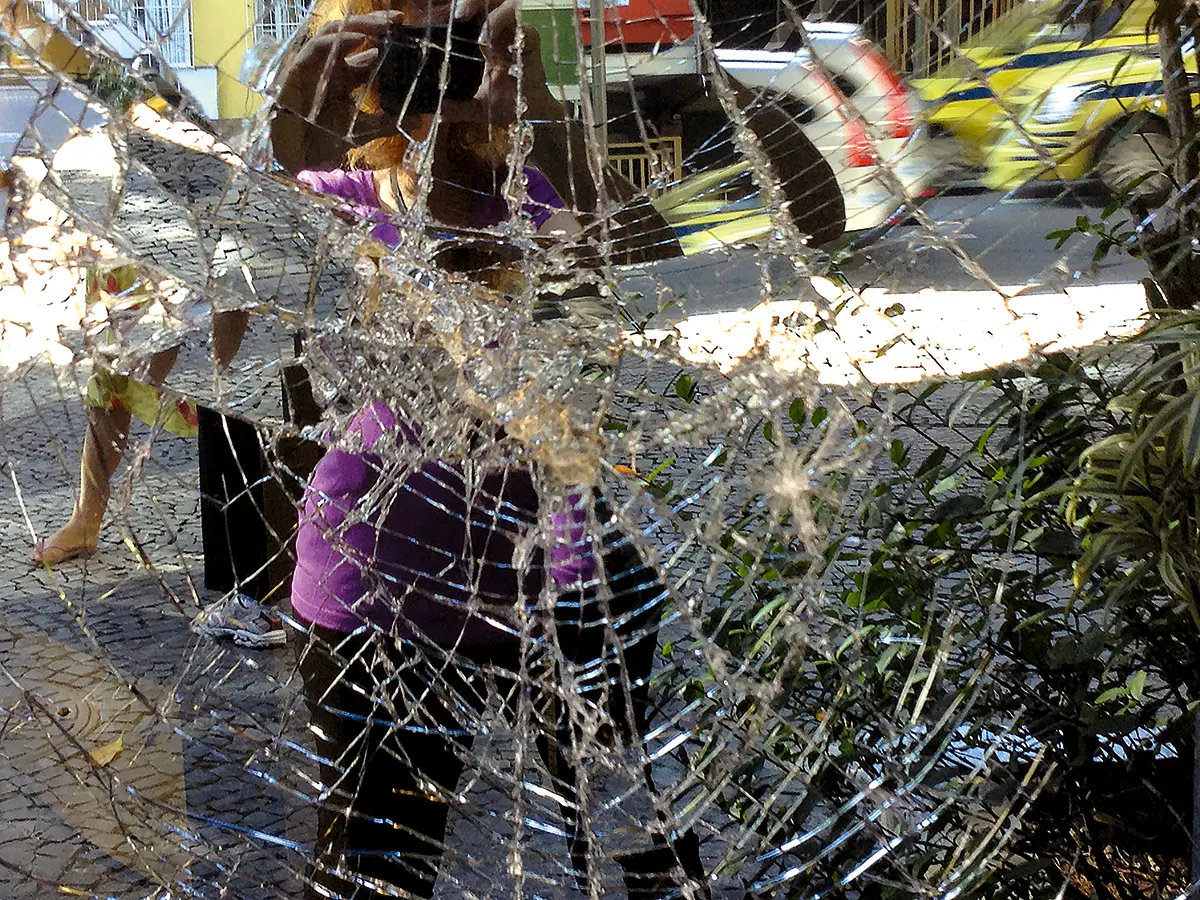
Framed, the glass pieces gathered by the artist during the riots and protests that took place in the streets of Rio de Janeiro in 2013 were a translation of chaos.
There was an olfactory memory also in the shards of glass left behind after the protests; reanimated now by Carvalho, it spread around the entire exhibition space and enveloped the audience. It was possible to perceive the smell of pepper, characteristic of the gases sprayed by the police against the rallying masses, and to connect the sensations of fragility and intimidation to the memory of a historical event.
Given her many concerns, Carvalho activated a tactile-olfactory journey for visitors to sense the way in which her investigation materialized in crystals, in personalized aromas.
In each of Carvalho’s blown-glass creations, like Ânfora#10 (Amphora#10) and Ânfora#15 (Amphora#15), both from 2017, there was an opening, a discreet space with perfumed crystals produced in collaboration with Brazil’s Givaudan perfume factory. They invited visitors to a combination of touch and smell, along with the omnipresent and always dominant gaze.
Incorporating encapsulated aromas into her creations, Carvalho’s project makes it possible for visitors to discover a decision that, rather than impeding tactile contact with the objects, invited audiences habituated to the art museum as a supervised experience to sense the cold glass surfaces and inhale strong smells that disrupted the environment and changed the reception of each work.
The installation Resiliência, from 2013, which materialized the artist’s denunciation of a time of crisis, conjugated the forces of a complex adaptive capacity and played in the exhibition the central role of a gesture transformed into an act of resistance and renewed awareness of a narrative in the process.
In the exhibition, visitors made contact with thirteen aromas, arranged in two installations, an artist’s boo, and six blown-glass sculptures with various fragrances.
There was even a station with six fragrant bars intended to be manipulated by visitors, an evident cut in the trajectory that was proposed as a final, didactic experience.
Also contributing to the composition of the environment was a 2017 video titled Memória do vidro (Memory of Glass), included in the dimly lit space of the exhibition gallery. Under controlled lighting, the black walls became denser and the transparency of the glassworks created shadows and an atmosphere of instability.
Josely Carvalho lives in New York and also maintains a studio in Rio de Janeiro. She investigates the quotidian in its common version as hours of a regular day and has worked with the symbolic imaginary of the sense of smell as a sensorial matter for the invention of her theses.
Exploring each work in detail became an incursion into the flow of use and discarding of everyday material, glass, which is nevertheless unusual in the arts.
In the vision proposed by Carvalho for the circuit of the Teto de Vidro exhibition, visitors recognized the malleability that is the very nature of blown glass, the aroma of forgotten scenes, and the splintered scar of individual and collective human memory.
CLAUDIA FAZZOLARI