An architect by trade, Mexican artist José Dávila (Guadalajara, 1974) has always approached materials in a peculiar way, appreciating their original natural state often by just reorganizing them without altering them—something that makes him seem more like a catalyzer facilitating the processes of forces that already exist. This is mutually suggestive, given that the variables within his process are the materials themselves and their arrangement in the space, in addition to textures, weights, and, most importantly, the juxtaposition of these elements, their relationships, and contrast.
The exhibition entitled Mechanics of the Unstable at the Galería OMR in Mexico City presents eight sculptures. The first group that viewers encounter stand out for the use of six-meter high metal beams and rocks—particularly those known as San Andrés rocks, which are grey with shades of green and come from San Andrés Ixtlán, in the south of Jalisco, the Mexican state in which Dávila was born. Playing with the juxtaposition of balance and instability, he adds spheres or other rocks arranged like weights hanging from a steel cable in strategic tension points. The beams form diagonals and as viewers move several angles can be observed depending on the point of observation.
The second group of sculptures displayed on the gallery’s second floor offers the same type of interactions between weight and materials, but this time with a wider range of elements, including concrete, glass, plaster, and wood; all arranged to generate a physical tension through a sort of confrontation between rigidity and fragility. In the piece titled Mecánica Inestable III (Unstable Mechanics III), for instance, there is even a red latex balloon that defies the weight and sobriety of the metal and the rocks in order to contrast the materials and generate a slight sense of chaos, of not belonging.
In the piece entitled Every Finding Has a Consequence there is also an element that appears to be out of place: a synthetic apple that generates interaction between balance and gravity—a wink to Newton and perhaps to Magritte as well. Dávila has mentioned that he is interested in all possible interpretations of the symbols presented in his work. So the apple in itself has multiple meanings.
The important role played by the materials and the minimalist use of elements borrows from works by artists like Donald Judd, Richard Serra, Robert Smithson, and Dan Flavin—Davila has created works that pay tribute to those artists, in an attempt to continue reinterpreting their valuable contributions, in particular with his Judd series created between 2007 and 2009. In the same manner, the work by Dávila not only has been influenced by the minimalists from the US, but also by his exposure to Latin American movements like Brazilian Neo-Concrete art.
Gravity as an omnipresent force becomes the common thread of the exhibition and a central element. It is the force that joins and disjoints at once; each piece of the sculpture plays with the interactions between mass and strength and instability and balance.
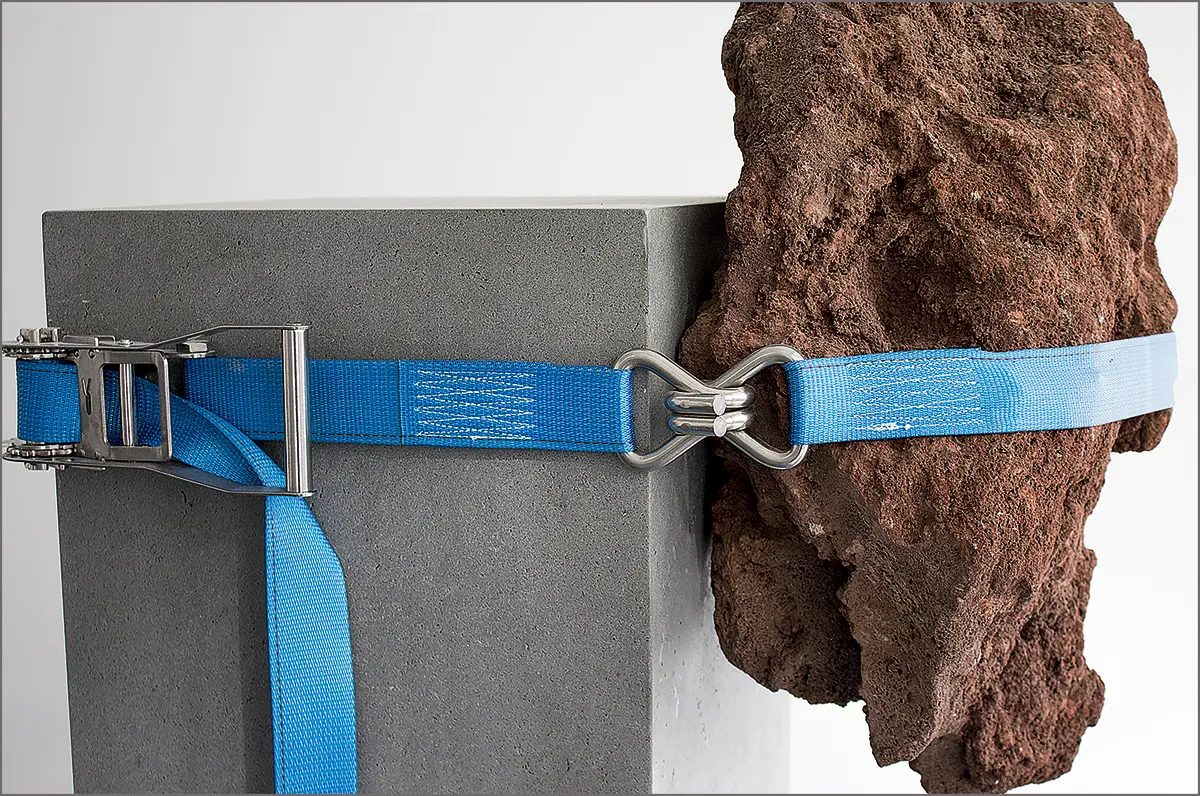
The latter one can be appreciated in the work titled Act of Perseverance, in which a stone block supports a volcanic rock with the help of a cargo strap. One is immediately attracted by the contrast between the solidity of the stone and the porosity of the volcanic rock. But then one realizes that maintaining both elements together is nearly impossible. Although kept together by a permanent tension, at times it would appear that the whole thing could collapse in an instant—something avoided by the precise calculations involved in the design of the piece.
While the instability of the works could suggest randomness, the precise calculations applied to every element in the pieces appear to rein in any perception of chaos and demand a certain degree of resistance from the materials. Based on a seemingly simple spatial composition, an unbalanced and yet harmonious effect is sparked, generating a functional system in which the leading role of raw matter allows for the simplicity of a metal beam or the primitivism of rock to become a highly symbolic group of works.
ISAURA RUIZ