1988. Wilson Ferreira-Aldunate is buried. Some gazes follow the funeral procession of the body while others focus on the front. A woman’s faint smile suggests a sign of relief. A suspicious man with sunglasses preens his beard; his impeccably groomed hair is aligned with a poster in the background that advertises the word “Gold.” In the middle of it all, a young woman overwhelmed by despair grabs her head with her hands and cries inconsolably. Her eyes accidentally meet Vidart’s camera. This is the story of a story turned into a photograph.
Off-camera. The stylebook of any photojournalist contains several dogmas of reason. And one such dogma states that images must show an action that synthesizes the news being covered. Curator Pablo Bielli, entrusted with selecting Jorge Vidart’s snapshots for the exhibition at the Centro de Fotografía (CdF) in Montevideo, Uruguay, knew about the open disregard for that written rule shown by the veteran photographer, who used to work for La Hora and La República. Vidart’s best scenes are those in which the newsworthy action is off-camera; the subjects portrayed are shown reacting to something above, below, to the right, or to the left outside the field of view; urban scenes in which the protagonists are not the news but rather those witnessing it: the spectators. In this manner, exhibition visitors are able to identify with those looking with pain, amazement, or feigned indifference at something that is not contained within the image. Other photographs meet us with the direct stare of the subject portrayed; that austere, histrionic-free, communication that moves us because of its ability to narrate without using words. They are also free from the literal approach encountered in the pages of newspapers.
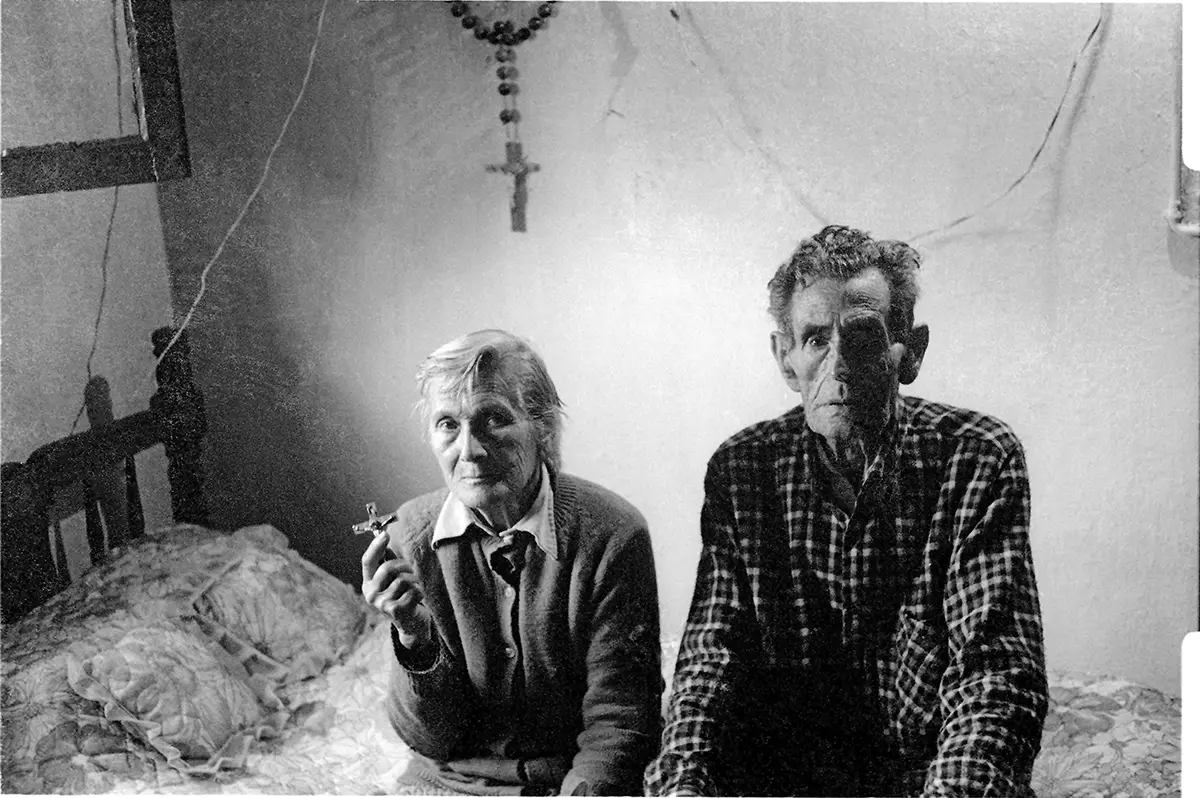
High-speed film. The exhibition Oriental Dialog. TRI-X: Introspective reveals a photographer capable of capturing a mood and a story in a frozen thousandth of a second. Loyal to the high-speed black and white photographic film made by Kodak—whose name is included in the title—Jorge “el Bocha” Vidart reveals himself as a storyteller, who does not rely on words to narrate rural and urban novels taking place in brothels, taverns, and out on the streets.
The—geographic and psychological—interior of Uruguay during the 70s, 80s, and 90s, the material centered on the Jara neighborhood in Asunción (Paraguay), and the photographic series intervened with texts, form a palimpsest of eyes, gestures, and aged wood. From the unassuming piece titled Vuelta Ciclista del Uruguay, Canelones, (Stage Cycling Race of Uruguay, Canelones, 1974) that begins the exhibition—which reveals a fearful country in analog—to the small intimate and metaphorical poems of recent years, Vidart establishes a narrative in every black and grey photographic grain. Because of their modest dimensions and arrangement in the space, these recent experiments are diminished by the large photographs from his traveling period and by some questionable clarifications—like those in which Vidart wrote by hand that his work stays away from “laboratory tricks.” Ignoring that less important final fragment, Vidart’s reassessment is justified through his ability to masterly reflect the stories of the immortalized mortals, hard lives, and past traumas that meet his lens. A series of portraits of different characters in focus in the same place constitute a line of figures that could very well be part of a street advertising sign. But it is not so. They challenge the rigid nature of single interpretations and only sell their soul to the person holding the camera. Every single fold of clothing, every single face wrinkle, shadow, and object, rely on each other to establish a timeless dialog. Those of us who grew up admiring the human and humanistic scenes captured by Robert Frank are able to transfer their purpose in Uruguay shaped by abandonment but also by success, by anonymous historic events and unnamed heroic characters. A photographic album that is familiar to all of us, even when it is about a generation suspended in the past, despite being developed in a remote dark room.
JUAN JOSÉ SANTOS