The retrospective exhibition centered on the work of Jorge Eduardo Eielson (Lima, 1924-Milan, 2006) at the Museo de Arte de Lima (MALI) establishes him at the forefront of Contemporary Peruvian art. The exhibition underlines the remarkable creative abilities that positioned Eielson as the most important contemporary artist on the stage of modern art in Peru today. The outstanding curatorship by Sharon Lerner and Gabriela Rangel follows Eielson’s artistic trajectory, conveying the way he assimilated and reinterpreted various modern art currents in contemporary terms.
The exhibition travels through this creative course by using Eielson’s most important series as guidelines, in an approach that sheds light on the various formal, conceptual, and thematic interests that occupied him pertaining to the history of Peru (the quipus and paintings with Pre-Columbian iconography), Peruvian geography (coastline landscapes), and experimental practices (performances and poetic actions).
The curatorship conveys the efforts by Eielson not only to inquire about the possibilities offered by traditional artistic mediums but also to transcend their limits through the combination of different artistic approaches (painting, sculpture, performance, objects, music, etc.) and the exploration of several artistic disciplines (visual arts, literature, theatre, poetry, music, among others), demonstrating in this manner his restless imagination and openness to new artistic developments.
These combinations are evident in “Quipus,” one of Eielson’s best-known series. On the one hand, the works in these series convey an underlying interest for the pictorial surface—championed by abstract painting—through the treatment of fabrics with coils and knots. By using fabrics of different textures, colors, and patterns, he generated forms and images that are foreign to painting traditions. On the other hand, Eielson expressed his interest in sculpture through the volumes that result from his handling of the materials, but also from an idea implicit in the process associated with the actions to create the pieces (twisting, coiling, knotting, and tensing) and, by extension, from an interest of a performative nature centered on the body that executed the actions.
An example of this is the piece entitled Proliferazione (Proliferation, 1993), a work consisting of a knotted and coiled multicolored fabric placed on a chair that serves as an analogy for the human figure through its meticulous coiling process, scale, and position in relation to the chair.
These interactions between different art forms are also evident in a landscape series centered on the desertic Peruvian coast titled Infinite Landscape of the Coast of Peru. Characterized by their high matteric value and coarse textures, these paintings seem like heirs to the European Informalism of the mid-20th century. Nonetheless, Eielson transferred this eminently abstract reference to the figurative realm—it is about the landscapes after all. But with these works, he actually played with the idea of representation, non-representation, and presentation. In this manner, the work titled Poema (Poem, 1977) both represents the shoreline, an abstract image (non-representation), and a presentation of that shoreline, insofar is made of beach sand. And he also included the word “poem,” which appears written on the sand, opening another universe of linguistic possibilities (using the word perhaps as a noun, to give the work its title, or as a metaphor for the beach?). A work like this articulates the preoccupations of modern painting, the explorations of conceptual art, and the games found in experimental poetry.
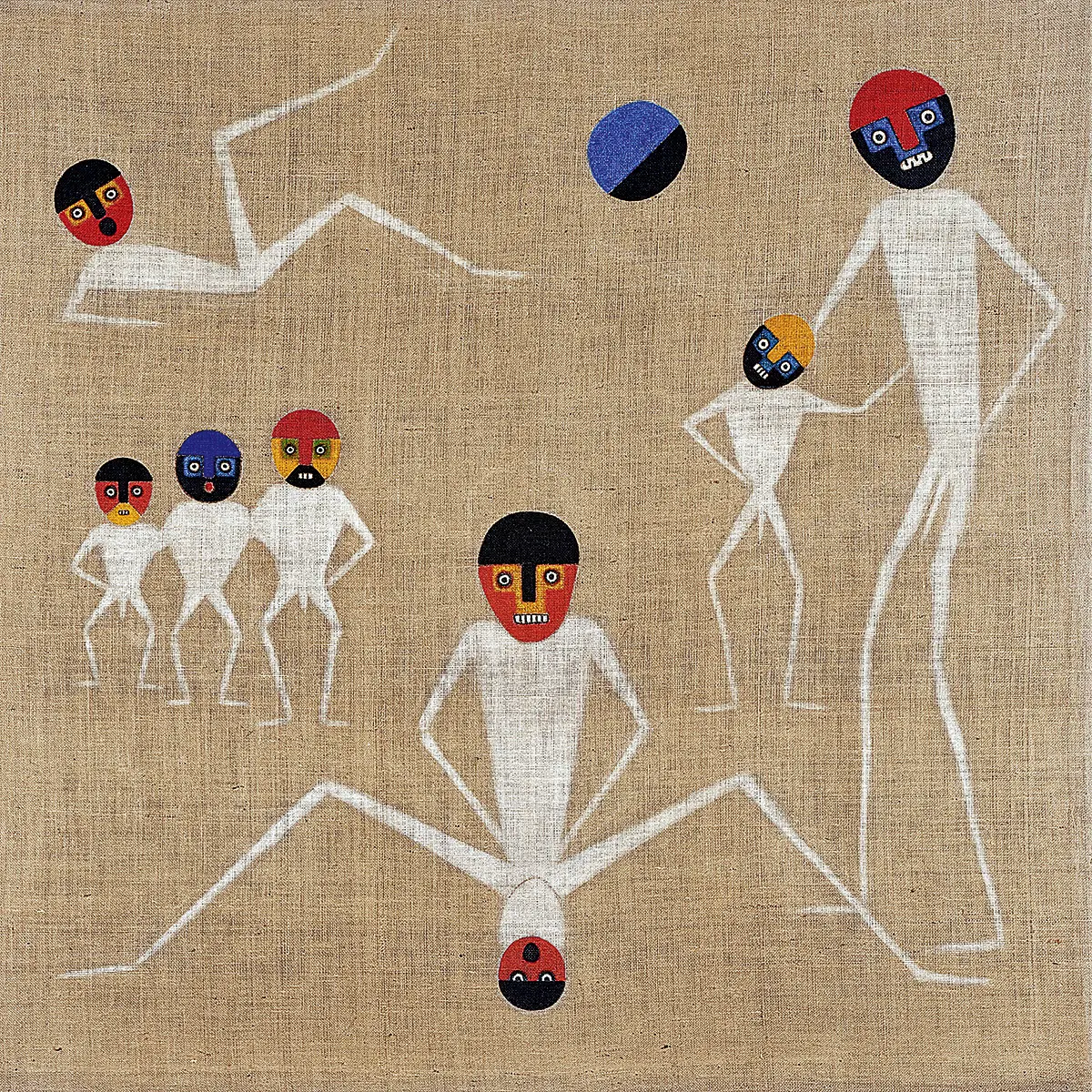
Eielson not only reworked the artistic forms of his time but also inquired about the historical and architectural nature of things, as exemplified by the 1985 painting series based on Pre-Columbian iconography titled Ancestral Ceremony I. The works depict a sort of ritual birth scene in which weird characters help build a bridge between premodern forms and a pictorial proposal that borrows from modernism but aims at contemporaneity. In addition, the pieces in this series also convey a special graphic sensibility conveyed through the design-like synthesis of their forms, as evidenced in the painting titled Autorretrato definitivo (Definite Self-portrait, 1985).
Eielson’s experimental approach is reaffirmed in his performances—some examples are shown through documents, photographic materials, and mockups—or in works like The Body of Giulia-no (1972) and Interruption (1988). These series showcase a predilection for ephemeral art and experimentation without regard for the art market, something also present in his poetic actions and the works labeled “expanded poetry” which include his auditory poems and verbal and visual images.
The retrospective exhibition at MALI solidifies the figure of Jorge Eduardo Eielson as an artist committed to the exploration and expansion of creative possibilities, and as an artist who in his search for, and dialogue with, other creative approaches, not only earned a place in the history of Peruvian art for his own work but also succeeded in paving new ways for the artists that followed him, creating in this manner the conditions for his enormous importance.
MAX HERNÁNDEZ CALVO