To collect is, to a large degree, to devote extended attention to the details of a given category of objects. A collector is enamored of every variation found in a given item with respect to others of its kind. He is governed by an intense curiosity about everything that surrounds his focus of interest. He wants to know it better and better. Walter Benjamin mentions, with regards to his own feelings towards his library, “a living sea of memories that flows in the direction of any collector busy with what is his. In fact, every passion borders on chaos, but the passion of the collector borders with his memories.”1 The German thinker refers to experiences lived and stored in the depths of one’s soul; for Jeanete Musatti, the meaning of a collection is markedly different, utterly uncommitted to facts as such. The stories created by her compositions may or may not narrate specific events; they may allude to subjective remembrances or be entirely fictitious and surreal, entirely random inventions of oneiric universes. In her solo exhibition Sem título (Untitled), at Bolsa de Arte Gallery (São Paulo), objects gathered during the artist’s many travels around the world are arranged in a wide variety of positions and in unique relationships. From crystals to cameos. From shoes to eyeglasses, small plastic dolls or artificial plants, apparently anything can attract Musatti’s gaze; the artist sets up her unique “dioramas” inside display cases that need to be carefully observed for a long time if one is to apprehend the totality of elements included in the composition. Painstaking care is taken in the arrangements, in the chromatic relationships, and in the balance of elements within the composition. Musatti’s sense of humor, diligence, and elegance are in evidence in each of her works, be it with many components or just a few.
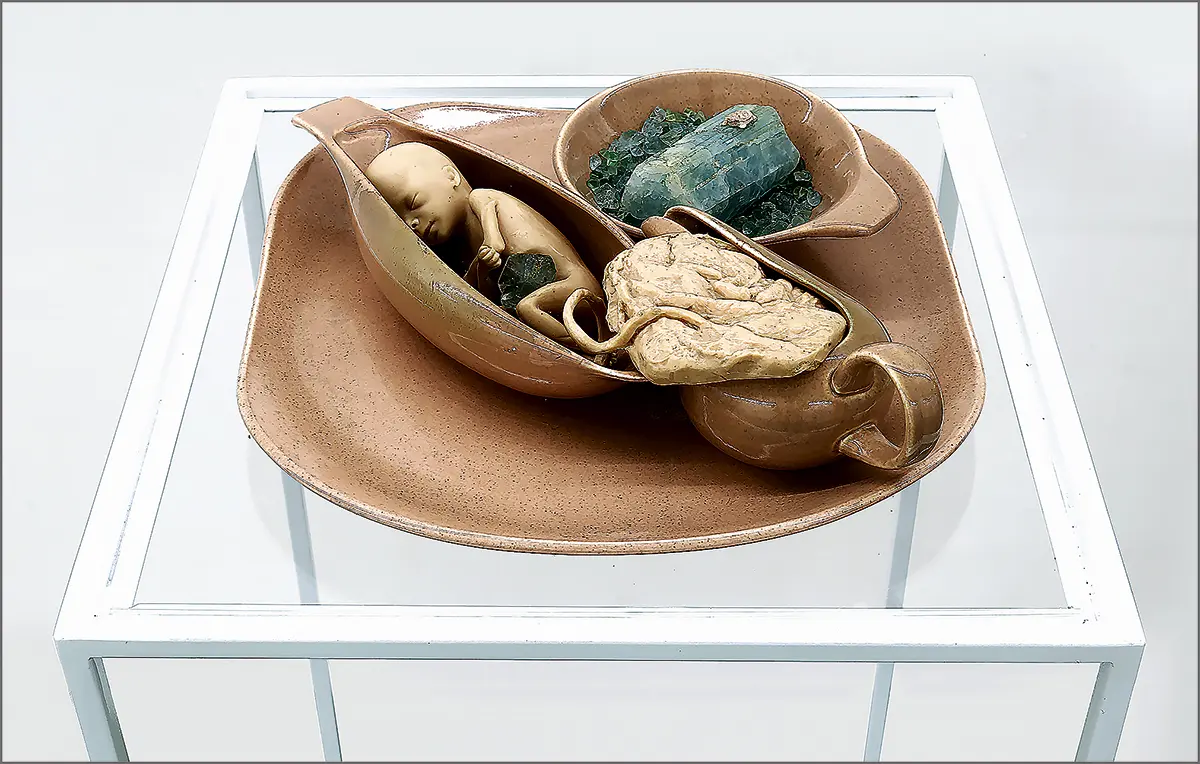
Musatti’s subject matter is widely varied, and it isn’t always as well defined as in Grande Prêmio Ascot (Grand Prix Ascot, 2017), where the head of a horse in malachite, a card, and some feathers are arranged on a layer of obsidian. Coala trans (Trans Koala), also from 2017, a plush animal toy adorned with a necklace and earrings inside a washbowl set on a granite circle, intends to comment on gender issues or the limits of the language of contemporary art. What kind of critique is implied in an installation of miniature chairs, titled Reunião de Críticos (Gathering of Critics, 2018)? The set titled Pantanal (Marshland) recreates imaginary landscapes using, ironically, plastic plants and resin animals found in souvenir stores. Some crystals are used in these works because of their mystical, symbolic content: for example, aquamarine—a mineral that counts energy and vitality among its attributes—appears in Nascimento e longevidade (Birth and Longevity, 2016/2017), a composition in which crystals of this material are disposed in connection with a plastic fetus and ceramic utensils.
There is in the exhibition space for earlier productions by Musatti. In the area towards the back of the gallery there are some of her older works, many of them untitled and several with clear political intent, commenting on events of significance for humanity in general. Particularly noteworthy are the exemplars from the 1982 series Desenhos Ritmados (Paced Drawings). These are exercises inflow and pause using a black and white pen, obsessively and rhythmically repeated on small sheets of rice papers. They might seem, in aesthetic terms, miles away from Musatti’s most recent works, yet there is a connection between both creative moments: the detailed and controlled construction of the compositional field. In the case of her drawings from the 1980s, the process is even more evident; rhythm, repetition, and serialization reveal the artist’s exercise in control posited almost as a challenge to remain faithful to self-imposed parameters for pace and direction. Here and there we find a disturbance in the general pattern of the plane, but even then formal harmony is carefully respected. More than like musical scores, the set appears as code in a language that we are unable to decipher; or perhaps as constellations of imaginary or imagined universes. The mystery, the ineffable element that remains subjacent in Musatti’s boxes with scenes composed of widely disparate elements that tell stories or tales, is also manifest in these drawings. More than decoding, perhaps what is most important is the exercises of unbridled imagination, both in the development of each work by the artist (which curator Ricardo Resende describes as frantic, with Musatti moving between several projects at once, shifting elements, returning, reformulating) and in its reception by audiences who arrive at them with their own baggage of concepts and expectations.
Musatti’s body of work was for long periods absent from the art system, held only in the artist’s own home/studio. In appears in this exhibition less as a retrospective than as a generous selection from the production of an unconventional artist, one in possession of the self-assurance required to traverse a variety of languages and styles with grace and fluidity.
NOTE
1. Walter Benjamin, “Unpacking my Library”. In Illuminations. Essays and Reflections. Schocken Books, 1969, 1987.
SYLVIA WERNECK