Visual and linguistic signs focus on the materiality of the letter, on the tension between what is utterable and what is visible. Those are the characteristics of Helena Trindade’s work as an artist, as can be seen in the exhibition A letra é a traça da letra (The Letter and the Trace of the Letter), at Paço Imperial in Río de Janeiro. The exhibition is proof that the genealogy of Trinidade’s oeuvre stems from the relationship between image and word, in ways that differ from the tradition that has taken root since Modernism.
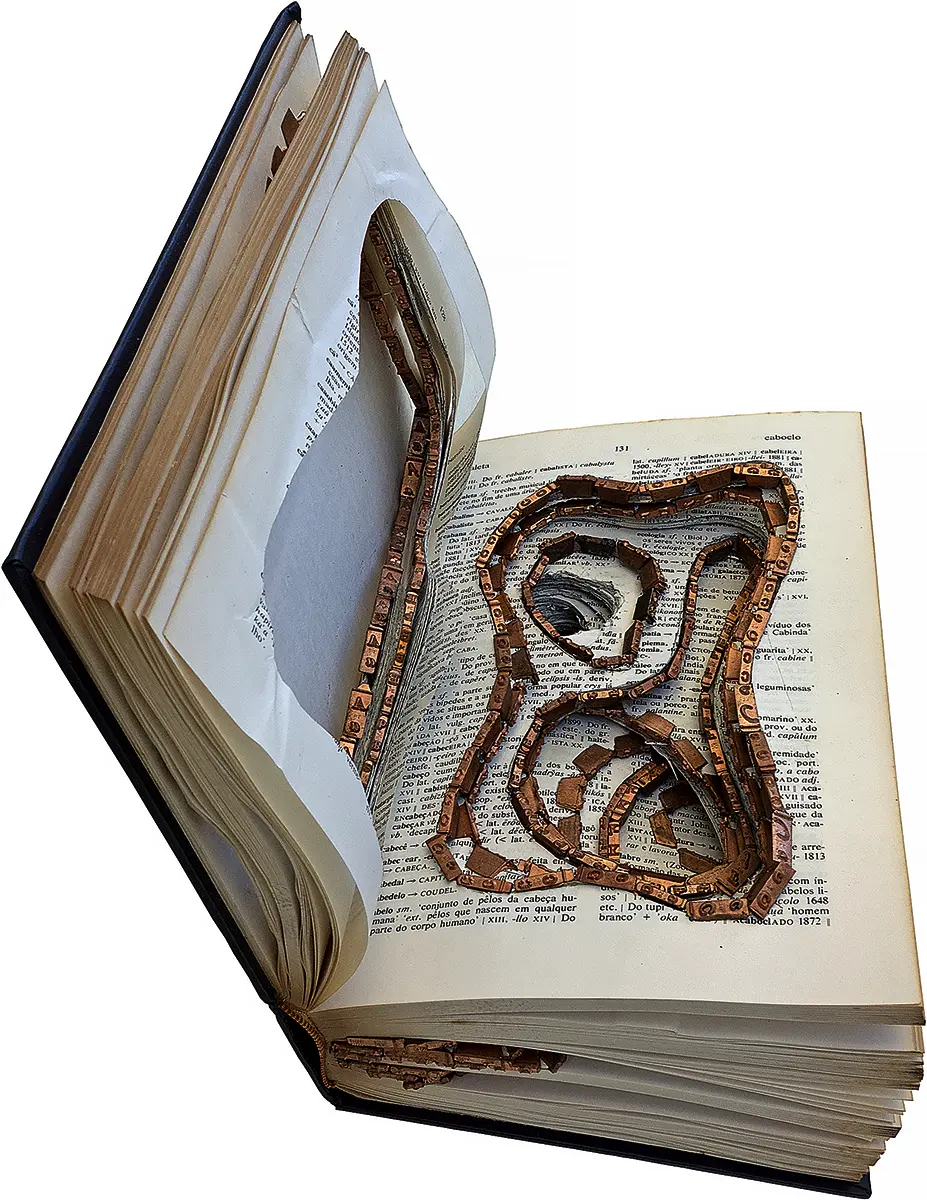
Created by Glória Ferreira, the exhibition featured 45 works of art, including objects, installations, photographs, sculptures, videos, and performances (on opening day), on display in the four galleries of Paço’s third floor. These works, mostly in large formats, had not been exhibited before. The exhibition took its title from one of the installations in it, comprised of the Alfabeto traça (Moth Alphabet), the invention of a self-referential alphabet (unconnected to any extant equivalent) with blurred typewriter keys and an etymological dictionary that has been bored through by the artist, moth-like, using small typewriter metal types.
The works on exhibit dialog with Brazil’s powerful Visual Poetry tradition, a field Trinidade has explored since the 1990s. “There is, in the motion generated by language, an incessant work of rearticulation that renders the issue of origins problematic since nothing is produced in the process other than by transformation,” explains the artist. Many letters and alphabets are present in the several installations on display. “Latin alphabets not segmented but in a process of constant construction, destruction, and reconstruction. The works refer to one another and establish a broad visual poetry field,” says curator Glória Ferreira.
Despite the solid relationship between letter and image, it is possible to find in Helena Trinidade’s work a leap into the spatial dimension, an unusual slant towards architecture, body, and word. On the words, the Alfabeto traça is arranged as in a calligraphy notebook. “Without a code, it dialogs with the destruction of the wall of language by viruses in the first installation, and with the presentation of matters of love and desire in the other galleries. It closes with the dynamic linkage of all the works—a linkage that is eminently provisional as Trinidade’s process continues to move forward, retracts, and transforms with the invention of a new alphabet,” the curator concludes.
For large installations, conceived as visual poetry, engage different aspects of the functioning of language by means of images, letters, and sounds. Each possesses elements that connect with the one that follows, and the audience is able to interact with some of them. The installation (a)MURO [(a)WALL], where we find a large wall built using letter stencils, for instance, attempts to involve the observer’s body with the forest of flower buds that one needs to traverse in order to gain access to the following gallery. In this installation, people recline on organically shaped elements of paper and bookbinding, moving them as, on occasion, changing those shaped.
The matter of time and the body is also present in the video D´Écrit x Des Cris (Writings & Screams), made in collaboration with Ana Kfouri, where the body appears always in pieces or through shadows and screams. In the installation (A)MOR [(L)OVE] there is a video diptych consisting of two projections on the gallery floor that interrogate various moments of a romantic relationship. One of the videos is dynamic and vertiginous, set to electronic music. The other one is placid and calm, set to ancient Greek music. The proposal was for people to pass between the two videos, projecting their own shadows and allowing themselves to be “bathed” by the images.
The installation Medida de todas ais coisas (The Measure of All Things) encompassed twenty objects that also referred to the body and the letter, in the form of utensils, books, toys, and other items that become works of art as they depend on revision and desire on the part of the viewer; intense, prodding works that connect with each other through their letters, their presence, and the location from where they speak to the others.
For Helena Trindade, “the letter is a ‘pre-text’ for poetic play.” She adds, “The poetic aspect of the letter takes place in an interval of indeterminacy, in the same lacuna, between the sayable and the visible. What opens up a given text to boundless readings is the work of the plasticity between letter and image. In the letter’s minimal formal unit, words are detected before they become signifiers.”
While for Modern Art the connection between art and word occurred primarily in the slant towards formal interactivity, as was the case with Picasso and Magritte, in the contemporary moment that relationship gained the pathways of a more profound aesthetic phenomenology. As Trinidade’s work shows, art and life come to fuse. The word participates in that fusion as a visual element loaded with latent meanings, but not as writing, and no longer as a mere complement to the image. It is definitively incorporated into the visual arts as a visual resource and sign; this is to say, as the postmodern rejection of the subordination of one to the other.
ALESSANDRA SIMÕES