For his latest exhibition at the Museo de Artes Visuales (MAVI), Gerardo Pulido (Chile, 1975) has created a sort of mental, material, and sensorial survey of his most recent artistic production. He has achieved this through an exhibition design that establishes a sort of ludic path and the great diversity of supports, mediums, and formats that he has been using in his work for the last four years; from small sculptures that look like mockups of larger projects still under development to his digital photographs—records of those objects—wall interventions and precarious-looking volumes created with discarded materials.
The title of the exhibition, Pictograms, clearly alludes to that graphic/pictorial condition present throughout Pulido’s oeuvre, but also to a sort of hidden “clumsy writing” susceptible to being deciphered in the pieces selected for this show. It also refers to the “unfinished language” inherent to studio experimentation and to a personalized codification of the manual and/or artisanal production methods—the trade—which is infused with the material nature of these new pieces. Pulido is unassuming about them. He refers to these works as “somehow crude, like the sketches for a greater project, mockups of a farfetched insane construction.”
Handmade, childlike, and primitive are notions that Pulido emphasizes here as he neglects any of the pejorative connotations that have been attached to these terms with the passing of time. In this manner, he assumes them as virtues and distinctive features that stand in contrast to the so-called fine arts or high art. In fact, the resemblance of these pieces to some objects underestimated for being considered “handcrafts” makes this exhibition—strategically presented next to the Museum of Archeology also housed in MAVI—particularly uncomfortable.
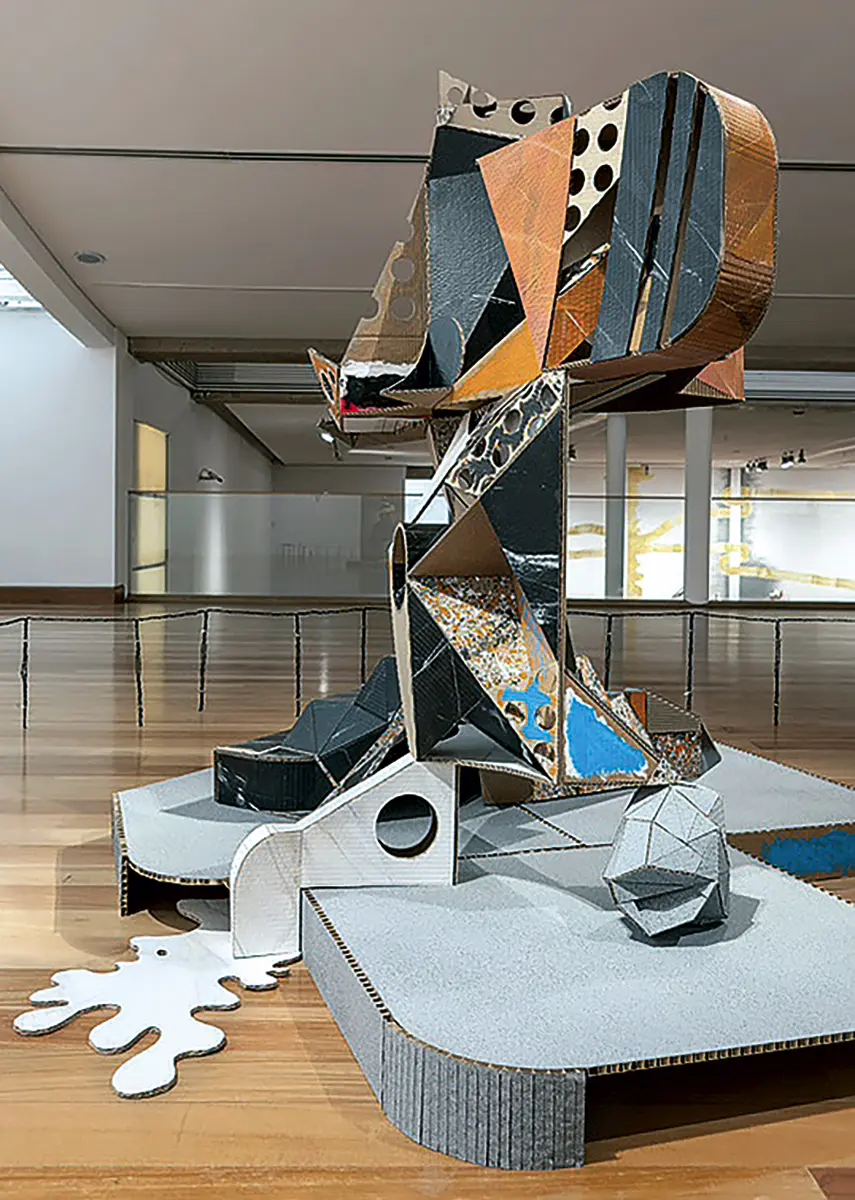
Nearly all these works elicit a sensorial impulse, a febrile and spontaneous desire to break certain rules if ever there have been any at all. But what at first glance appears to be a game of endless combinations of materials and forms is actually something that Pulido takes very seriously, as he knows very well where and how to fit each of the elements of his compositions to make them work; like where to apply the metallic powder, how to balance a plastic cup on a soft drink can be supported by model sticks, how to tame corrugated cardboard, or where to place color fields and apply decorative patterns in this entire overloaded collage, this call to simulation. Or, as Pulido said in a recent interview, “The elements must be fighting one another, but even as they fight they must need one another.”
Pulido makes do with what is within reach, with the waste generated at home or the studio. But even then he is selective. In addition to being attracted to certain forms, to their accessibility, or almost zero cost, he also favors what these materials evoke in him at the personal level or in connection to his interests as a professor, writer, and researcher. The group of sculptures resting on cardboard plinths—an essential part of the works, some painted to mimic the surface of marble—pay tribute to the abstractions of vanguards from the 20th century. One of the series, titled Letters, even makes direct references to Lygia Clark’s Bugs. But the inclusion of other imaginaries in the exhibition that also resonate very strongly with Pulido—the one with the toys or the one centered on science fiction cinema—shape his proposals into something similar to spaceships, school crafts, and modernist sculptures.
Additionally, the exhibition is infused with a condition that is inherent to its components: fragility. Like in early modernism, Pulido understands these works more as objects to be observed than to be handled, despite the fact that his chaotic compositions, excessive textures, and colors invite us to touch the works. This distance between object and viewer is emphasized with the series of projections (otherwise fragile barriers) designed and executed by Rodrigo Canala, an artist who has been collaborating with Pulido since the years of the Taller Bloc initiative. They are more like doodles than barriers, almost a joke, which is precisely what makes them so charming.
With these works, Pulido approaches affective and genuine territories as well as the realm of the spontaneous and unpretentious gesture, which are far from certain pre-established formulas and economically-minded requirements that cater to the durability and success expected by the market. It is honest, accessible work with the ever-present potential to expand, to reach endless numbers of new combinations and twists, like those enjoyed by the artist during the very act of creating.
ALEJANDRA VILLASMIL