During an artistic career that spans more than twenty years, Mexican artist Gerardo Monsiváis (Nueva Rosita, Coahuila, 1974) has been photographing nature across the Mexican territory. These photographs have served him as referents not only to paint the series of works included in this solo show but also to question the pathetic reality of an increasingly eroded natural landscape exacerbated by the neglect of mankind.
But in this context, what does nature mean to Monsiváis? Beyond any formal visuality, it is a place of encounter for his thoughts, a space to interpret realism in solitude, face the devastation and then convey it to viewers. It is about human beings confronting their spirit in nature and, in the process, unraveling the evident crisis unfolding before their eyes. In the particular case of Gerardo Monsiváis, the heartbreaking nature of his images conveys an honesty that sheds light on the traps and difficulties of painting as a medium. His approach ignores any considerations towards the conventional art market and the possible monetary value of his visual representations.
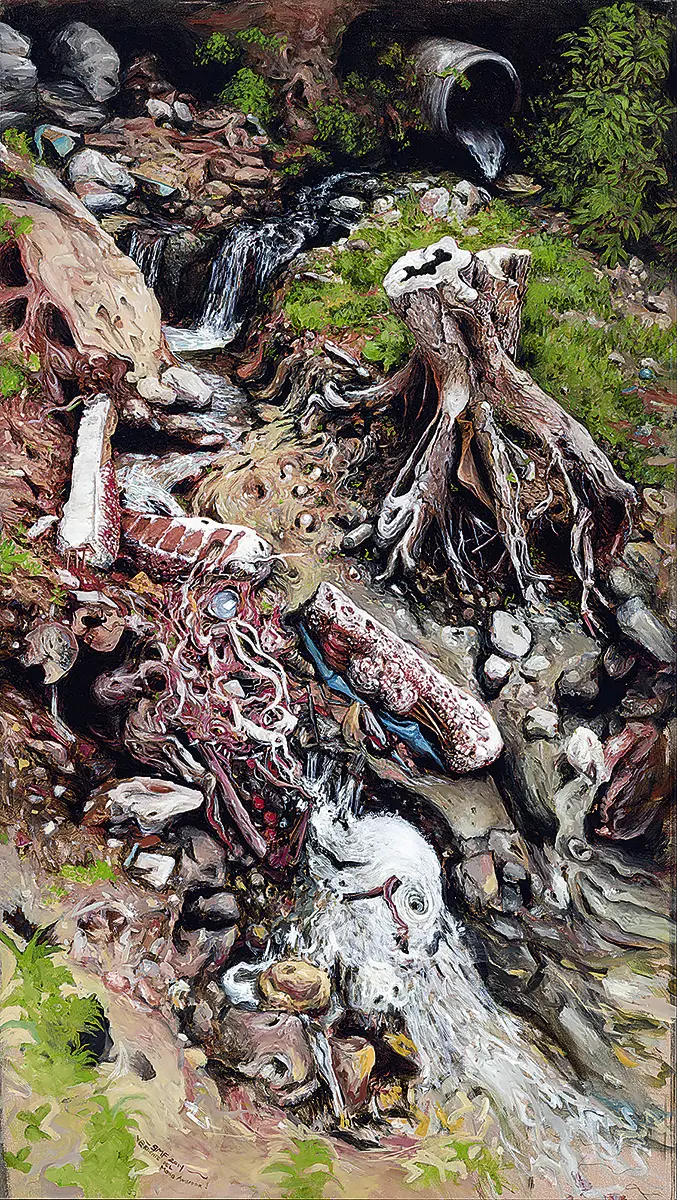
The solo show by Gerardo Monsiváis offers a terrifying vision in the decadence of his landscapes: contaminated rivers, stray dogs, loneliness, and the erosion of nature reveal a crisis in the traditional themes of painting. He transforms his work into a desperate cry that reverberates through the works exhibited in Once Upon a Time in a Damned Paradise. Curated by Sara López, the exhibition was inaugurated during the month of November in the glass exhibition spaces of the Pinacoteca del Estado de Nuevo León, in the city of Monterrey (Mexico). According to the curator of the show, the exhibition rescues faint traces of an animal existence defined by its vulnerability, offering a rare glimpse at the beauty of characters from a transhumanist world in which hierarchical order rules for the benefit of our dominion over all other species, without any natural splendor involved.
The show consists of more than fifty works that showcase Gerardo Monsiváis’s mastery of contemporary naturalist painting. With irony and a somber tone, he offers a critique of the current deteriorated state of the world. Once Upon a Time in a Damned Paradise is an exhibition organized by the Council for Culture and the Arts of Nuevo León with the support of the Federal Ministry of Culture. The works by Monsiváis were created with acrylics and oils on nonwoven fabric, wood, and panel.
Despite the somber tone of his still-lifes and landscapes, they underscore a technical mastery that confers the works a beauty that pulls viewers towards them. The tensions between the decadent elements in his pictorial representations and the mastery with which he renders them—demonstrated through the handling of color and the brushstrokes—represent a clear critique of the disheartening aspects of contemporary life.
Deteriorated objects, neglected animals, and polluted rivers are the central characters in his works. Their presence becomes a cry for the loss of beauty in the world and the human loneliness involved in its pursuit.
Born in 1974, Gerardo Monsiváis’ artistic life has oscillated between the visual arts and music. He studied at the Universidad Nacional Autónoma de México (UNAM) and began his artistic career around 1995, focusing on painting and drawing. But throughout his trajectory, he has used several other complementary mediums like video, photography, installation, serigraphy, and sculpture. Sound art and experimental music have been his parallel activities. Monsiváis co-founded the multidisciplinary improvisation group Los Lichis, among other initiatives, under the alias “Yeyo von Moroder.” Throughout his career, he has shown his work in seventeen personal exhibitions and more than fifty group shows at public institutions and spaces and private galleries in Mexico, the United States, France, Spain, Colombia, and Belgium.
ROCÍO CÁRDENAS PACHECO