The work by Mexican artist Gabriel de la Mora (Mexico City, 1968) has been characterized by the establishment of narratives shaped by certain processes (or they could also be called tasks), the time required to assemble, find, and complete them, as well as by installations that fulfill a paradoxical function in the museum space.
On the one hand, there is the formal power of De la Mora’s work—which I could only describe as lyrical—and, on the other, the narrative component, which becomes the basis for a game in which mission, intention, gaze, time, and work eventually take over the story, in an overt tribute to (De la Mora’s reading of) Gilles Deleuze. The artist quotes Deleuze in order to appropriate the French philosopher’s ideas—flagrantly making them his own—and turn them into the essence and subtext of his own work. It is a quote and then something else. It follows the premise postulated for De la Mora’s first anthological exhibition presented at Proyectos Monclova, based on the first law of thermodynamics (matter and energy cannot be created or destroyed, only transformed) and the role that the artist has (or can have) as mediator or agent for the transformation of matter. According to its thermodynamic definition, entropy—used as the title of this anthological exhibition—measures both the number of microstates that are compatible with an equilibrium macrostate and the degree of organization of a system, which defines the proportions between internal energy increments and the system’s temperature.
In Wikipedia, entropy is defined as “an extensive function whose value in an isolated system increases during the course of a natural process.” The correspondences or equivalences drawn from De la Mora’s process—in addition to the fascinating fact that entropy describes the irreversible nature of thermodynamic systems—can be perceived in the general approach of these pieces and installations. These can only have one signification (or resignification) based on the narrative that precedes as premise and creative process. So dependent are the works of the narrative that it strips them of any meaning that they could have initially had and turn them into a synecdoche of the 19th-century cabinet (with orders and systematizes the extraordinary). By doing this, Gabriel de la Mora also fulfills his role or place as creator or intermediary at the edge where irony and literally are confounded.
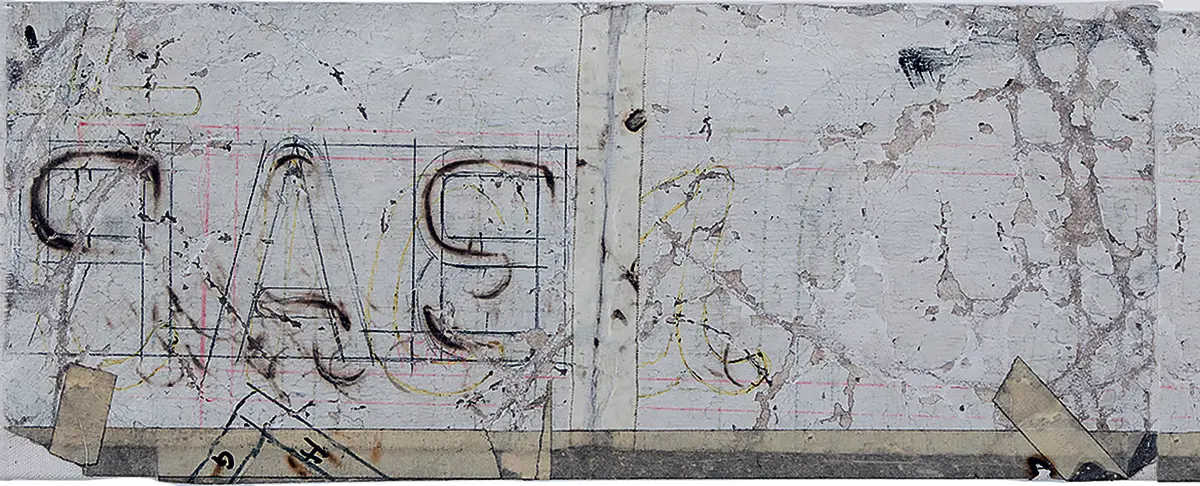
The series featured in this exhibition are 1) Burnt Papers, charred sheets of paper randomly created during the systematic (and ritualistic) burning process of De la Mora’s Master’s thesis. The process took ten years to complete. It began on October 25, 2007, and concluded on November 8, 2017. The resulting series consists of sixteen works made of the carbonized remnants and visual documentation of his process. 2) Neon Papers, featuring drawings and interventions on previously burnt neon paper. 3) Drop Ceilings, consisting of and (re)presenting the process of finding and collecting drop ceilings from homes that were more than one hundred years old. They were displayed in the exhibition area like paradoxical objects; as an act of recovery and appropriation, but also as an abstract gesture that trapped the passage of time and (once again) De la Mora’s lyrical vocation as the supreme organizer of the world (or its remnants). 4) CACO3, in which De la Mora collects and presents a large number of eggshells arranged on 20 × 20 canvases. While De la Mora thought that the process would take four years, the assistant he hired for the task was able to complete it in half that time. The title of the piece represents the number of fragments that constitute it. 5) Obsidian, from which De la Mora presents a single piece mounted on a wall, created with typography produced by a master craftsman who works and sells pieces made of this material in the archeological site of Teotihuacán. The titled references a quote by Gilles Deleuze that somehow synthetizes De la Mora’s ars poetica “If repetition exists, it expresses at once a singularity opposed to the general, a universality opposed to the particular, a distinctive element opposed to the ordinary, and instantaneity opposed to variation and an eternity opposed to permanence.”
RICARDO POHLENZ