Gabriel Baggio presented his most recent exhibition, Fabers, at Zmud Gallery. This production is in line with one of the artist’s core explorations: the development of performances in which he learns a variety of crafts. These crafts are usually connected to personal interests and imbued with domestic or familial elements, as was the case with Agarradera tejida al crochet (Crocheted Handle), from 2007, or with Picante Pollo (Spicy Chicken), presented in 2008 at MALBA with Nicolasa Choque. Even Baggio’s first performance, Sopa (Soup), from 2002, would fit in this mold: in it, the artist learned from his mother and grandmother a traditional family recipe, and the results were tested by the audience and by a couple of professional tasters who assessed the subtle differences between the three versions. Projects of this kind are inscribed in what is known as relational aesthetics, which, unlike traditional artworks, manages its time to generate encounters that produce the experience.
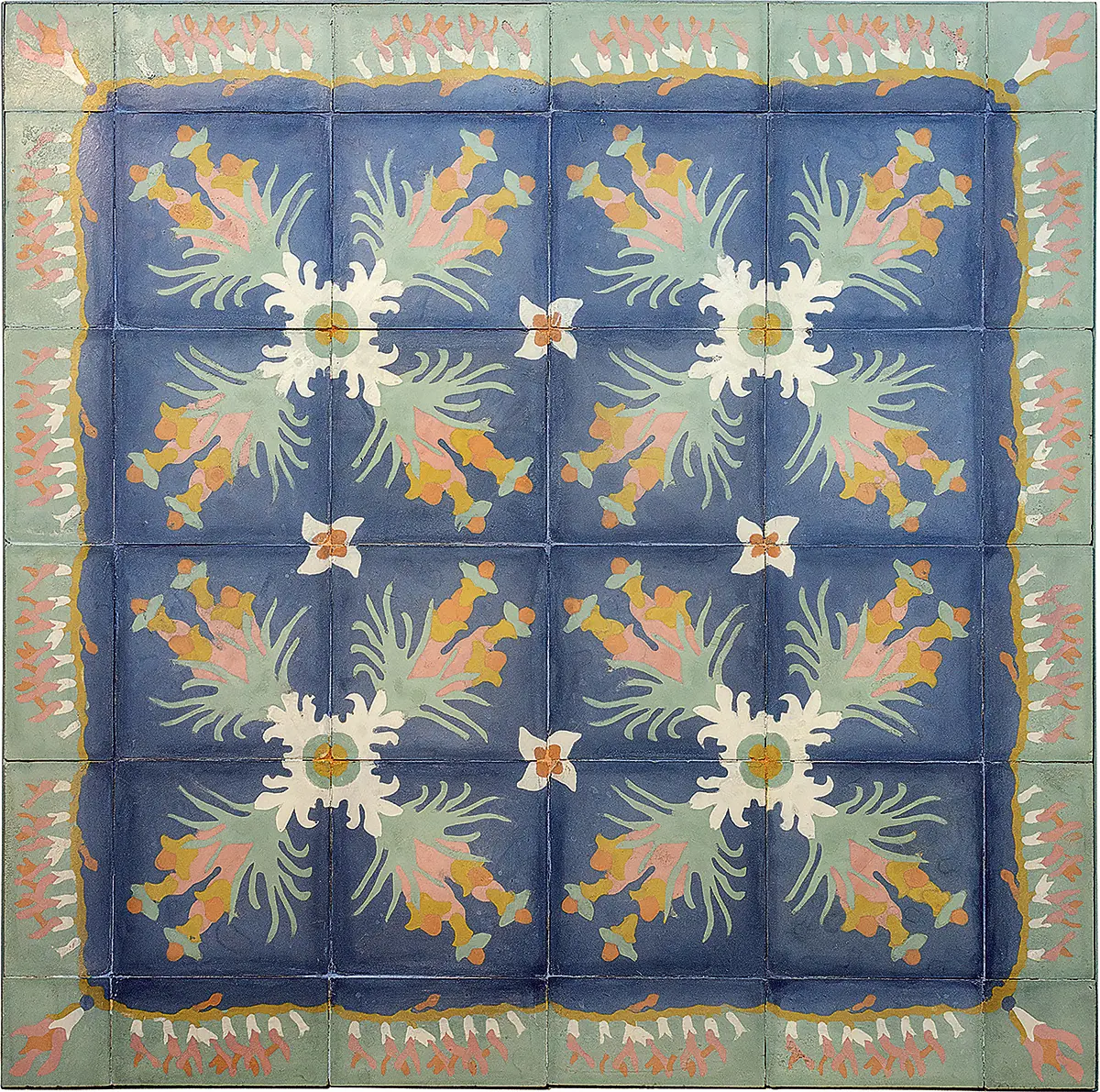
On this occasion, Baggio focused on learning to build hydraulic flooring. The project began as part of the YAXS artistic residence, held last year in Guatemala, where Baggio met Moisés, a local craftsman who taught him the process. The show’s centerpiece is thirty-six tiles in a design created by Baggio, mounted on an iron structure and hung from the main wall. Unlike traditional European designs for hydraulic floors, Baggio’s composed his design on the basis of flowers that are typical from the pampas. Also included in the exhibition were two further possible designs, made with tempera on paper.
While in previous occasions Baggio learned the new craft on-site, generating a circumscribed encounter and managing his own time, his resource here was different, and all that was left was the record of his learning process. The exhibit in the gallery featured a video loop of Baggio learning from the craftsman and his helpers, who guided him step by step. We see how the transfer of a given knowledge occurs in the context of a relational experience marked by the quality of the time shared. Also connected to this is the cozy, intimate space of the workshop and Baggio’s decision to copy the craftsman’s tools and bring them from Guatemala to the gallery. To that end, he created a mold for each one of the tools, copied it in clay, and covered it with gold dust. Those working instruments were thus rendered useless, yet their ritualistic coating brought the material aspects of the work into greater visibility. Similarly, Baggio decided to include in his exhibition discarded materials and pieces of flooring that served for the creation of the main design. Some of these materials were placed on the floor, and some color proofs were framed and mounted on the wall. Here, the specific space of the workshop gains preeminence and is brought into the exhibition space by means of the various objects that populate it, such as the tools, the discarded materials, or the workbench’s protective covers.
In this attempt to render visible the transfer of knowledge (and perhaps to elevate its status), Baggio’s repeated operation comes with a degree of irony: the tools cannot be used for work, and the floors are not to be stepped on. In a way, this move gains greater meaning in a context where the manufacture of hydraulic flooring is in sharp decline since it involves a piece-by-piece process using matrices on which pigmented cement is applied to form the design.
AYELÉN VÁZQUEZ