Franco Contreras’ Obra Primera XVI. Paraíso perdido (First Work XVI. Lost Paradise) prompts us to conceive of alternative horizons for an understanding of the relationship between art and nature. The exhibition signals a deep dimension in the exploration of the environment, the elements that comprise it, its inhabitants, fauna, flora, fences, skies, thickets, and undergrowths, to recreate the diluted experiences of memory and the legends of his native land. The title comes from two sources that remain as the axis of Contreras’ work. On the one hand, the reference to Obra Primera (First Work), a term included in the title of all his exhibitions as a kind of “relief at not having to name something that is only relatively clear to me,” can be understood as a permanent start and restart of the creative act. On the other hand, the subtitle Paraíso perdido (Paradise Lost) alerts us to the presence of the biblical narrative that has accompanied the artist since childhood: “The presence of the serpent, the trees, the bats, the mountains and other works I exhibit, evoke my firm belief as a child in the biblical stories that I heard and learned from my mother’s naïve and fantastical teachings. And besides that beautiful tale, there is the nostalgia I feel for the loss of that pristine and simple world where I was born and brought up, in contrast with the contemporary world, devoid of any pathways that can tells us where we are going.” Contreras’ proposal is a strategy of contrasts between the simplicity and precariousness of the materials used, and the complexity of works that, despite their apparent fragility, come to dominate the space with their great constructive force. Here, rusticity gains an unexpected exhaustiveness, a new value that makes it possible for us to re-understand popular imaginations and gives new impetus to artisanal practices in contemporary discourses. This is a narrative of the quotidian, of the most common experiences, seen from a poetic perspective beyond that which we apprehend with the naked eye. Contreras’ works populate the exhibition with beings that inhabit fantastical universes and move between magic and remembrance, reality and imagination.
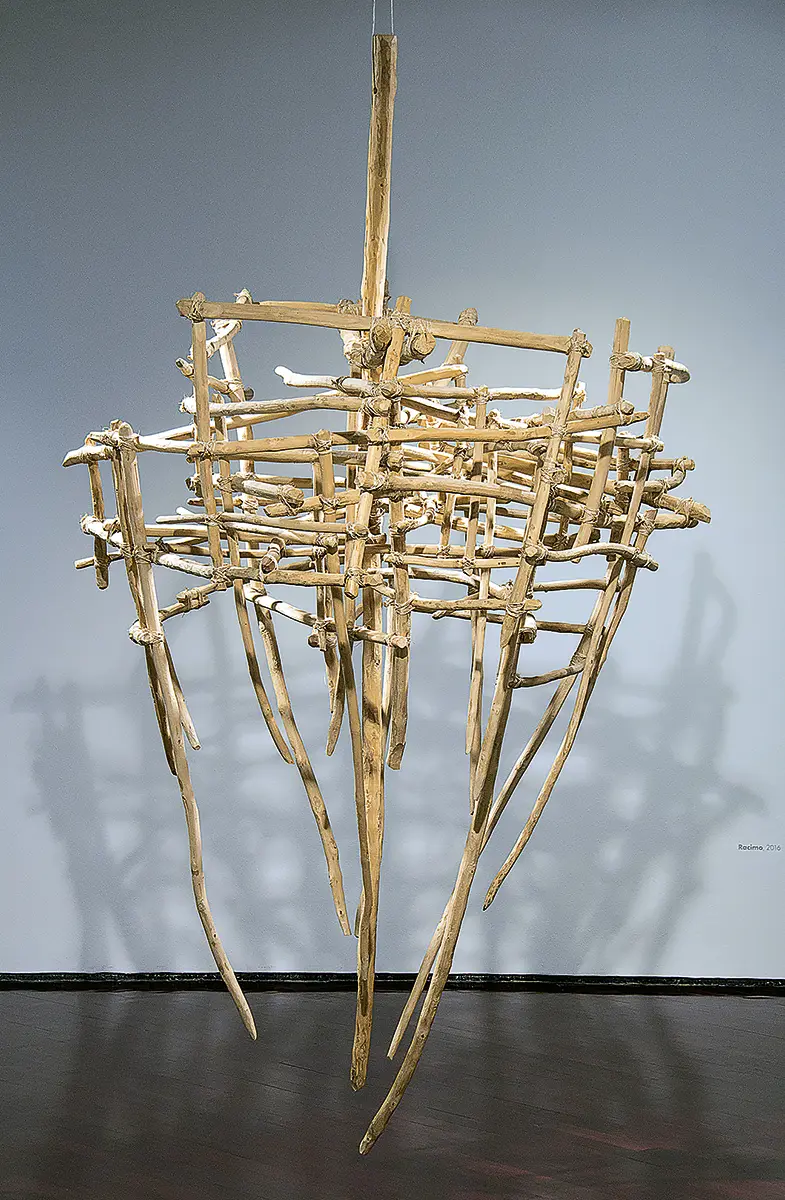
The selection encompasses an 18-year period (2000-2018) and comprises a series of drawings, sculptures, and installations that are spare, essential, and sincere, made using coffee wood and wires. These works depict the environment around the artist’s hometown, its fields, mountains, rituals, masks, animal and plant ancestors. In them, space plays a key role. In the coffee wood structures, the material functions as a symbolic construction that calls forth meanings of fleetingness and simplicity, but also a reworking of nature and its elements. In the Murciélagos (Bats), the essential form seems to float as it sketches and blurs its flight between the shadows projected onto the floor and the wall. In Racimo (Bunch) and Cambur (Banana), the allusion to fruits and plants wavers between the austerity brought forth by the dried coffee tree branch and the profusion that the artist infuses into his compositions. Joining the coffee wood are rope knots that activate not only material but also conceptual resonances: a connection with the land that in those knots projects a plastic quality. The works made using wire and brass sheets are three-dimensional, but they could also be seen as delicate paperless drawings, with lines that unfold into faces, cities, or death rituals. These are complex constructions where the lack of artifice augments the expressive power of the figures, as is the case with Máscara (Mask), El velorio (The Wake), and El suicida (The Suicide). Pueblo con iglesia (Village With Church) presents us with the structure of an almost aerial, transparent landscape that reveals a situation that is connected more to the senses than to matter as such. Contreras’ airy, thin lines overflow the paper windows at a tiny scale, which gains greater dimensions as we observe it in detail. The conceptual references posited by Contreras’ oeuvre are also in evidence in the titles of his works, as these underscore for us well-defined notions (waterfall, bridge, window, fire, lightning, mountain, smoke, tree, mask, home, wind). These titles braid with ease the artist’s personal and existential experience of his environment.
Empty space also plays a significant role, since, by circulating between the structures, it allows for an interplay of light and shadows that enrich the motion. It behaves as an essential component of the works and becomes a very important feature of their language. Thanks to this, the drawings come alive and breathe. All the works display keen attention to the details that enhance the meaning of the general result. They function as stand-alone items and at the same time as pieces of a whole. From the floor, they take off in flight in the gallery’s absolute space, all in harmonious balance. Contreras opens up a different zone of research, diaphanous and peaceful, bringing together the popular and the academic, the cultural and the natural, the rational and the sensible, the plenitude of poetry and a constructive rigor.
MARÍA LUZ CÁRDENAS