Let us begin by remembering that throughout the years Mexican master Francisco Toledo (Juchitán de Zaragoza, Oaxaca, 1940) has not favored any reviews of his work that have not been revised by him. Notwithstanding the great respect that I feel for Toledo, this analysis centered on his exhibition entitled Recent Self-Portraits presented at the Latin American Master Gallery was not submitted to him for approval. Even before I had the opportunity of seeing the show, I heard several commentaries from a prominent group of experts and admirers of Toledo’s oeuvre. And when I learned that the show centered on a single theme made me want to see it even more. In any case, the process involved in the completion of this review could not have unfolded any other way since Toledo does not attend the inaugurations of his shows or participates in social activities. On the other hand, those who have had the opportunity of knowing him personally shared the experienced of three endearing aspects of his personality: a recurrent tendency during conversations to appear surprised or plead ignorance accompanied by a smile and a shrug.
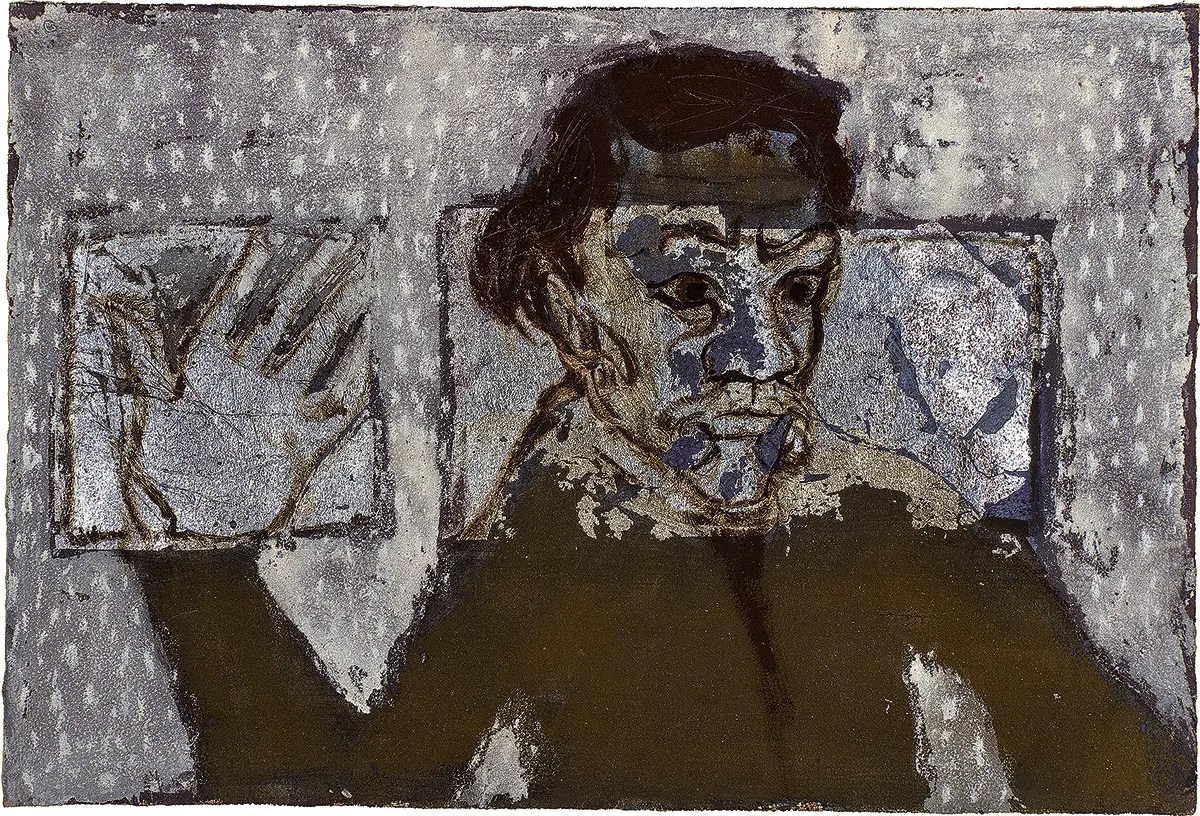
The paintings in this exhibition include frontal self-portraits on canvas or paper, many of which are in the middle of the frame. In addition, Francisco Toledo presented several pieces with other types of compositions. Some paintings have been rendered with a craquelure effect whose resulting textures are the only thing accompanying the subject. In others, Toledo drew a grid, incorporating geometry that contrasts the organic nature of the image’s subject matter. And since only one step separates a grid from a square, Toledo uses the square here to enclose the face. But by rotating it and turning it into a rhombus he manages to lessen its enclosing effect. The mask, the next step, is used as an independent element, as a time traveler.
Great masters develop styles and through the years infuse personal characteristics into their work. But not many consolidated artists still actively manage to develop new approaches. Toledo works tirelessly and never ceases to introduce new directions in his artistic production. He recently presented an exhibition at the Instituto de Artes Gráficas de Oaxaca (IAGO) that featured his incursions into the field of design. It was an equal parts intimate and powerful exhibition proposed through very personal vectors, as he does in other disciplines. In this respect, and as one of those great masters, Toledo appears to be one of the few exceptions to the aforementioned rule. And the exhibition Recent Self-Portraits confirms it. His work offers a very unique mythical world. His self-portraits are not psychological or social, or… They contain ancestral and telluric echoes, as well as reverberations of a pictorial nature.
Toledo’s specters have been present throughout most of his production, not only in painting but also in most of the other mediums he works with, as he has mastered all materials and processes. The self-portraits successfully capture his physiognomy while also enveloping him in a mythological and aural mass that removes him from everyday life—which does not detract from the fact that he is deeply committed to social causes. Throughout the exhibition, in Santa Monica, the intense gazes of his self-portraits are what gives him away. On this occasion, the titles are more personal than usual. An example of this is Cara blanca del lado materno (White Face on My Mother’s Side, 2017). This is way more information about himself, his personal and family history than he usually is willing to share.
These works are more paintings than drawings. But there are a couple of portraits that render the reliefs located on the forehead and mouth in the style of Pre-Columbian attachments. His usual labyrinthine circles–like traces on the ground—are present in several of his portraits. Through elements like these circles and many other touches—like triangles or visual comas—some portraits become animated in those saturated surfaces. His self-portraits expand until one captures the entire body, while others depict the subjects gesturing in a three-quarters pose.
With respect to materials, there are feathers and mucilage extracted from orchids—that agglutinating substance found in plants and microorganisms—watercolors, tempera, and mixed media on paper and on canvas. The predominant earthy and grey colors are accompanied by some works with deep blues.
In an interview included in the catalog,1 Francisco Toledo said the following: “I have self-portraits from 1950 when I was fourteen or fifteen years old. I do not remember exactly what prompted me to make them, but it perhaps was photography. When I discovered the work by Manuel Álvarez-Bravo in the catalog of the library of the Escuela de Bellas Artes, I was very excited and wanted to be a photographer. It was then when I took photos of myself.”
NOTE
1. Interview by Germaine Gómez-Haro to Francisco Toledo published in La Jornada periodical, Mexico, July 16, 2017.
GRACIELA KARTOFEL