
Visual and ethnographic elements define the main crossroad of documentary photography in museums. A potentially problematic issue is settled when the purely visual aspects that characterize any image accompany the reflective and critical components that supposedly define the documentary function of art spaces. Something like this is on display in the exhibition by Federico Ríos at the Museo de Antioquia centered on the daily life of the Revolutionary Armed Forces of Colombia (FARC), a recently disbanded guerrilla movement transitioning into the political arena.
In fact, the information displayed on the walls, written by curator Santiago Rueda, emphasizes the visual aspect of the show, something that speaks to the degree of mediation that is now involved in works of this kind. Other photographers have also had to deal with this issue, as they often find themselves torn between the visual aesthetic values and the thematic complexity of their works. Actually, the photographs in this exhibition at the Museo de Antioquia are presented in such a way as to ascribe to the continuity of artistic genres; portraits together in one section, landscapes in another, and everyday life scenes elsewhere.
But ethnography is also present in the exhibition, establishing a distance from the purely formal compositional and aesthetic elements. While chromatic values, light, and composition gravitate towards viewers, there are also questions that do not follow their logic. As result, there are certain practices, activities, objects, and routines emerging from the analytical gaze successfully integrated with photography that is nonetheless well aware of its role as an archival device. In this manner, for instance, chairs confiscated by the guerrilla from their adversaries are presented by Ríos in a serial manner to document a practice that reveals the presence of an aesthetic element amid the harsh context of war.
As a display directly offered to the photographic eye, the exhibition can reach collaborative dimensions in works like the series of portraits of former guerrilla fighters, first depicted with camouflaged uniforms and then wearing regular clothing; and the instances when the subjects portrayed decide to show the camera, in an improvised demonstration, the implements used for war: weapons, of course, but also cleaning implements, photographs of children, books, etc.
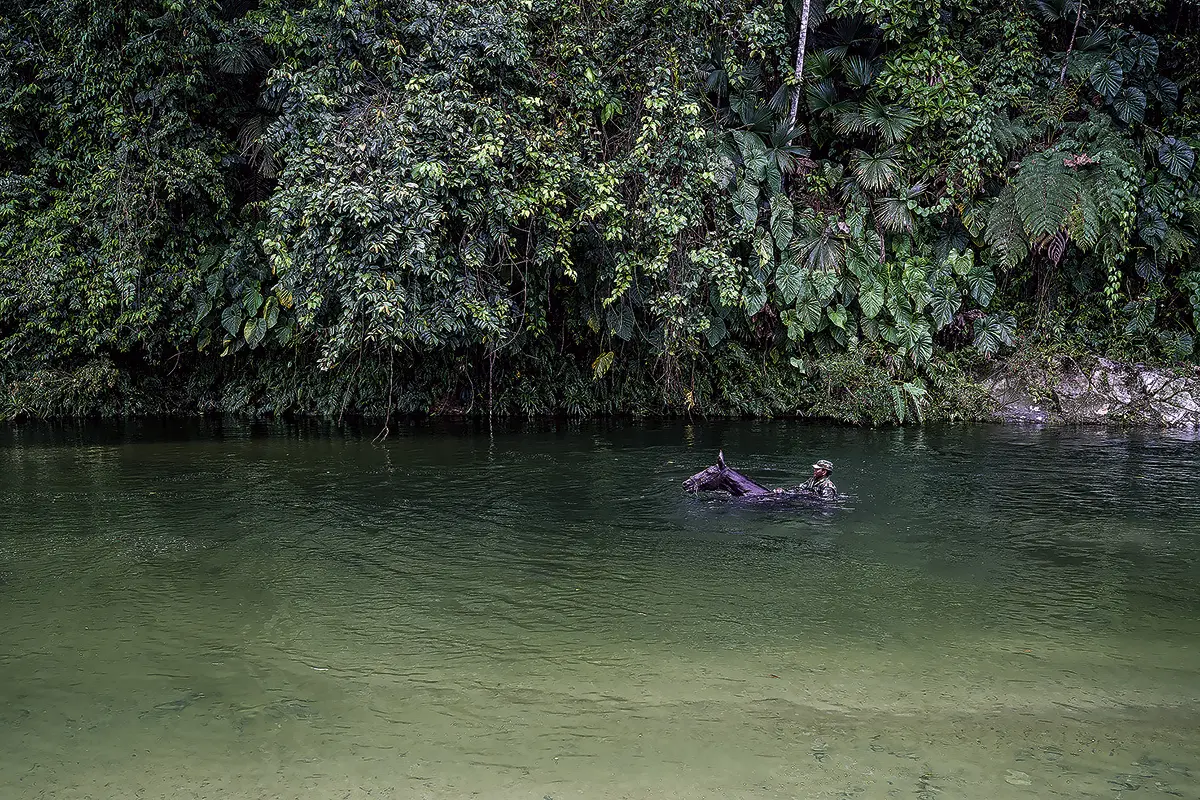
This aesthetic presence is of course connected to something not quite accepted in photography criticism. Namely, the prevalence of conventions inherited from the history of mimesis. Hence, the participation of photography in the landscape tradition brings to bear two of the most attractive elements in documentary photography centered on the Colombian conflict: the contrast between landscape and culture, and the often inaccessible exuberance of nature amid the atrocities of the war; the amazement of a butterfly on a boot, a pressure cooker as an improvised geyser in the middle of the forest, or the endearing portrait of a female insurgent carrying a baby.
There is also another intersection as problematic as the one defying the aesthetic and ethnographic elements. We should not forget that photography is not only a narrative discourse but also an argumentative one. While the photographs are intended to capture fragments of everyday life, there is also in them an underlying conceptual, and perhaps even referential, interest. This is the case with the portraits of the leader of the guerrilla group and of the Colombian president. The former is shown resting on a cot bed, while the latter in an elegant living room in the Capitolio Nacional of Colombia. This is the reason viewers may feel at certain times that one purpose—telling historical events—is problematically associated with another—to justify an idea—through coordination or subordination. Ríos’s photographs narrate, but also discuss, overcoming the armed conflict as well as the inability to escape stereotypes.
The beautiful and compelling gesture of the large-format photographs facing each other in one of the intermediate spaces of the exhibition successfully conveys the important role played by the narrative in search of an experience that could be called “allegorical.” One of them shows a blue tower drying on a clothesline, lost in the immensity of the tropical forest bursting with vivid green colors like a wild animal. A second photograph depicts another piece of fabric that this time, rather than serving a mundane purpose, has become a ceremonial object: The flag of Colombia, on which it is possible to read the acronym for the guerrilla organization, now a political movement. Caught in between, subjected to the interrogations of these two movingly solidary and antagonistic images, is the viewer. He/she does not look or question, but rather becomes the object of the inquiry posed by a symbol that, while empty like any rag, when it embodies a flag inspires people to give their lives to defend it.
This is with respect to the visual discourse, museography, and curatorial gestures which, want it or not, are aesthetic and visual clues as well as decisions intended to make comprehensible to viewers images that own nearly everything to the documentary realm. There is also the matter of our personal contextual assessments, the sudden vertigo of the reality that confronts us in the exhibition, and the social dialog and recognition proposed by the photographs. In this sense, the exhibition fulfills one of the purposes of the official cultural policy: to make people understand the most opaque aspects of a conflict which, approached from the perspective of these peaceful and at times bucolic images, becomes absurd and, as result, also tragic.
Photography in contemporary art is one of the few expressions capable of critically confronting the blindness produced by the hypersensitivity created by the mass media: those who distort more than inform and who, in their attempt to increase their audiences and reject violence, generate even more intolerance. It is no small achievement that this exhibition offers a window into the humanity of those citizens once demonized and who today are likely to continue facing difficult challenges on their path towards legality.
Hans Belting’s statement that photographs show bodies “but convey the soul of people” comes to mind every time we are confronted with men and women in the flesh living a life that, while different from ours, is not less relatable and capable of moving us. The phrase by Emmanuel Levinas according to which the face of the other “is what prevents us from killing him” is something that good photographs can help us understand.
EFRÉN GIRALDO