Looking at death to stay alive; could be the essential motto for the lines that follow.
In 2014, the art group El Cuerpo Habla (The Body Speaks) from Medellin, Colombia, received the Sara Modiano Award for a performance inscribed in the territories of social and political reflection through the human figure. Fifteen nude bodies piled on a cart—that mundane object used by street vendors to carry and display fruits and vegetables—were dragged from the Universidad Nacional to downtown Bogota. It was, at first glance, a collective body, a nearly undecipherable mass that confronted people walking on the street. Passersby did not hide their surprise upon encountering the unusual scene. Titled Cargamontón (a combination of the Spanish words for “carry” and “pile”) in reference to the game that we used to play as kids, the piece addresses something that belongs to the realm of the sinister. Physical violence perpetrated on many people, racial discrimination, and the paradoxical moral of Colombian society are a few of the ideas contained in that innocent child’s play metaphor.
On February 24 of this year, this piece was shown for the first time in Medellin. On this occasion, the cart left from the Art Department of the Universidad de Antioquia. It exited from the lobby on Avenida Ferrocarril and then took Avenida Carabobo continuing on a straight line towards Calle La Paz. It then continued to Perú street until exiting at Avenida Oriental. Once it reached Avenida La Playa, it headed towards its final destination: the Teatro Pablo Tobón Uribe. The trip was not short. From 2:00 pm to 4:30 pm downtown Medellin became the stage for the moving cart, this time carrying 18 nude persons. It was two and a half hours of discrete breathing and subtle movements.
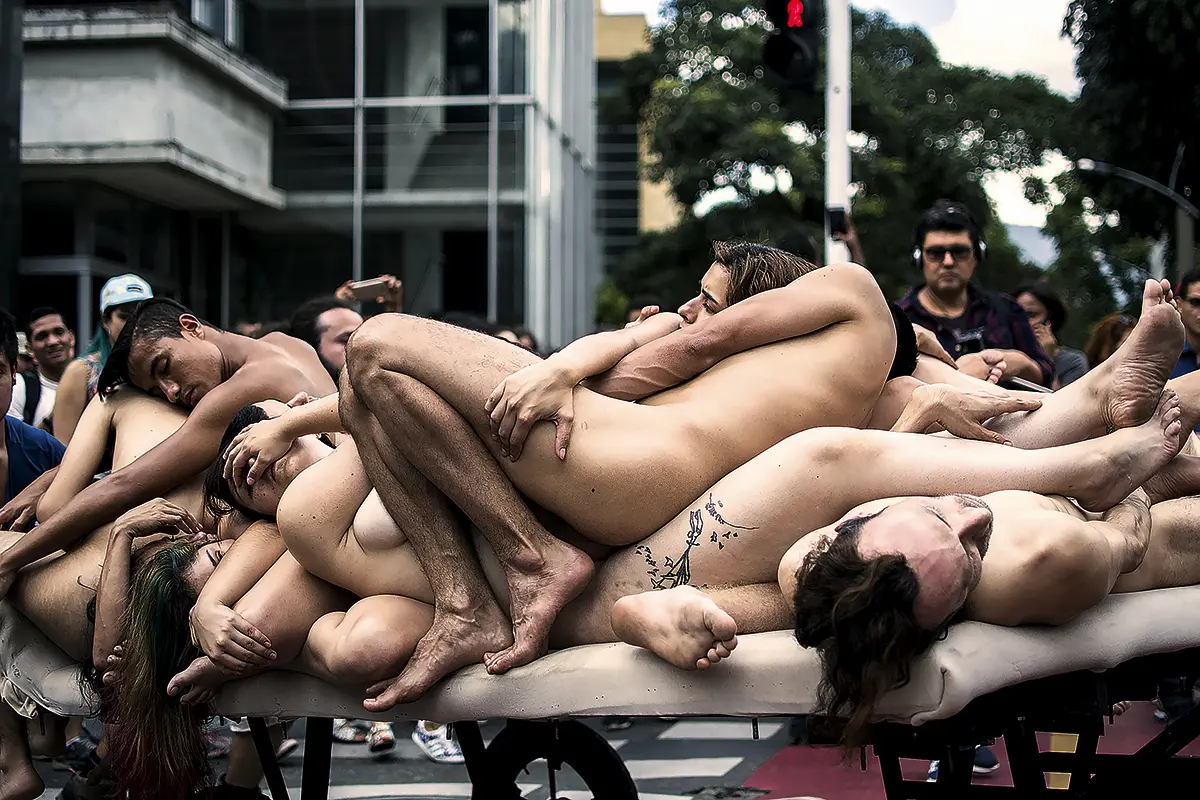
This group of stacked bodies piled up one on top of another reminds us of the violence that besieged Colombia during the second half of the 20th century and resulted in countless mass graves. But this work is also about celebrating life with the reinvigorating force drawn from resistance; about finding in the collective a vital and death-defying dimension (manifestations that are also present in Colombian society). It should be pointed that the provocative nature of the action involved the public through an event that invaded and disrupted everyday life while expressing a clear sense of dialogue with the geography in which it unfolded.
An important fact to be considered is that the performance was presented in the context of the #CulturaAlCentro project jointly developed by the Ministry of Citizen Culture of the Town Hall of Medellin and the Vice-Rectory of Outreach of the Universidad de Antioquia. The initiative was intended as an initial diagnostic of the cultural sector in downtown Medellin for the eventual formulation of the so-called Cultural Plan for that section of the city—one of the government’s public policy agendas promised many years ago but not yet fulfilled. The project was approached from two directions: a reflective one, in which ideas and theoretical frameworks shed light on possible scenarios with which to think about culture; and a second one that favored the development of activities and actions in the public space, in some instances used as a sort of laboratory.
In this context, it is safe to affirm that Cargamontón addressed several key issues like the need for art in the public space in order to encourage reflection and critical confrontation, a public policy that allows for different types of aesthetic manifestations in an environment that nurtures diversity, and the role that the visual arts can play in the construction of cultural citizenship.
It is known that the relationship between action art and the Latin American context has been defined since the beginning, during the late 1960s, by intense social and political turmoil. It is also known that a generation of art critics, including intellectuals like Nelly Richard, Mirko Lauer, Juan Acha, and Rita Eder, among others, promoted independent visual thinking that responded to the sociohistorical realities of Latin American countries. Therefore, it is no accident that the work relies on performance as a representation strategy often embodying—as if in an attempt to establish a live dialogue—denunciations and resistances, oppositions and objections, as well as shared losses and grief.
Cargamontón could very well subscribe to the following precept: action implies a gesture that is both poetic and politically open. Emotional impact, physical defiance, and social depth; these are probably perhaps appropriate notions to describe this proposal by El Cuerpo Habla group and explain the piece’s power; a power contained in the statement that invokes: to endure, in the face of death and oblivion, through the body.
JORGE LOPERA