An important retrospective by Eduardo Ramírez Villamizar (1922-2004), one of the greatest exponents of Geometric Abstraction in Latin America, was presented at Durban Segnini Gallery, in Miami. Titled His Own Sacred Geometry, the exhibition brought together thirty-eight works made over more than five decades. The selection included reliefs, sculptures, paintings, and a large number of sketches, many of them with annotations, which show a detailed overview of the processes developed by this great master throughout his life.
The exhibition began with Manto emplumado (1988), a monumental piece in oxidized iron that synthesizes several aspects that characterized his work: geometric abstraction, the use of non-traditional materials, and, at the thematic level, his great interest in architecture, nature, and pre-Columbian cultures. His inclination for abstraction arose during his stay in Paris, in the early fifties, during which he became familiar with Russian Constructivism that proposed breaking the limits of what could be considered pictorial by reducing it to forms and lines and exploring the possibility to create a universal language. Upon his return to Colombia, he became a pioneer of abstraction in a country dominated by figurative tradition. Following the line of Joaquín Torres García (1874-1949), he was inspired by the geometric-abstract forms of goldsmithing, pottery, and pre-Columbian sculpture and created works that were revolutionary at that time.
Although he ventured into painting, represented in the exhibition by two Untitled works (1951) and (1994), the reliefs and the sculptures dominated his artistic production. Ramírez Villamizar describes the origins of the reliefs in one of the catalog’s texts: “When, in 1957, I was commissioned to paint a mural for the Banco de Bogotá, the light and the architecture of the place led me irremediably to a three-dimensional solution. Trying to extract the strength of the stone reliefs from Mexico’s pre-Cortesian architecture and the vigor of the baroque gilded wood reliefs from the altars of the churches of my hometown Pamplona, dazzled me since I was a child, El Dorado emerged. It was one of my first public works and one of my first attempts to apprehend the spirit of pre-Columbian art through geometry.”1
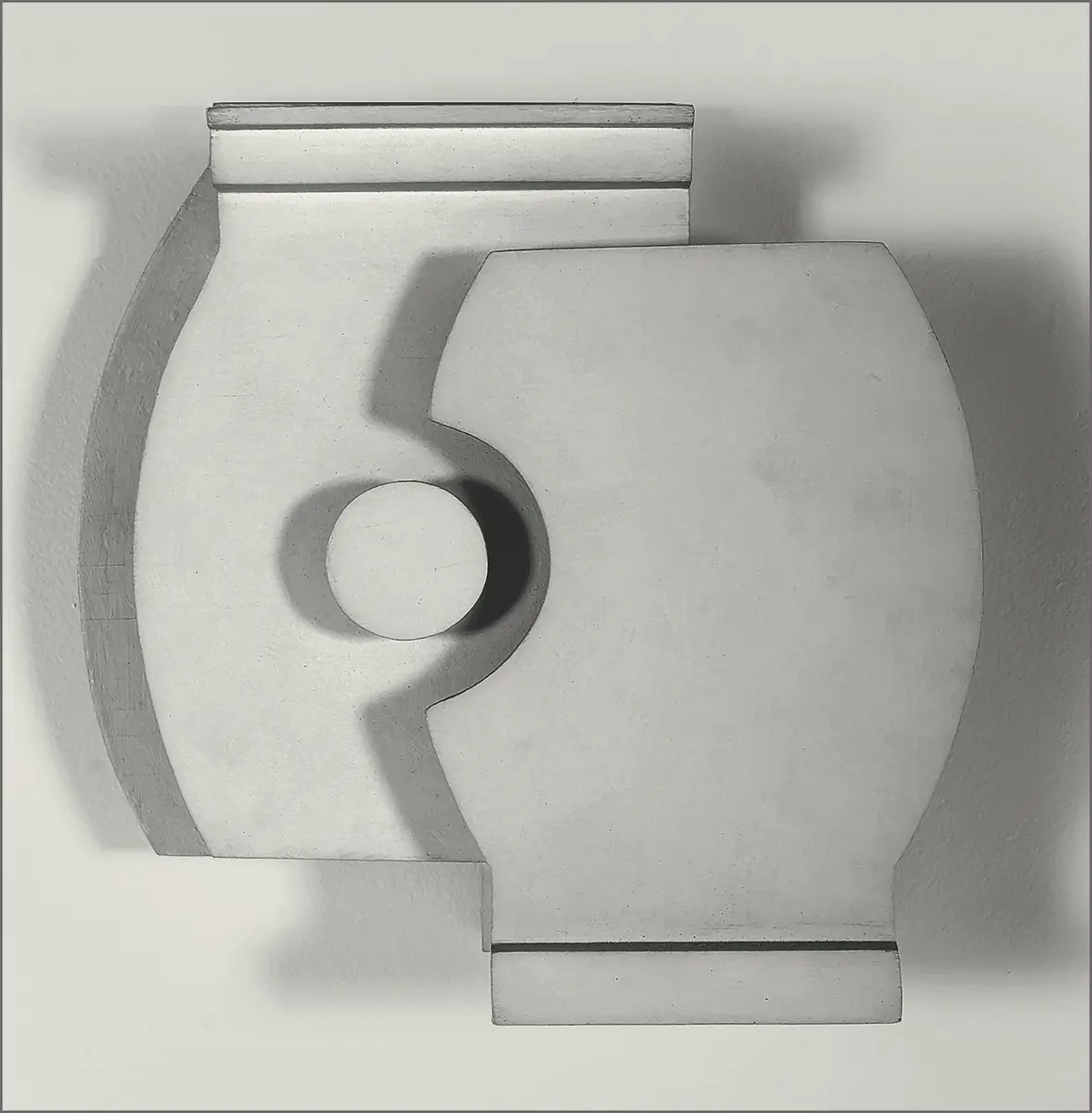
Of the works presented in the exhibition, the white reliefs in wood stand out. Pieces such as White Depth (1960), Silent Surface (1960), and Small Wood Relief (1960), produced during one of his stays in New York, show a geometric abstract language of simple forms and subtle three-dimensionality. Later works such as White Relief No. 2 (1966) and White Relief No. 5 (1966) present more pronounced geometric shapes in which overlapping wooden planes generate gray shadows on the different white surfaces. Maíz (1986) and Pre-Columbian Frog (1986) reveal the maturity of an investigative work that results in delicate geometric reliefs of straight lines inspired by pre-Columbian goldsmithing. According to Ramírez Villamizar, “between pre-Columbian aesthetics and modern aesthetics, geometry emerges as the great mediator. Its laws are erected in the instrument par excellence that molds and transforms matter.”2
The organic forms, in particular the snail, are of great interest to the artist and inspire works such as the sculptures Caracol escalera (1979) and 3 Caracoles (1989). As documented in one of the sketches included in the exhibition that refers to the biological principle that governs the growth of snails and mentions the logarithmic spiral studied by Descartes and Bernoulli, he based his work on a continuous investigation of the biological and mathematical principles that dominate the environment, especially nature and architecture.
Among the most representative works are the sculptures in oxidized iron made in the eighties and nineties. They illustrate his constant references to nature, Cóndor (1998), pre-Hispanic cultures, Paisaje de Machu Picchu (1989) and Ofrenda Muisca 2 (1999), and architecture, Puerta Ruina (1998), and the use of a personal technique that characterizes many of his monumental works made for public spaces. The artist reflects on it: “Admirer of the strength and nobility of metal, enchanted with the unrepeatable patina with which rust and corrosion dress the sculpture, I found it difficult to accept its finite and perishable character. (...) But the iron itself emerges whole and pure from the earth and it returns to it turned into dust and filings. And this eternal return to primal matter, that slow pilgrimage to the final fusion of the elements that bring death, seemed to me so natural and absolute qualities, so resounding and beautiful, that now I do not conceive my sculptural work but immersed in that spectacular process.”3
Although Ramírez Villamizar’s work refers to life, to the sacred, it was very clear to him that, as human beings, art is perishable. Even so, as this important exhibition demonstrates, his work transcends time and consolidates him as one of the great legacies of modern art.
The exhibition was accompanied by a two-volume bilingual catalog that includes essays by curators Adriana Herrera and Nicolás Bonilla.
NOTES
1. Eduardo Ramírez Villamizar, “Tribute to the Pre-Columbian Artificers”, in Eduardo Ramírez Villamizar II (Miami, Durban Segnini Gallery, 2017), 78-79.
2. Ibid. 79.
3. Ibid. 79.
FRANCINE BIRBRAGHER