A preeminent conceptual artist, Dario Escobar is known for arranging mass-produced items in ways that invert their significance (sometimes literally as in soccer balls turned inside out). The aesthetic objects Escobar chooses, act as both critiques of globalization and as commentaries on contemporary art.
Mass production is erasing differences between individuals and regions, resulting in uniformity. By presenting commodities in unfamiliar contexts, Escobar upends our expectations and restores a sense of individuality and authenticity to otherwise indistinguishable components.
His practices reflect a strong association with Minimalism. Escobar cites Donald Judd and Carl Andre who, “speak of the concept of reducing the form to its essence.” Other influences would include Arte Concreto, Arte Povera, Pop, and Latin American Geometric Abstraction which explores seriality and experimentation with form.
Lines of Flight is an appropriate title for Escobar’s third solo exhibition at Josée Bienvenu Gallery. Three bodies of recent work by the Guatemalan-born (1971) artist are presented and each offers a separate approach to both “lines” and “flight.” Indeed, a bold quartet of wall pieces seemed to be flying in an interlocking kinetic arrangement, alluding to belief, suspension, and perpetuity.
These four wooden shapes were all cut the same—irregular, 9-sided polygons. The wooden surfaces of these puzzle-like forms were half-covered with paint. The contrast between the uncovered wood and the four colors used, initiated a conversation between the seen and the unseen, and by extension, between different worlds. Escobar is always exploring the interface between worlds and he consistently finds new ways to unify opposing elements.
There were also other sets of modular paintings that continued Escobar’s intriguing manipulation of planes. While he has worked on similar arrays before, he increasingly infuses his pieces with Guatemalan substances and methods. For instance, in one of these sets, Escobar paints a line or triangle onto brown Amate paper, which is made by pounding bark with a special stone. The paper was used in shamanistic rituals and codices in pre-Columbian times and was actually outlawed.
Likewise, the pigment called “mayan blue,” is created with indigo leaf and heated tree resin. Escobar has done extensive research and collaborated with a chemist to recreate the original, pre-Hispanic color.
As the groupings of separate works interact, they hint at what lies beyond the picture plane, at something that invisibly conjoins them. Likewise, Escobar invites us to look back in time to see how things can be brought forward to create profound connections.
In the second group of paintings, the palette shifts from blue to red. Again, Escobar has recreated an indigenous pigment by using cinnabar to mimic a color associated with Mayan royal tombs. Taking a pivotal step away from the apocalyptic portent of his earlier motor-oil paintings, the artist now generates hope by restoring heritage and integrating previous knowledge into the compositions.
Continuing to bridge worlds, each of these red-on-white paintings is presented in frames (with visible clasps) that were replicated from one found in Le Corbusier’s studio. While modeled on the 1940s-era utilitarian frame, the new ones use local materials, thus “re-framing” the view, while emphasizing the cultural (as well as sculptural) aspect. This unexpected presentation reassigns assumed hierarchies of perception.
In Red Composition No. 25, a row of six vertical rectangle paintings is hung side by side with an additional one capping the left side and another one hung below on the right. Through ongoing investigations of simple geometric forms, the images he develops achieve a purity that minimizes divisions between the artist and the viewer. In probing these variations, he merges content and process. “Order, simplicity, and harmony” are his hallmarks, noted Isabela Villanueva in an essay for an almost concurrent show in Denmark.
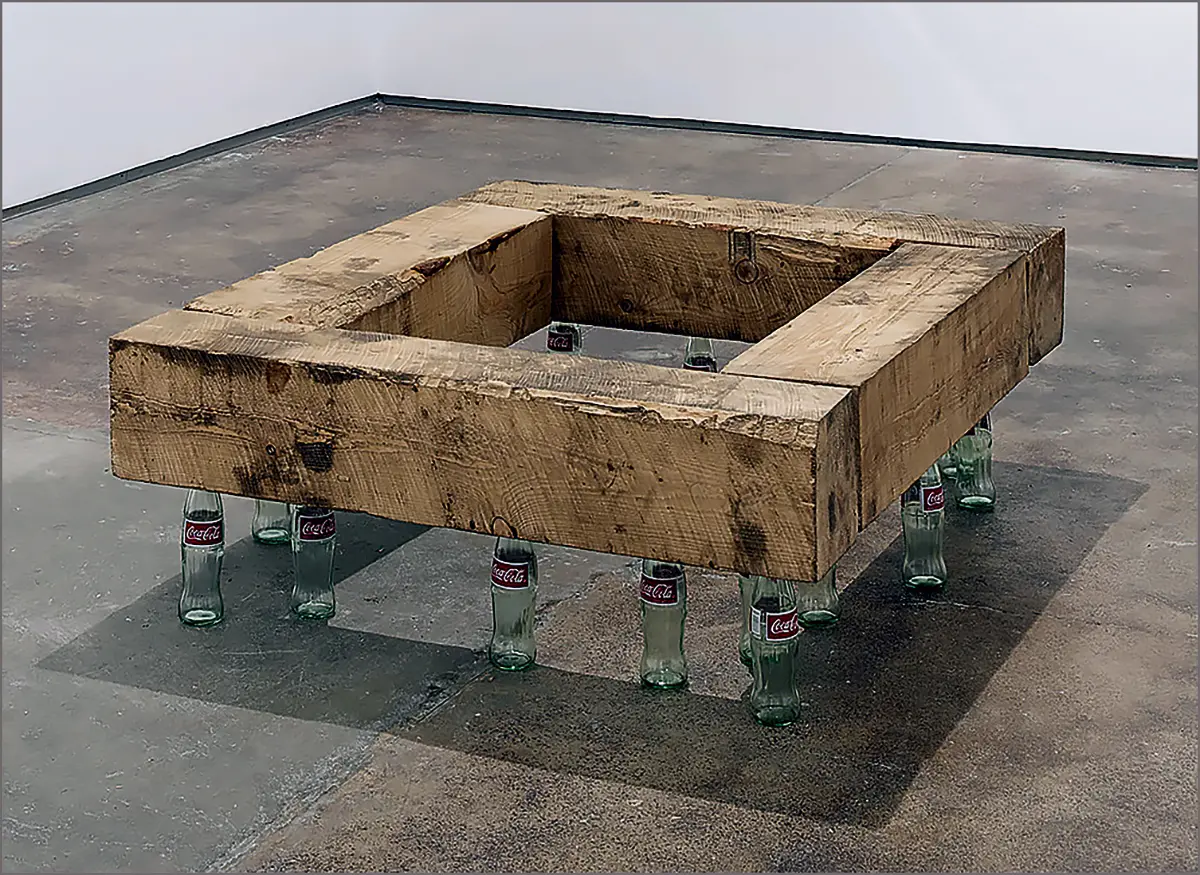
The idea of flight is most implausible and ironic in four free-standing installations. Heavy wooden beams rest on top of glass Coke bottles. In these pieces, Escobar presents an allegory in which we can clearly see ourselves locked into a precarious symbiosis. Does our existence rest on identical, empty vessels? What kind of support systems can we maintain? Escobar’s unique sensibility plumbs these essential questions in works that address balance with humor and grace.
Referring back to the title of the show, maybe it is time for us all to take flight. These witty, humble, and provocative works by Escobar reveal a spirituality that can show us ways to take a leap of faith and liberate ourselves from the strictures of conformative culture.
JEFFREY CYPHERS WRIGHT