To bring its Timeline exhibition cycle to a close, Casas Riegner gallery organized a joint exhibition of works by the Colombian artists Danilo Dueñas and María Fernanda Cardoso. The interest in having Dueñas’ and Cardoso’s works together in public display responds to their shared dedication to exploring the material aspects of the world and proposing a turn of meaning from the standpoint of the viewer. Danilo Dueñas’ career began in the early 1980s and initially focused on a painting of an abstract bent. However, Dueñas gradually began to explore surfaces and pictorial matter as such, with such meticulousness that he quickly broke through the physical and conceptual boundaries of pictorial abstraction and moved towards giving shape to artistic situations located in closer proximity to the viewers’ cultural universe. María Fernanda Cardoso’s career began during the second half of the same 1980s decade, but, unlike Dueñas’, its first horizon of meaning was sculpture. From her earliest works, Cardoso expressed an interest in the contingent nature of the gestures and materials that could come together in a given sculptural situation, which prompted her to explore a broad spectrum of materials and a varied repertoire of gestures to intervene them.
The Timeline cycle—with the participation of eighteen artists—occupied the gallery’s program for a little over half a year, and its goal was to explore a timeline within the body of work of each of its participants. This closing exhibition, the sixth in the cycle, features late-1980s works by Dueñas and Cardoso that announced the paths each was to follow in subsequent years, as demonstrated by the presence of works made in 2018. In this way, the exhibition summarizes thirty years of creative processes that include significant confluences, such as a shared drive towards installation, and ability to articulate the work to given architectural spaces, and a tactical appropriation of objects and materials. At the same time, the exhibition Apología de lo perecedero (In Defense of the Perishable) makes the divergences between these two artists very clear, notably in their thematic concerns, with Cardoso pursuing a sustained attempt to connect with the biological processes that give nature its shape, and Dueñas exploring what can be understood as the spirit of the material world—a preoccupation that can be traced all the way back to his first abstract paintings.
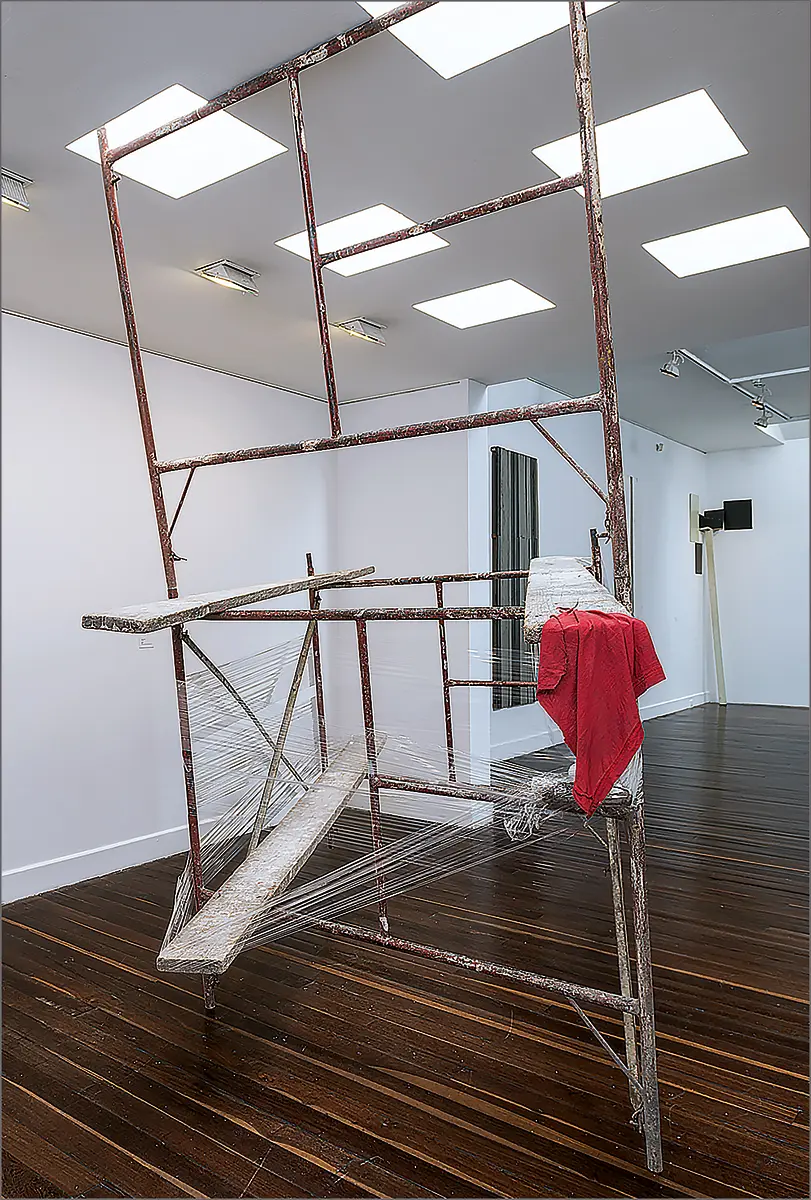
Danilo Dueñas’ art seems to emerge from a need to expand the conventional understanding of what it means to paint, which has made it possible for him to gradually connect his work to different strategies for demonstrating that the more art moves away from its traditional fate, the closer it comes to its function of amplifying and complementing the experience of our passage through the world. It can be said, thus, that the sophistication, rigor, and complexity that characterize most of Dueñas’ works come from a kind of reprocessing of the idea of the surface. Dueñas’ works have included the use of conventional supports and pigments in some instances, to which he has added the need to use raw surfaces like Formica, triplex, or self-adhesive materials, as well as found objects or parts of objects like fluorescent tubes, wooden construction frameworks, scaffolds, books, and even photographs.
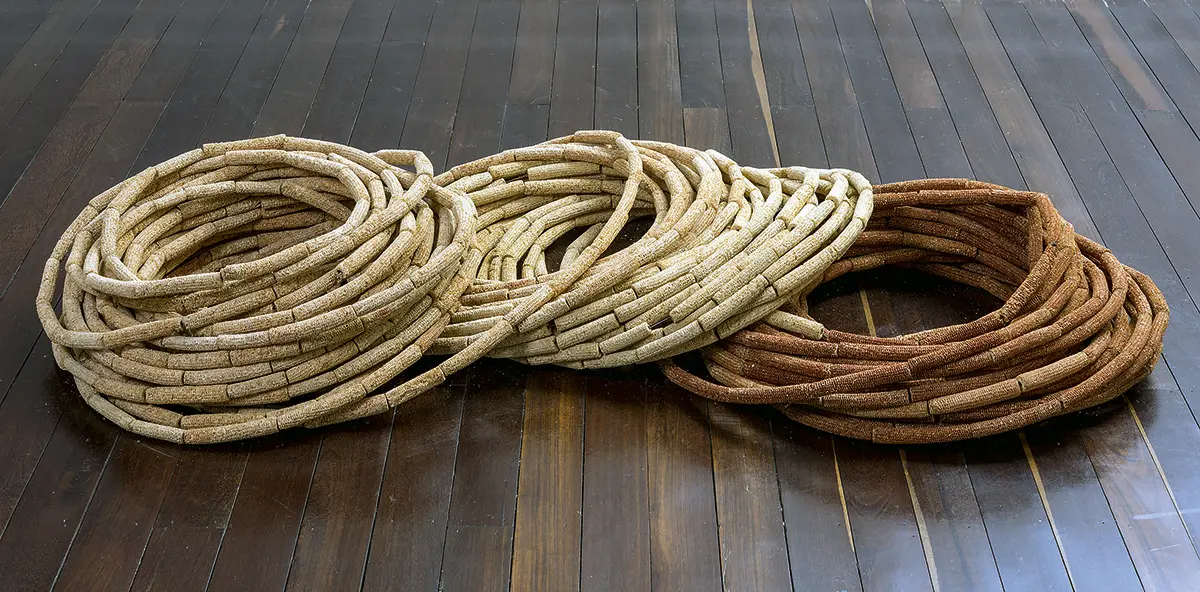
María Fernanda Cardoso has insistently worked in the observation and appropriation of the formal processes of nature, encompassing the entire cycle from birth to death. Cardoso has intervened animal and plant organisms, or their parts, with procedures such as accumulation and repetition, which allow her to configure new visual situations that don’t always reveal their starting point. Although sculpture is often understood from the standpoint of objects, Cardoso has explored it from the beginning of her career in direct connection with the material elements that comprise her work and in relation to the architectural space where her works are to be located.
Apología a lo perecedero brought to the fore the meaning that matter, place, and the body have for these two artists, who have made their mark in the art world precisely for the way they explore that which seems outside of it.
JAIME CERÓN