
A happy encounter of works in perfect dialogue occurred in the exhibition titled Counterpoint at the Diana Lowenstein Gallery in Miami featuring pieces by artists Clemencia Labin and Alex Trimino. The name of the exhibition could not have been more appropriate as it refers to the relationship established in musical composition between independent voices that are tuned and harmonized to create an intensely expressive whole. This whole—the gallery space—resulted from a mounting that was on point and achieved the proper integration of the irreverent, fluid, colorful, and media-rich pieces created by these two Latin American female artists.
Clemencia Labin is a Venezuelan artist who lives in Germany since 1975. She graduated from the Kunstakademie Hamburg in 1975. Standing out in her already long artistic career is her participation in representing Venezuela at the 54th Venice Biennale in 2011.
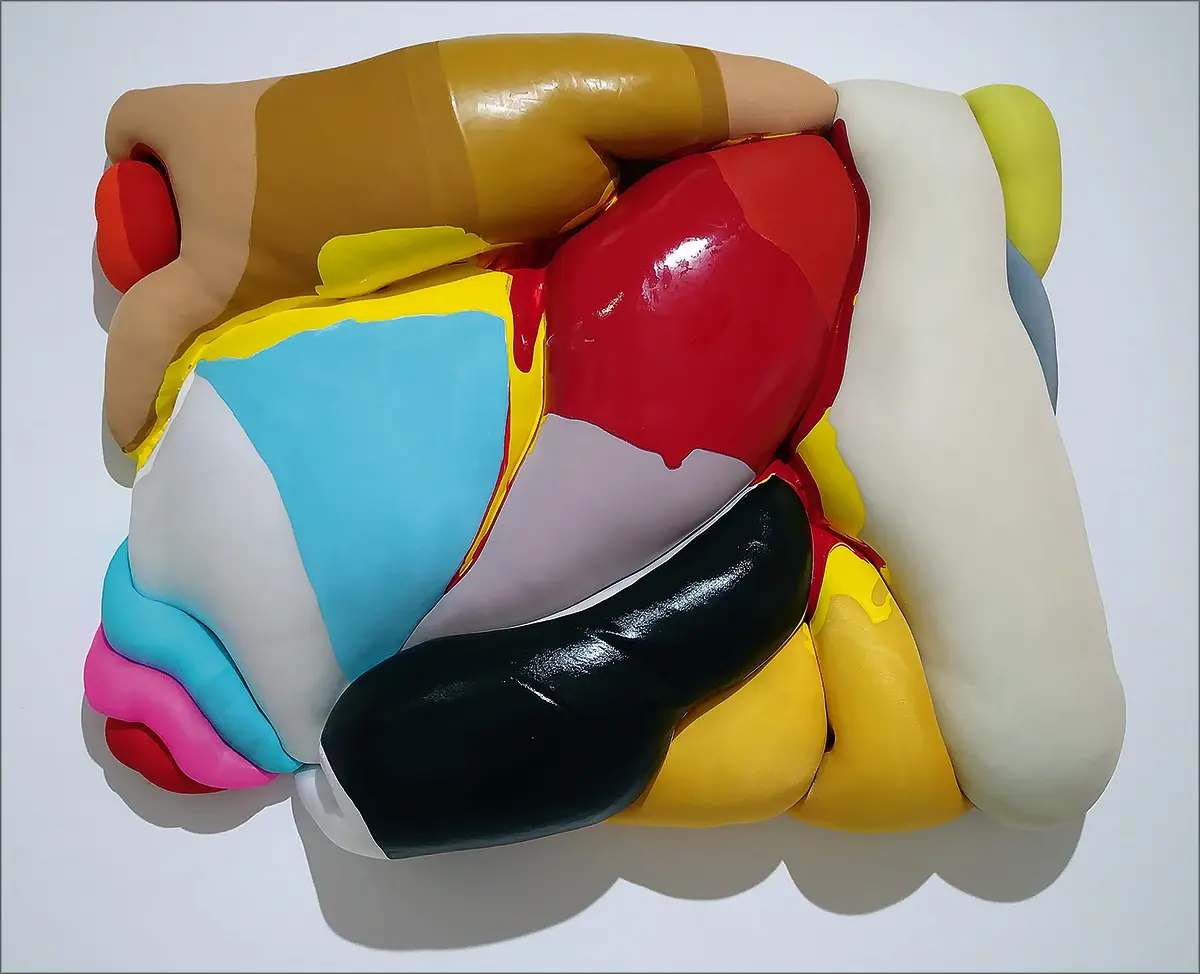
Labin’s work is characterized by a very personal language used for the creation of surprising and overtly sensual visual formulations expressed through unusual color and texture combinations, the creation of soft volumes, an insistence on curves and round shapes and, generally speaking, the emergence of an organic and voluptuous formal universe.
Created with self-confidence, humor, and irony from a subjectivity nourished by personal and collective experiences, Labin’s formal vocabulary is connected to an exploration of the archetypical aspects of femininity as well as to the baroque—or more precisely, Caribbean—imagery of her homeland. Her work imbricates the contemporary reconsideration of artisanal processes, poised experimentations with materials, forms, and volumes, as well as a deep exploration and overcoming of the expressive strategies of painting—which allows her to turn color into haptic materiality—and of the syntax of abstract language; as she gives form to a spatial “longing” of forms and reveals its connection to the hidden mechanisms of the imagination.
In Counterpoint, Labin exhibited Cosidos (Sewn), collages created with pieces of fabric, cotton-polyester, stitching, threads, and acrylic; Pulpas (Pulps), cushions of organic shapes created with lycra of various contrasting colors, stuffed with cotton-polyester and painted with acrylic; Columna Layla (Layla Column), a soft vertical volume stuffed with cotton-polyester and created with a succession of printed cloths that replicate the superimposed segments of a totem; and Scenarios, ephemeral urban maps created on the wall with fabrics, crayons, self-adhesive tape, and stuffed volumes.
Alex Trimino is a Miami-based Colombian artist. In 2012, she earned a Masters in Fine Arts from the University of Florida and attended the Ox-Bow Artist Residency of the Art Institute of Chicago with a grant from the Joan Mitchell Foundation for visual artists.
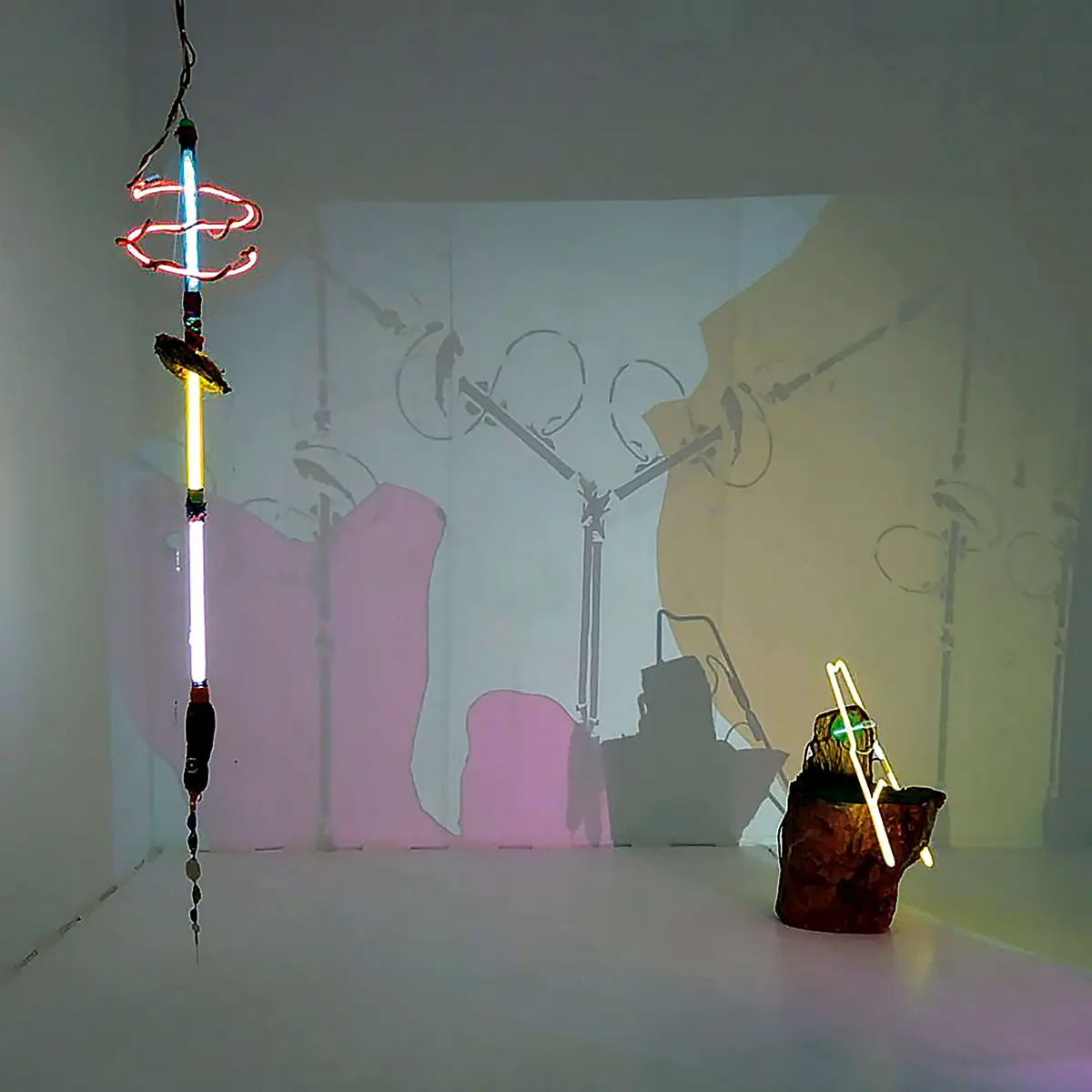
Trimino creates assemblies and installations characterized by the utilization of lights of various colors in combination with different types of materials obtained from several sources. In addition to the neon and fluorescent lights, Trimino incorporates natural materials—like pieces of wood, logs, or vegetable fibers—artisanal textile fragments—crochets, different types of weaves, tassels, etc.—and industrial materials—like cables, tubes, and plastic sheets, among others. Her sculptures mimic the form of urban vestiges generated by the random accumulation of elements. In them, every object added to the assembly acts as a palpable piece of reality that, together with the others, has been “composed,” in a precarious and fragmentary manner, like a sort of accumulative process. Trimino also combines new objects with found or discarded materials, furthering the complexity of the already heterogeneous nature of her luminous assemblies.
The series Totemic consists of vertical pieces whose centers are outlined by neon tubes. In Totemic Lore II, for instance, curbed light tubes are arranged over a wooden log that acts as a base. They hang from the ceiling and are held together with cords. This arrangement underscores the confrontation between technology and tradition and reveals the underlying transient nature of such encounters. Crochet fragments, plastics, and several objects were added to this sculpture that seems like the model of a sort of postmodern vestige that materializes the heterogeneous quality of contemporary societies.
The work titled Binocular Disparity consists of a vertical axis that hangs from the ceiling like a strange mobile, while the piece titled Disillusionment–The Land of Shadows incorporates a projector to cast lights and shadows on the background wall, maximizing in this manner the construction of a poetic and hallucinatory space reminiscent of visions of a sleepless megalopolis.
The luminous assemblies by Trimino refresh this distorted interaction between technology—and its obsolete remnants—and multicultural traditions; between waste as capitalist excrescence and its counterpart: the new; and between the natural and the omnipresence of manufactured products, the former as the weak gap trying to resist the latter.
KATHERINE CHACÓN