The text titled Axiomas para la acción (Axioms for Action) by Carlos Amorales is the backbone of an exhibition that, according to its curator Cuauhtémoc Medina, should only be viewed by those “[…] gladly willing to abandon their innocence […].” The project titled Naturaleza Negativa (Negative Nature, 2012-2018) consists of a full-size reproduction of Amorales’ studio that offers viewers a window into one of his personal spaces. Other exhibition proposals also contained within this piece are:
a. Scenes rendered with black acrylic paint, applied with an airbrush gun on white drywalls that alternate with sharp images of motifs included in various other projects by Amorales: birds, cut-out silhouettes, hybrid creatures with both human and animal features, masks, and maps, among others. Faint human silhouettes hold well-defined images, possibly to activate the axiom of the disappearing artist self through creative exercises in public spaces.
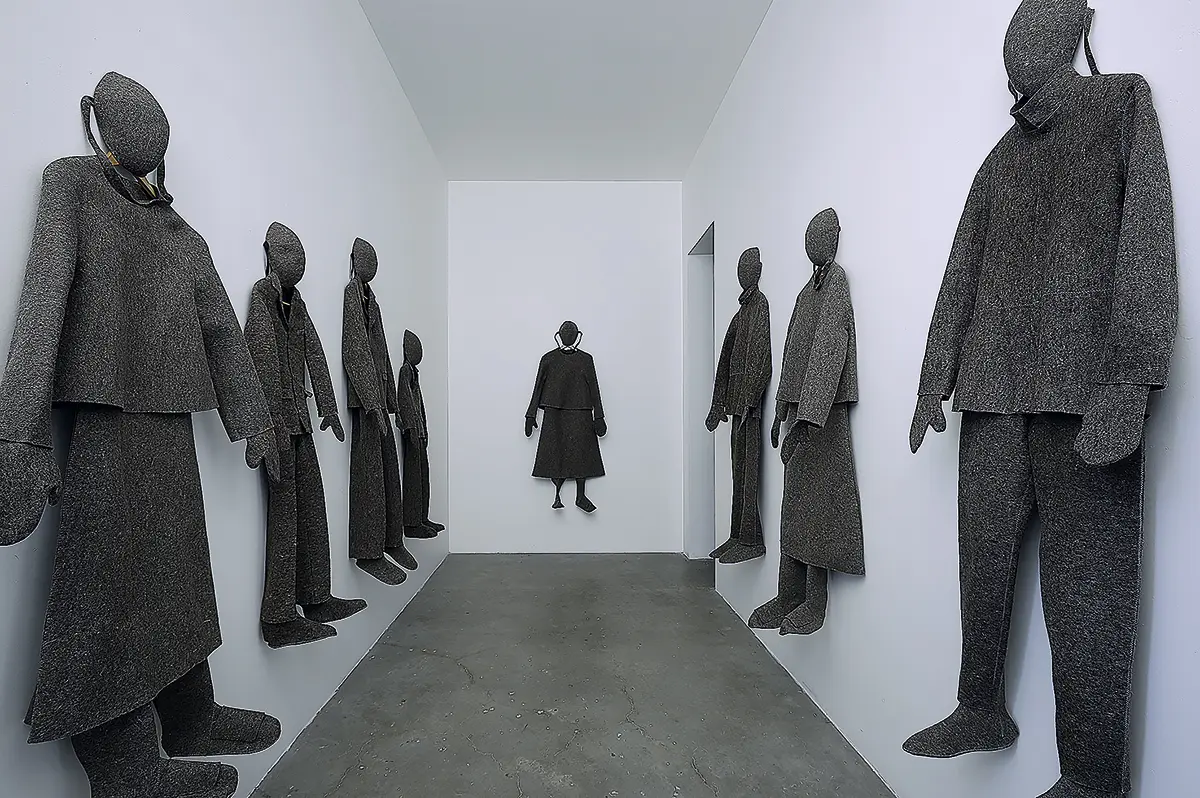
b. Other rooms in this area display projects connected between them and created in 2015: Familia (Family), felt garments hung on the walls serve as an autobiographical reference to being the father of two children, but also as a reference to the clothes in projects by Joseph Beuys and Kazimir Malevich. In another project also in this area titled El Esplendor Geométrico (Geometric Splendor), a video with sound and lithography on paper, Malevich’s scenographic motifs are also used as inspiration to propose “[…] an ambivalent relationship between the imagination of children and the avant-garde […].” Connected to this work is the medium-length digital film in color and with sound titled El no me mires (The Eye-Me-Not). It suggests the theme of inequality and power: the Inuit myth of a local man invisible to European traders, the behavior of people in a whaleboat, or an Asian-looking man caring for two children with European features. The objectual resolution of these projects could correspond to the first axiom proposed by Amorales: to articulate actions in the space between the private and public realms, between the art world and other activities.
Viewers suddenly encounter a multitude of black butterflies transgressing the boundaries usually established in exhibitions. Displayed everywhere in groups of varying densities, they invite to a sensitive experience and repel at the same time—as it occurs with any encounter with the sublime, which always alludes to experiences that surpass the human ability to assimilate them. Titled Black Cloud (2007), the piece consists of 45,000 paper cutouts of moths of different sizes. What at first glance could appear to be referring to mankind’s inability to stop the forces of nature is actually a metaphor for the contemporary dynamics involved in the handling of visual manifestations and the exercises of power that they entail.
A parallel narrative is presented in the video titled My Dear Rational Blonde (1996), an early work in which Amorales incarnates an exploration of transgender identity that combines the artist’s body gestures with a wrestling mask and a wig; it could be connected to the Axiom for Action No.4: the evolution of language as a generator of concealed content disseminated in society.
In Axiomas para la acción (Axioms for Action), Amorales presents twenty-five monotype posters featuring practical conceptual art quotes that initiate a dialogue between expressions of a linguistic (Axioms as theoretical propositions about the body that lead to other most specific reasonings) and visual (Visual plays with printed elements from the real world: vegetables, body parts, manufactured materials) order that incite reflection on those contemplating the works.
Carlos Amorales activated his linguistic principles between 1996 and 2018, the period when the works in this exhibition and this project were created. In addition to representing a manifestation in its own right, the ramifications of the linguistic component are present throughout the works exhibited. Amorales postulates them as interfaces, devices in the continuous transformation to inquire on the nature of communication, signs, as well as individual and collective perception. In them, the artist quotes multidisciplinary artists, like Dan Graham and Matt Mullican, who are impossible to label under a specific category.
The interaction sparked by the spatial proximity and formal features of the three-dimensional works Telaraña transformable (Transformable Spider Web) and Dark Mirror—created with aluminum, resin, and car paint, both from 2008—activates our perception of two physical poles: something suspended versus a fallen, broken bird on the floor.
Other works also offering different approximations include: Las Masas (The Masses, 2017), a medium-length digital film presented with accompanying flyer-like serigraphy, offers a fresh reading of Dada, on the occasion of the one hundredth year anniversary of the movement, through the video of a concert by the band Cyclops presented at Cabaret Voltaire in Zurich, the birthplace of this current; and the piece titled Aprende a joderte (Learn to Endure), a series of gouache drawings that contrast medieval iconography with texts of mean and irreverent contemporary sayings.
A decisive work is an installation titled La vida en los pliegues (Life in the Folds) created by Carlos Amorales for the Mexican Pavilion at the 57th International Art Exhibition of the Venice Biennial in 2017. Through printed images, serigraphed tables, multiple letter-shaped ocarinas of a ceramic alphabet, and a video that explores, in the style of concrete poetry, the visuality-sound of abstract cut-outs on various supports: sheet music in two-dimensional presentations that can be played with the three-dimensional alphabetic ocarinas placed on the tables, enabling the activation of the third axiom for action in this exhibition: to generate a show with dialectic concepts that suspend classical narratives diluted through several users (viewers visiting the exhibition).
The medium-length digital film titled La aldea maldita (The Cursed Village) brings us back to the experience of feeling horror and sublime contemplation at the same time (like with the project Dark Cloud). It narrates the lynching of a family through the appropriation of shadow theater and stop motion animation. A puppeteer is exposed from time to time (a metaphor for power, the artist’s presence, or the pre-eminence of mankind?
EUGENIA MACÍAS