
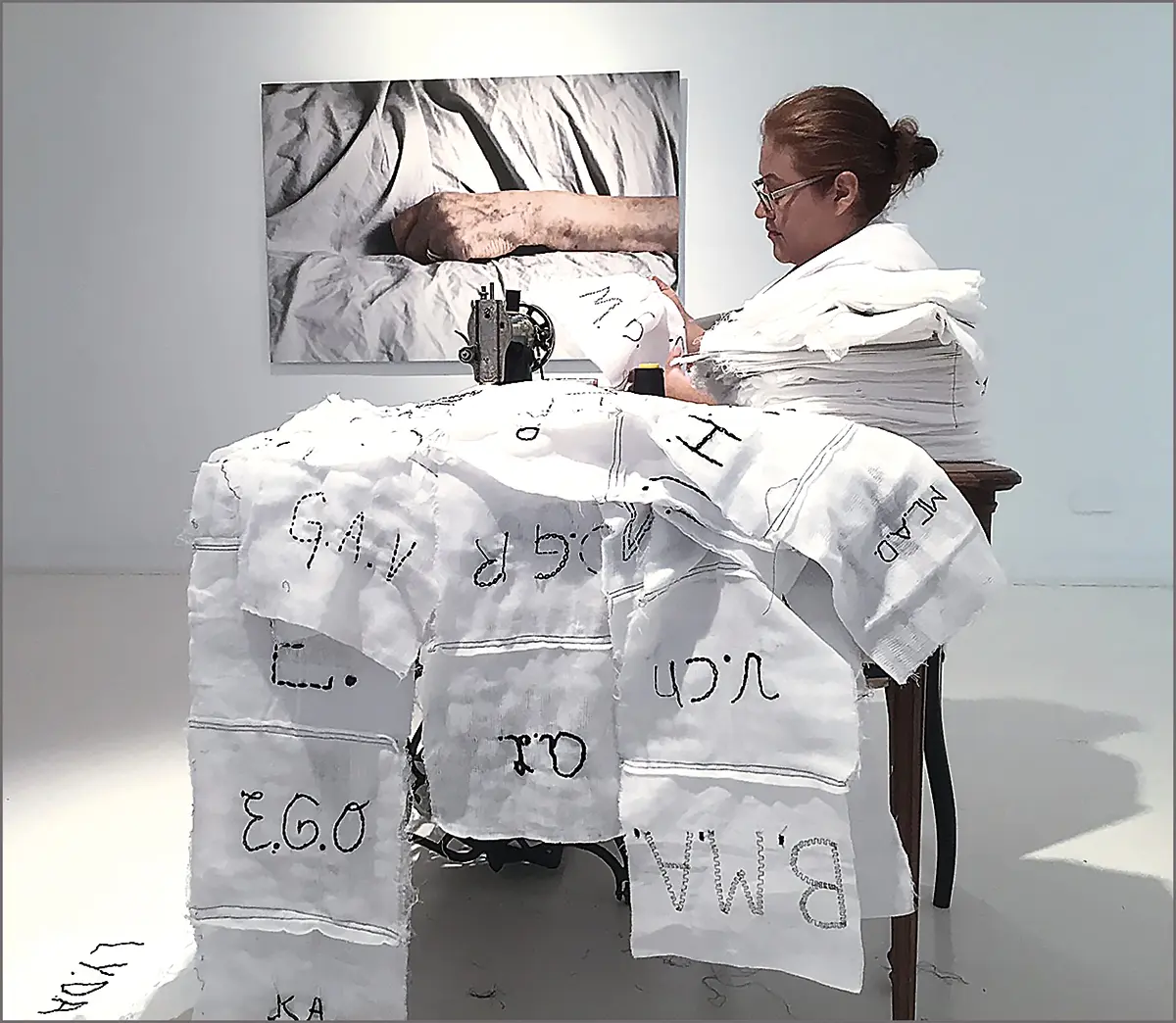
The title of this new Beth Moysés exhibition at Fernando Pradilla Gallery in Madrid has two meanings. First, it suggests that the artist continues to think about Barbara Kruger and her fierce critique of the patriarchy, paying tribute to the American artist by paraphrasing the title of Kruger’s large 1999 retrospective at the MOCA in LA, Thinking of You. Second, it tells us that Beth Moysés continues to think about her mother, as demonstrated by the five works devoted to her maternal remembrance on exhibit in one of the exhibition’s two sections. These works bring to light the autobiographical roots of a good part of Moysés’ oeuvre, her private motivations, the way in which her profound solidarity with women who have suffered domestic abuse is anchored on her own life experience. They evoke a familial scene dominated by the imperative absence of the artist’s mother. In a full-color, large-format photograph, all we could see was her old woman’s arm framed by the white bed sheets, perhaps a hospital’s. In another photograph, we saw two hands trapped in a bundle of pale-gray fabric and thick woven material, set in such a way that any attempt by the hands to free themselves would only tighten the knot. Hanging from the walls of the white cube where a large metal pin, a large sewing-machine needle, and a video showing Moysés, her mother, and her daughter intently rocking back and forth. Presiding over the scene from its center was an old sewing machine—“as old as my mother,” said the artist—on which a nameless woman sews, one by one, white gauze squares where a number of equally unnamed women had embroidered the initials of 1,000 victims of femicide in Spain in recent years. The scene was familiar, but it was at the same time imbued with a mute feeling of violence—presumably similar to the violence endured by Moysés’ mother and by the artist herself, even if only for unrequested and unwanted complicity with the suffering of a wife and mother in a home inevitably marked by patriarchy in a society as patriarchal as Brazil continues to be. In that oblique way, Beth Moysés told us not only that she is vitally concerned with the tribulations of the female condition under patriarchy, but also that she trusts in the redemptive potential of the public airing and exhibition of such tribulations. And in the ability of a sewing machine, such an emblem of femaleness, to become an instrument for their denunciation.
In the second part of the exhibition, we found items that update the line of work that Moysés has sustained over the years, consisting not only in prompting confessions by individual women but also in incorporating those confessions into original healing rituals for women living in shelters in various cities and countries. On the exhibit, there were photographs from Casa de acogida (Shelter Home, 2017) and the video Aguas transitorias (Transitory Waters, 2018). The former showed one of the key phases of her rituals: the writing, on the women’s arms, of phrases attesting to their liberation: “Now I will be in control of my life,” “We don’t know what we are capable of until we try,” Now I am awake and I don’t want to sleep ever again,” “I will change my daughters’ fear,” or “I want no more lies.”
In turn, the video documented a portion of a healing ritual held this year in João Pessoa (Brazil), where women clad in white tunics cross a river on two boats and use cups to pick up water that they then spill on their own heads. The symbolism was as transparent as it was ancient. Water has been a cleansing element in many religious traditions, imbued with the ability to clean not only the body but the soul as well, and in the Christian tradition in particular it operates the miracle of (re)birth: a person’s immersion in a river or the spilling of water on a baby’s head imply their new birth, their birth to Christian life.
In their evident archaism, the symbolic aspect of water recovered by the healing rituals developed by Beth Moysés, and the rituals themselves, offered a sharp contrast with two other works installed in the same gallery. The first was a video documenting the circulation through São Paulo streets of ambulances intended to alert locals, with their relentless sirens, to the fact that violence against women is a serious reason for societal alarm. The second was a red cross set on a window to mean “Healing done here.”
CARLOS JIMÉNEZ