I have known Benjamín Ossa’s work since 2011 when he was just beginning to develop his experiments centered on how our behavior is shaped by phenomena like light, color, and time. The very first exhibition that I saw of his work was at the already closed Salón Tudor of the Cerro San Cristóbal in Santiago. On that occasion, he presented his initial research on the effects of light in our psyche and in the space onto which light is projected. In that show, Ossa was already honing the mechanisms that operate in his increasingly sophisticated light boxes—a simplified way perhaps of defining his ingenious environments for the dance of light and shadows—in that instance through a graphic intervention on the windows of the rustic Salón Tudor’s rustic architecture: geometric cutouts made on a surface fixed to the glass that made us aware of the passing of time. Sunlight would flood through these cutouts and be projected onto the floor surface in a rotating manner, like a sundial, according to the time of day. Since then, Benjamín Ossa (Chile, 1984) has been refining his approach to one of the most obliquus natural—and artificially created—phenomena and the way it relates with our perception of time and space.
Rejecting the static and inflexible state of the traditional school of sculpture, Ossa has not only used light as a constitutive material in his work—in order to confer ephemeral and sensorial qualities to it—but also to render a certain mysterious, magic, and even mystic and sacred halo. Benjamín Ossa belongs to that group of artists that have used light to materialize—or made more tangible—those connections between mankind and something superior, almighty and inexplicable, represented throughout history and symbolized in many cultures and religions by a halo or aureole. Nonetheless, his studies on light and its volatile and diffuse properties are subjected to the rigid and constrained process of technical drawing and to the geometric field of graphic art, always yielding open and suggestive results.
The unstable nature of our perception constantly changes the meaning of the things that surround us. This is the reason that Ossa’s work seeks to create environments able to operate within that instability. According to the artist, “I approach my work from the logic of relationship systems, as well as from thermodynamic, mathematic, temporal, and even mystic principles. This is the reason that my artistic inquiries point to the creation of experiences composed of phenomena that transit through time as well as to sensorial stimuli that activate the perception of, and, as result, reflection on, the things which occur around us.”
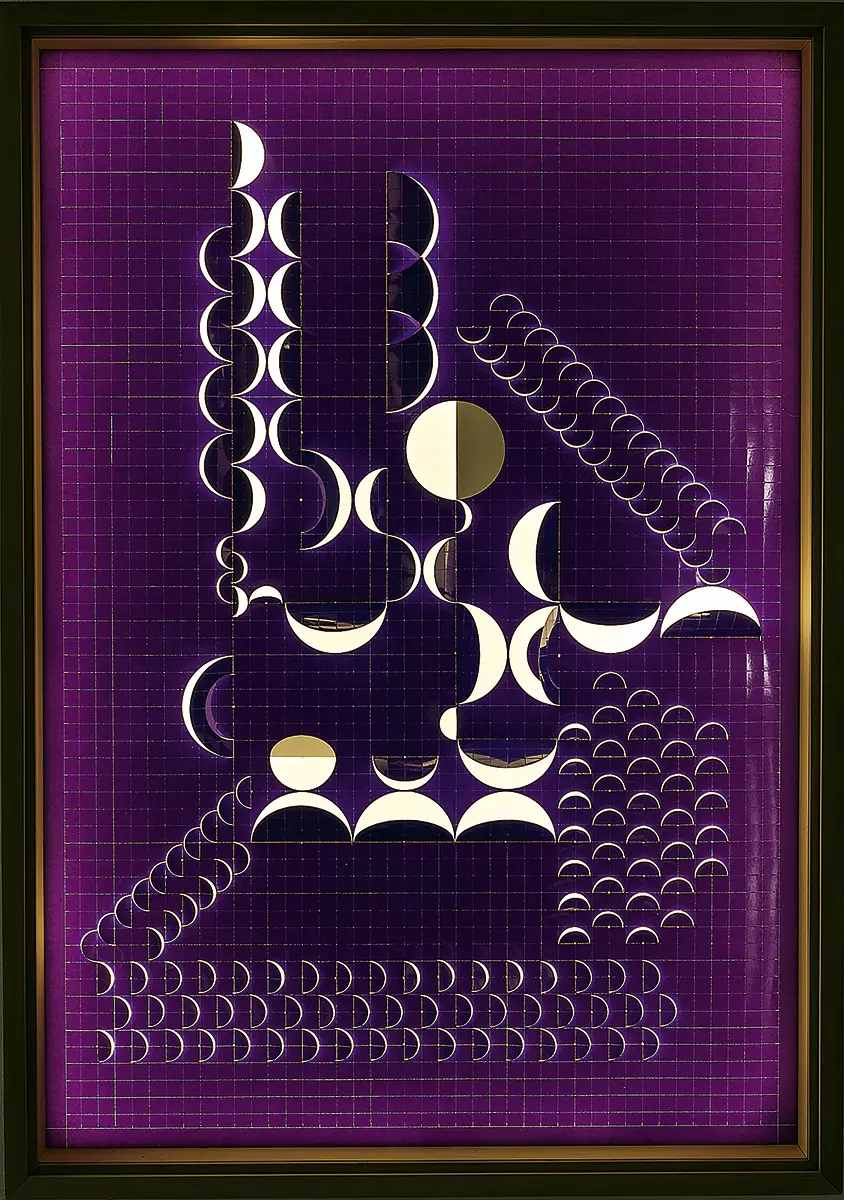
Seven years have gone by between those interventions at Salón Tudor and the exhibition just presented at the Artespacio gallery. But what we saw there a couple of months ago is the result of Ossa’s tireless reflection and research centered on drawing and its collateral phenomena. Drawings of Light, the title of the exhibition, consisted of seventeen “retro-illuminated” drawings that proposed an exploration of color, light, and form. It was a concise study where geometry and abstraction played a central role, on the one hand, in referencing the artistic legacy of the United States and its history and, on the other, in expanding the artistic legacy of this part of the world. According to Ossa, “This approach to drawing has become a constant element of my work and research. In some way, my drawings are the laboratory, the reflection, and the study of the phenomena present in every one of my projects. Cutting allows for opening, cracking, and modifying the plane.”
The lightboxes varied in color, another of the formal elements that Ossa has been exploring, relying on works by theoreticians like Wolfgang von Goethe. On the other hand, the designs reference textile patterns from indigenous American cultures or from industrial constellations and diagrams. Ossa understands drawing as a tool for reflection, as a personal language that becomes inexhaustible and that is gradually constituted into a fundamental part of the processes in his work. “Drawing is somehow the question that precedes and questions the action of creating… It is thinking. Today, the space containing this type of artistic practice verges on the subversive; in digital culture, fast and liquid in every sense, dedicating time to think before a grid in order to develop a language would seem a chimera.”
These recent works by Benjamín Ossa are like many of his other proposals, artifacts that not only transmit light but also experience it. They do not fulfill any utilitarian functions or are built according to any engineering or scientific reasoning. As curator and art theoretician Pedro Donoso would say, they are “devices that turn the observer that activates them into the center of the action.”
ALEJANDRA VILLASMIL