Titled Deriva (Drift), Ariamna Contino’s solo exhibition at Havana Gallery featured several of the artist’s paper fretwork creations as well as some of her usual collaborations with Alex Hernández. Contino and Hernández have risen as a duo and achieved critical approval relatively quickly. If the title of the exhibition prompts thoughts about the precarious situation of Havana Gallery after the passing of its director of many years, Luis Miret, Contino offers proof that the cause of any decay in the gallery’s commercial prospects won’t be the flimsiness of its artistic offerings. In this exhibition, for example, Contino gracefully combines the delicate, minimalistic design of her paperwork with the brutalist material par excellence, concrete. It could be said that with Deriva, Contino seeks to demonstrate the conceptual and aesthetic closeness of both languages.
La falla de San Andrés (The San Andreas Fault) confronts visitors as soon as they step into space: it is a wall sculpture comprised of an irregular concrete block, placed horizontally, and cut pieces of construction paper piling up on top of it. The concrete block is long but shallow, producing the effect of relief, and its tectonic appearance seems to allude to images of cross-sectional cuts of the Earth’s crust. The San Andreas fault, located in western North America, connects the states of California, in the United States, and Baja California, in Mexico. Printed on the pieces of construction paper are fragments of the New Testament; these are passages that contain references to the disciple of Jesus after whom the fault is named. In this work, Contino establishes—literally and metaphorically—several layers of possible readings. On the one hand, by choosing a geographical feature that connects two territories in conflict (at least in terms of migration), she points to the futility of politics against the force of the natural sublime, which since the Romantic era has permeated many representations of the landscape. By combining two materials associated with the development of Western civilization (the paper of the sacred books and the concrete of imperial buildings, from Rome to the present) to create an irregular shape, she underscores the fragility of such foundations.
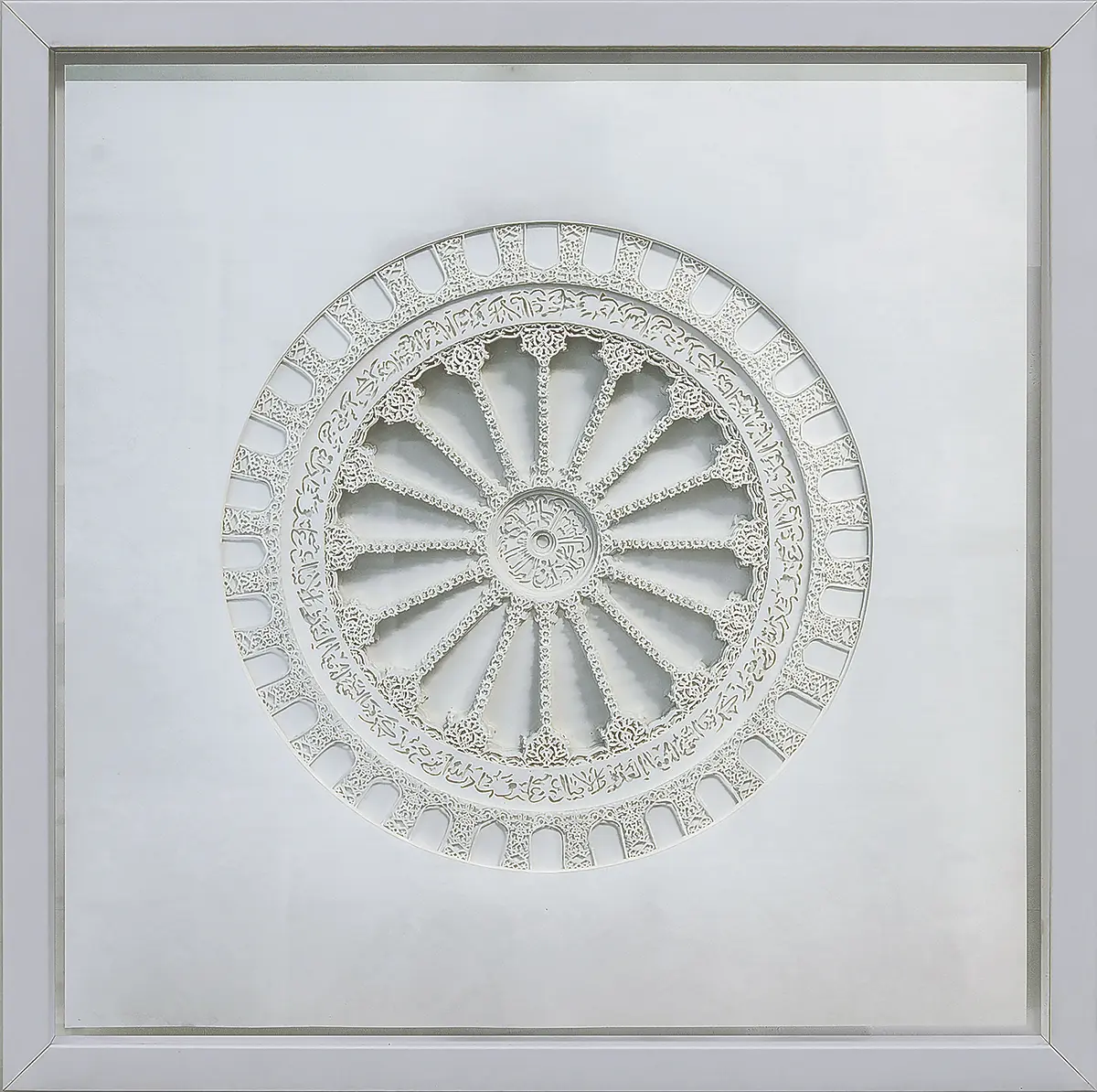
Contino’s references to classical buildings have a different nuance in the series Juicio de valor (Value Judgment). Contino focuses on the floor design of architectural structures where geometric principles demand a La falla de San Andrés. The references include the dome of the Blue Mosque in Istanbul; the Louvre’s Crystal Pyramid; Villa Farnese in Caprarola, Italy; and the Funerary Temple in the Pyramid of Khafre. Here, Contino continues to alternate fretwork paper and concrete bas-relief, but in stand-alone works that are independent of each other. She translates real architectural shapes into paper fretwork, and the graphic representations of floor plan to concrete. The dissonance between the fragility of the material (paper) and the durability of the design (concrete is already part of the dialect of monumental art) becomes even more salient. It could be seen as a tribute to artisanal work, implicit in design understood in its Renaissance sense as the drafting of an ideal form on the basis of linear structures. For their balance and geometric beauty, these forms have survived the many shifts in our value judgments, and remain untouched.
The Romantic sublime and the horizontal line return with Escuchando el silencio (Listening to Silence), a sound installation on the wall in which a tensed piano string produces a sound as it is touched by a kind of guitar pick attached to a motor. Contino creates a sort of almost imperceptible acoustic landscape, like the geological motions that are barely detected by seismographers. The sting is a subtle metonymy of Romanticism if we think of a piano as the period’s preferred musical instrument. But also in Eterno retorno (Eternal Return), Contino seems interested in creating transcendent resonances that in a way connect, with their symbolic vastness, with the idea of the sublime. She uses small formats in sixteen works with white paper, taking as her referent images that allude to the duality of beginning and end. A compass marks the Inicio de un camino (Beginning of a Path), which includes Cráter del volcán Puyehue (Crater of the Puyehue Volcano), an Iceberg and the Puerta de Brandeburgo (Brandenburg Gate). Despite their minimalistic monochrome appearance, the designs waver between the schematic and the baroque.
It should not come as a surprise that Contino is interested in dichotomies and dualities. After all, she is part of a duo for which every problem seems to have two (or more) solutions, as happens often with such collaborative experiences. The show included several works in collaboration with Alex Hernández, among them Desobediencia (Disobedience), which had already been part of a previous exhibition in the same gallery, and consisted in the intervention of the architectural space by transforming the shape of a column from cylindrical to square.
ELVIS FUENTES