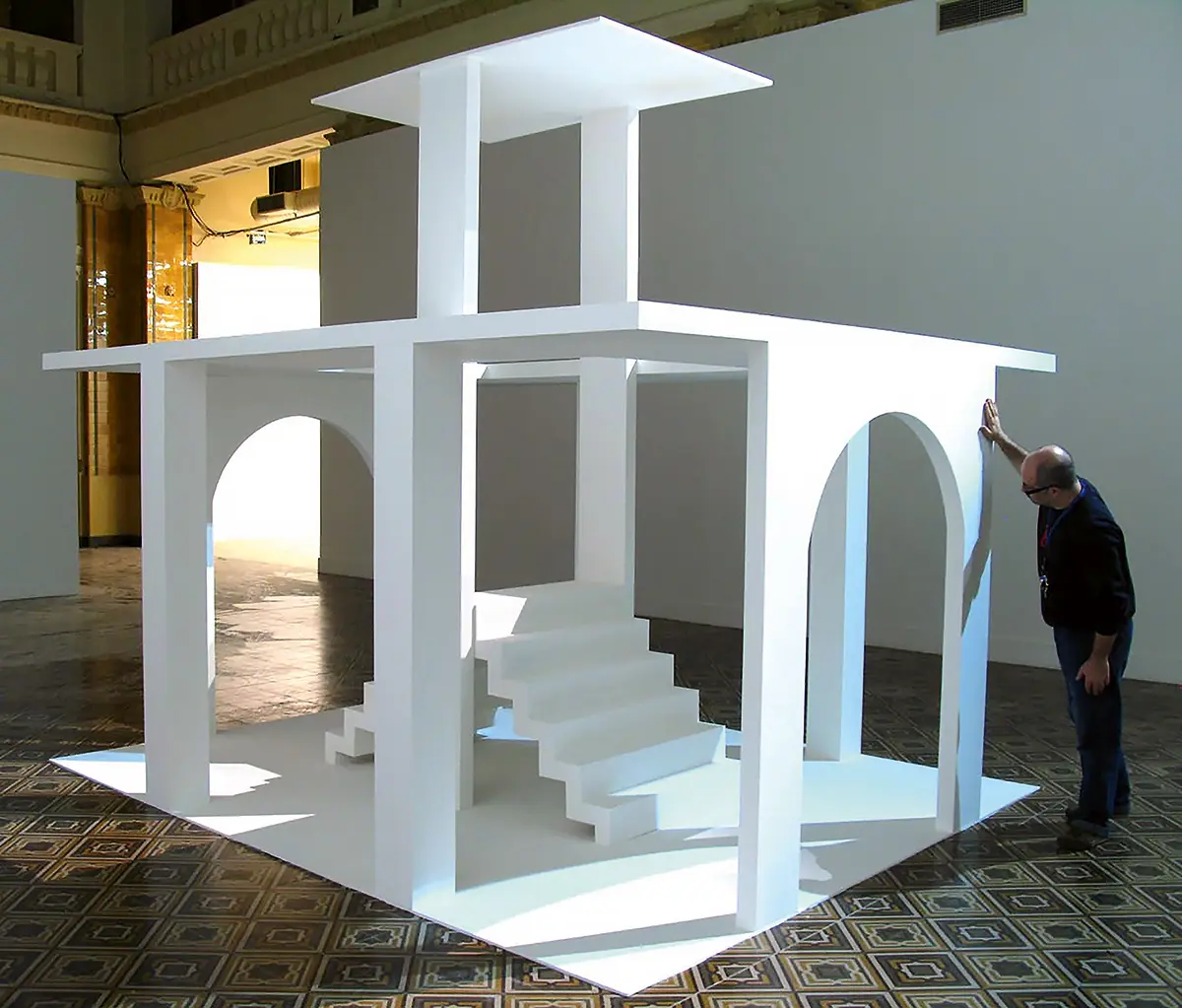
Too large for a model and too small for a building, Homage to Modern Architecture, by Bahia artist Almandrade, inhabits the interval between physical body and idea—an interval, chasm, space, or gap that the artist was, in fact, to explore throughout his career, be it as a bridge between the project and the object, or as a link—always lost, always sought—between words and things.
Homage to Modern Architecture was first projected in 1979 and built almost thirty years later, in 2012. It is a house of a sort, occupied in its entirety by a staircase that leads nowhere. A Sisyphean ladder that ascends only to descend again, with little more than the space of one of its steps as a summit. Almandrade comments on his own invention, paraphrasing LeCorbusier: “This machine for a living does not work, it only laughs (…). A staircase to nowhere. Irony. (…) The absolute symbol of inhabiting an era was rendered redundant. The economy of the square meter came to besiege the modern tenets of a civilization that believed blindly in technology as a solution to the world’s problems.”
Almandrade’s work is part of a modern Avant-Garde tradition (and how contradictory it sounds now to call the Avant-Garde a tradition), a current that in Brazil was taken to its ultimate consequences, from the dream of Brasilia to the ripping apart of art as such in the attempt to transform it into life itself, with the Neo-Concrete movement.
In sum, Almandrade is an artist who, from the 1970s on, reengaged and developed several of the key pathways in Brazilian art of the second half of the Twentieth Century. An artist who imbibes the geometric art of the 1950s—both from its representative practitioners (Décio Pignatari and the Campos brothers) and from its dissidents (Wlademir Dias-Pino and his Machine for Laughing, or Sírvalo Esmeraldo)—as well as the Rio de Janeiro Neo-Concrete school, specifically the work of Oiticica, with whom he was in touch since the 1970s, and the poem-process and the poem-book forms.
This series of movements is ultimately geared towards a fracturing of art as representation. With this, they inaugurate the possibility of looking at an object or a square shape just for the sake of looking at them, without identifying what it all means—without, moreover, them having to mean anything, just by virtue of a square being a square, a form just a form, just a spot apprehended by our perception. Come to think of it, it is interesting that the more square shapes this type of art propose, the greater freedoms it involves. This is an art that expanded the spectrum of the senses, and there, with no other way out, transformed itself into the experience and even renounce it to be art. The poem became a drawing on paper and the book ceased to be an object in order to become an object to be decoded, manipulated, and sensed rather than read—an object perceived, that is, even with the tips of our fingers.
Antonio Luiz Moráis de Andrade was born in São Luiz de Bahía in 1953. Thus, more than a pseudonym, Almandrade is a distillation of his given name, as well as a kind of self-designation. This is closely connected to the exploration of words and signs that have characterized his work as an artist. Indeed, naming himself appears as the foundational gesture of Almandrade’s oeuvre, and this is how he started to sign his paintings and visual poems in the 1970s.
Almandrade left the interior of Bahia in order to study architecture at the University of Salvador. As he has noted, he was already interested in drawing and writing. In fact, he didn’t go into the humanities because he couldn’t decide between the different fields. As soon as he arrived to the university, he began to explore the library, and this is how Almandrade ran into the 1956 issue of the journal Art and Décor. Let no one be misled by the title: the issue was a vehicle for the Concrete artists—fierce enemies of the decorative and the ornamental—to find publicity to their work. Indeed, it was the unofficial catalog for the first Concrete Art exhibition in São Paulo. The journal was filled with abstract-geometric works of art, harbingers of a new aesthetics that yet to achieve wide circulation, all the more so in Brazil’s provincial northeast.
Very soon, the future Almandrade was journeying to São Paulo and Rio in order to establish contacts with the artists that were pushing into the fractures of the representational and dissolving the boundaries between art and life; returning to Bahia with a heavy harvest of news, images, documents, and poems, he launched the journal Semiotics. The working title for the publication had been “Semiosis”, but the censorship organs of the military regime in Brazil rejected this. “Why?”, Almandrade wonders. “Because they didn’t understand it—and, truth be told, we were not all that clear on what it was about, either,” he hastens to answer.
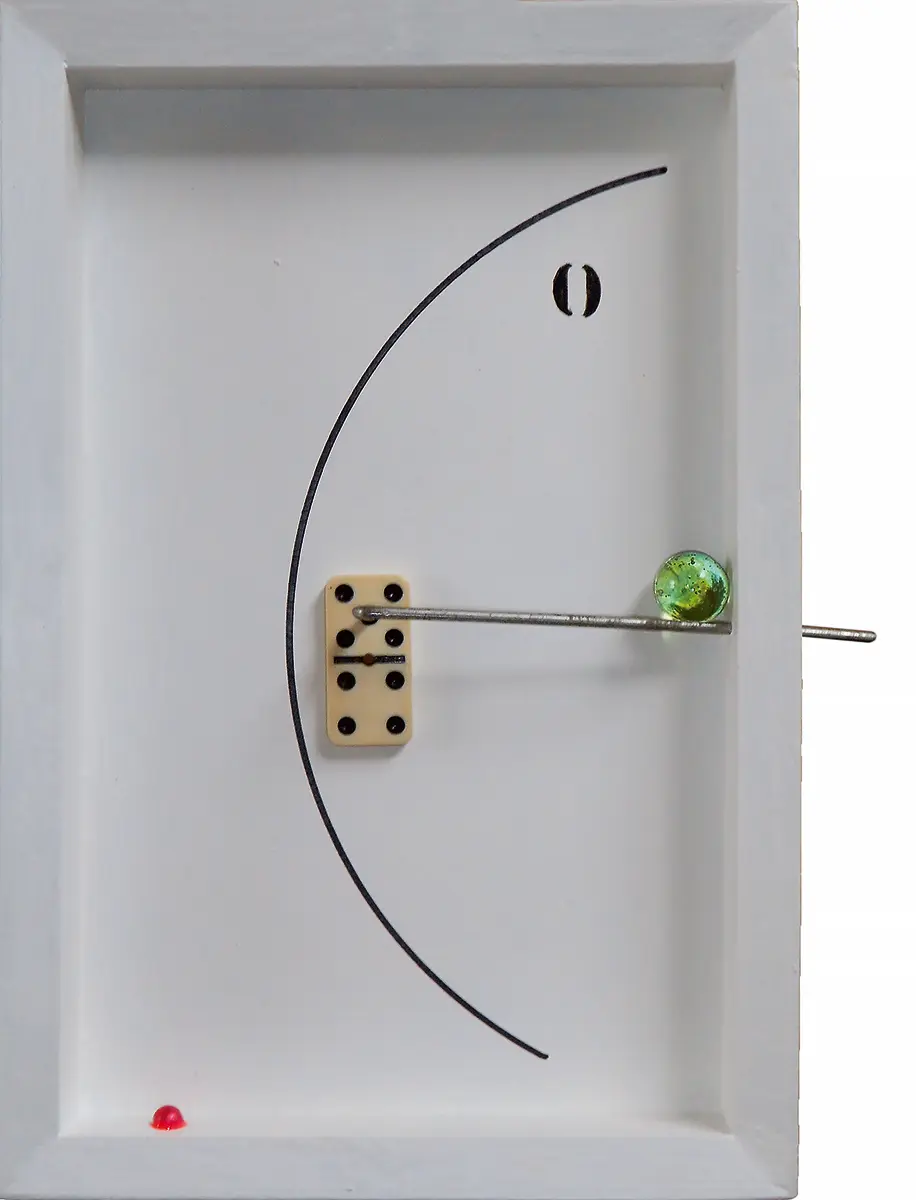
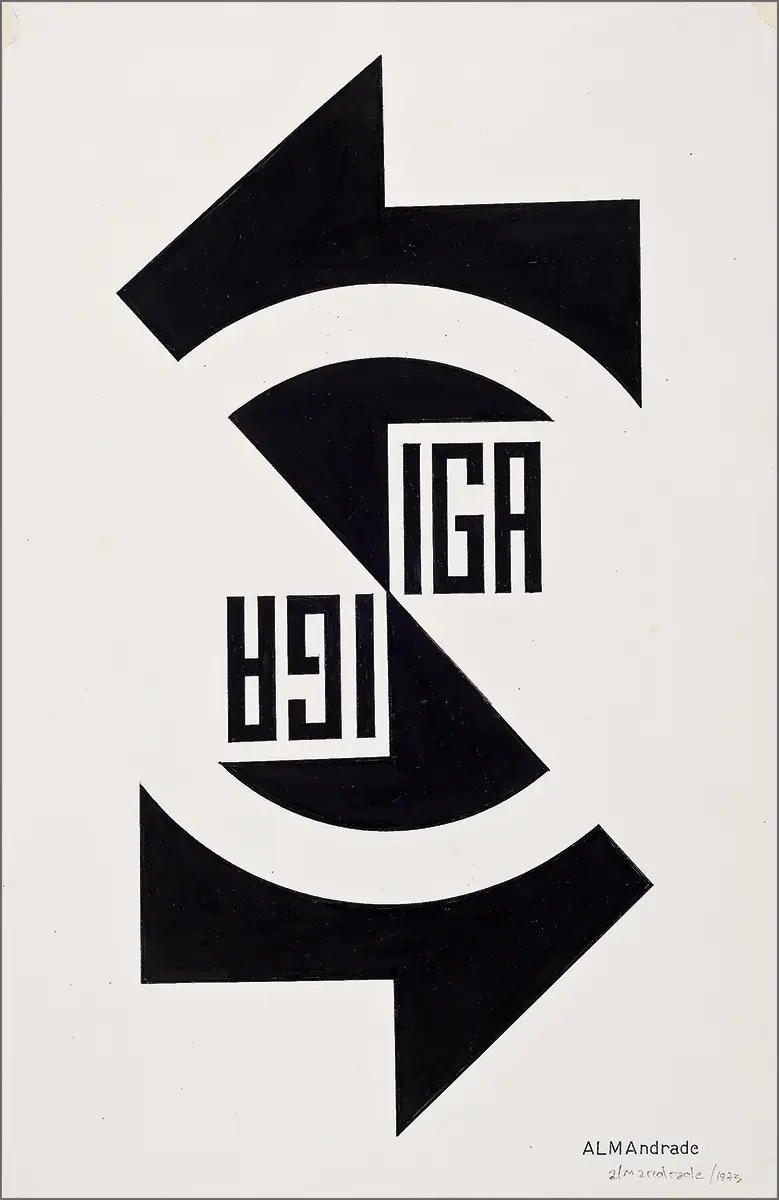
Based on Peirce rather than Saussure, the journal delved into questions about the ability to signify and the connection between sign and object, issues that were to become key to Almandrade’s work. For example, in a visual poem like Siga (Follow), from 1973, the initial “S” functions as a drawing that represents the direction that the term involves. These are poems and creations in which the word—its image on the paper surface—is an active part of the thing or the action being referred to.
Almandrade recounts how this journal was the first to present the ideas of Michel Foucault in Bahia; indeed, Foucault’s Discipline & Punish was very influential on the artist’s thinking about urban issues as an architecture student. Here I can’t avoid thinking of The Order of Things, from 1966, which tells how Modernity begins with the opening of a gap between names and their referents, a painful fissure that the Twentieth Century attempted to heal by means of reconciliation of signs and objects. This dream was more utopian even than the dream of Brasilia because it attempted to find a language that instead of separating us from the world, would be the world itself. We see this project enacted in various ways from Xul Solar to Concrete Poetry, and beyond. Almandrade’s visual poems are inscribed within that framework: visual poetry is a practice where words are seen and read in a single motion, with no seams between the act of perceiving and the exercise of identifying.
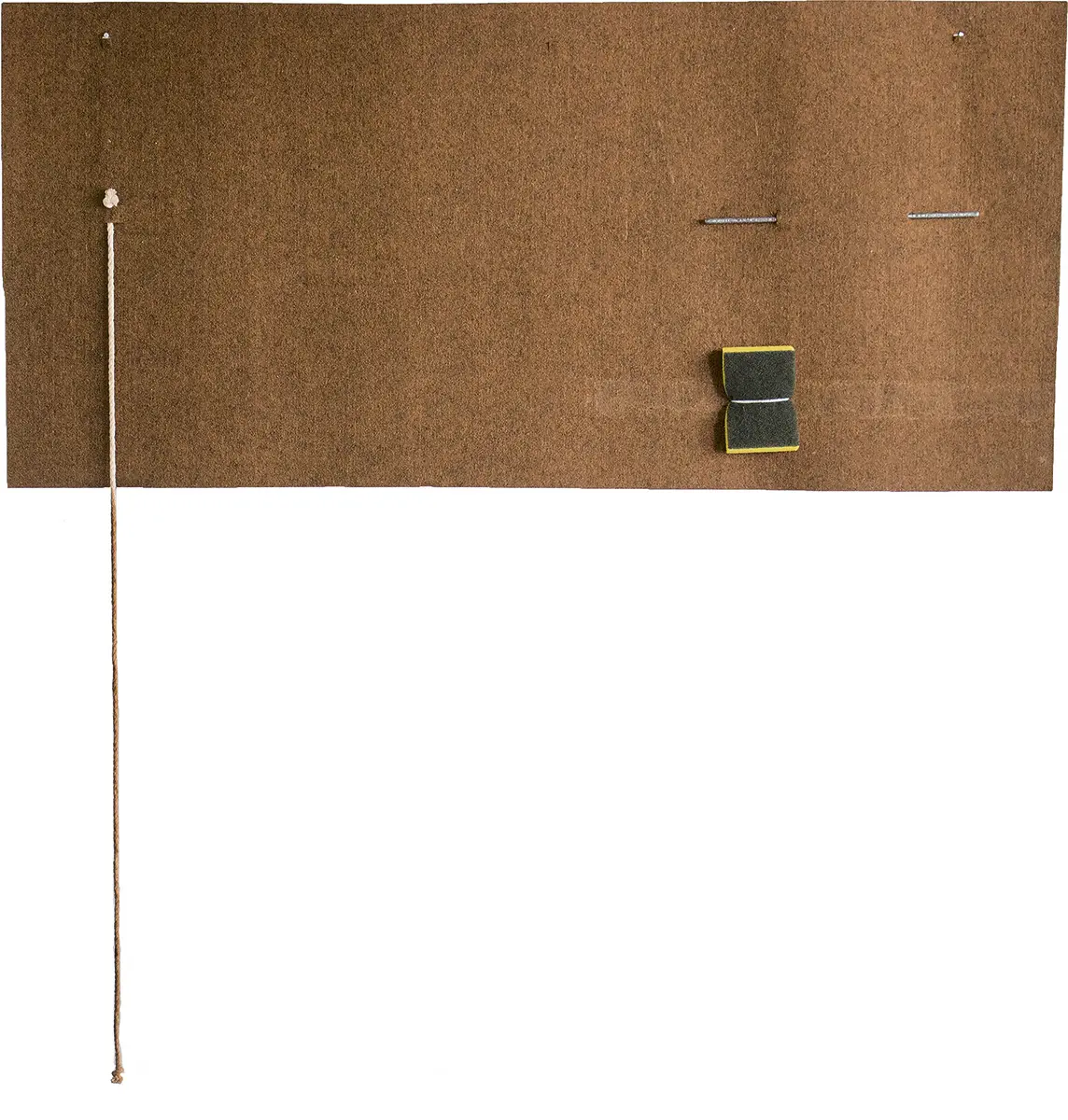
“Adam’s first task,” says Almandrade, “was to name things, so as to establish dominion over them,” as though knowing a name was a form of subjugation. “I can only have that which I know,” the artist adds in order to explain that the other option is to leave things without names and signs without referents. Thus, at times Almandrade proposes titles that have no connection to the object they name. These games leave viewers suspended in an interval, unable to capture the object they have in front of their eyes.
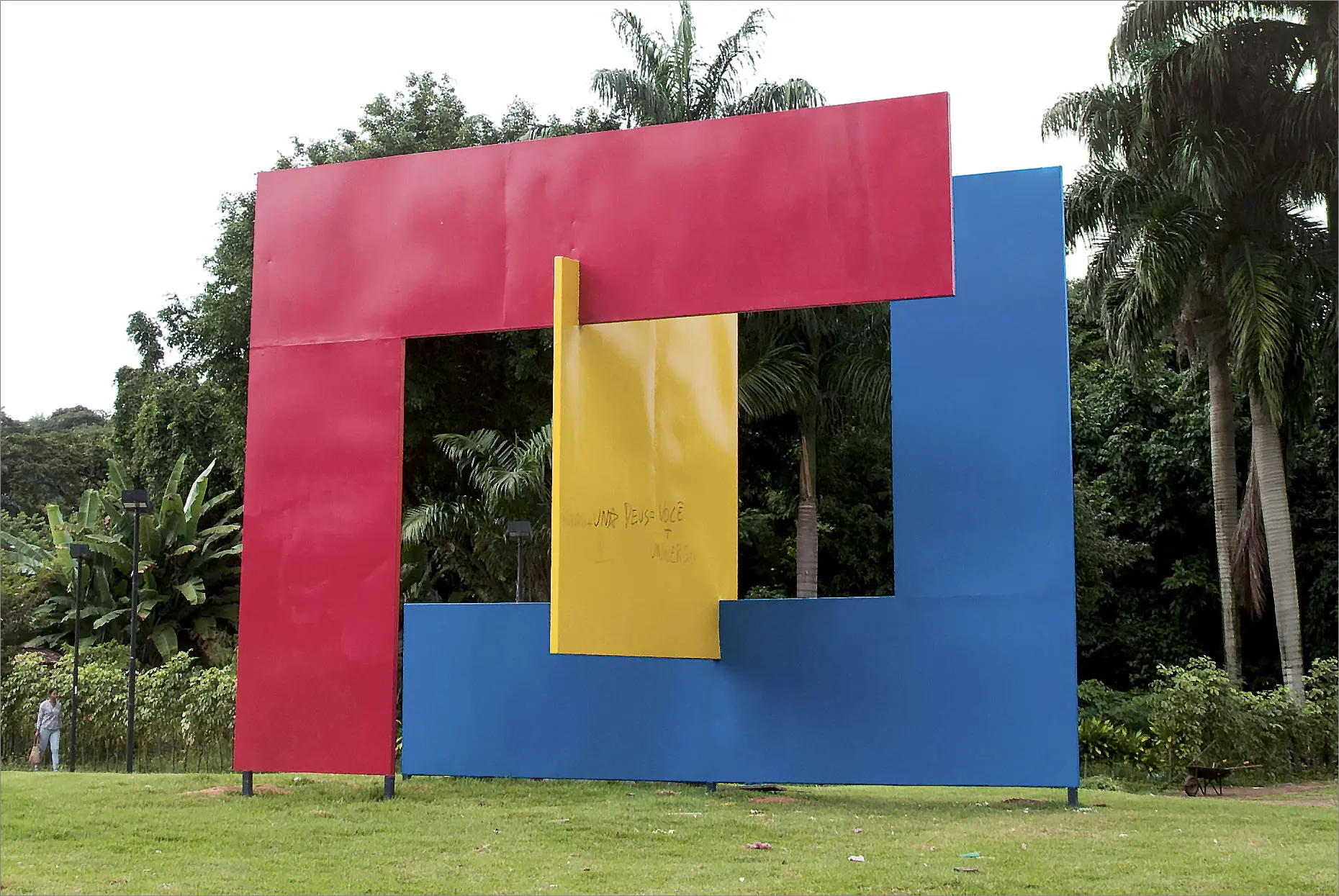
After university, Almandrade began working for the Planning Department of the Salvador Municipal Government, alternating between his job and his artistic practice. The experience was influential in his creative process, both in terms of the conception of the project (architectural plans appear in several of Almandrade’s works) and of an interest in public spaces. In fact, Untitled – Sculpture for Public Space, built-in 2014 at the Ondina Campus of the Federal University of Bahia, is a clear example of this. The work consists of three planes that emerge directly from the paper and take over space; a fluctuating box in which a yellow square is supported by a blue and a red “L”.
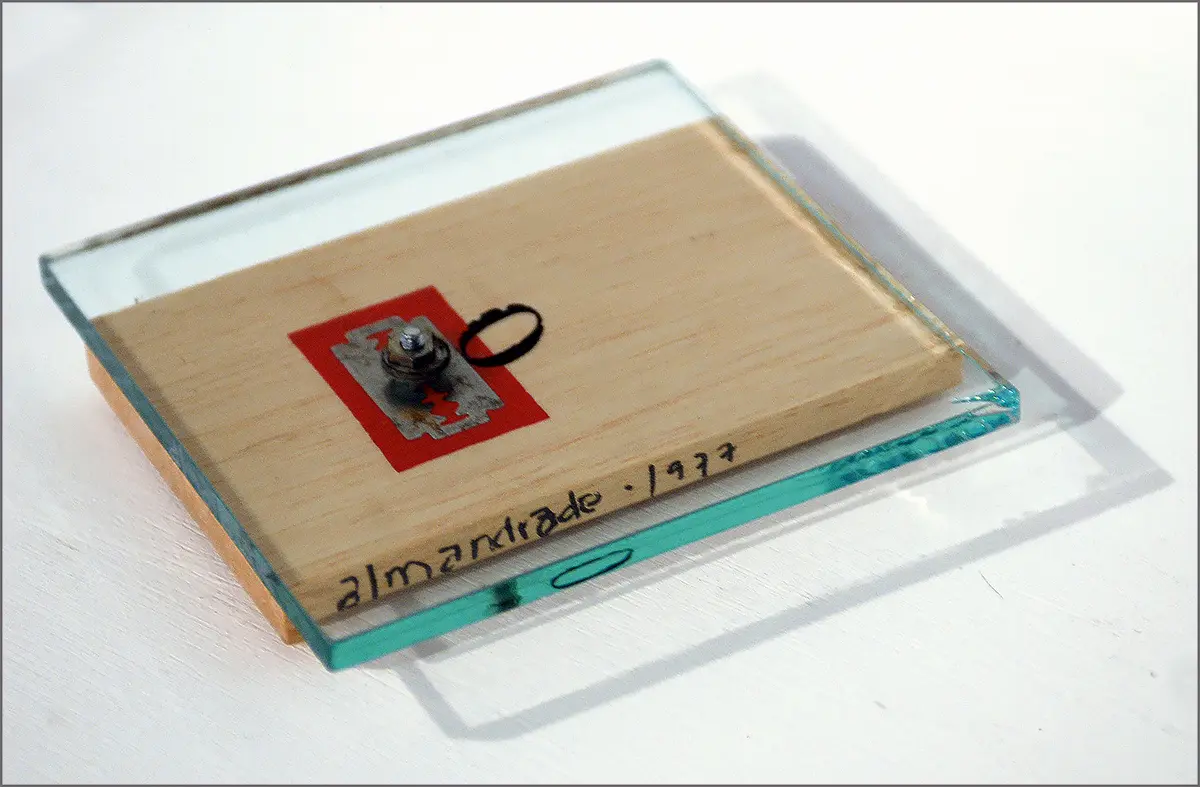
More than a painter, Almandrade thinks of himself as a sculptor, someone who creates three-dimensional objects. This might seem a contradiction, as one would think that, being flat, painting is closer to poetry and its support, paper, the quintessential plane. Yet, the opposite is true. I’ll explain. As I said, the project of a visual poem consists in turning words into images, and in that way to bring “pleasure without the need to decipher”, to use a phrase used by the artist in a text about the poetry of Wlademir Dias-Pino, creator of the process poem in Brazil1. In sum, visual poetry’s break with representation directly interrogates painting in its condition as a plane that pretends to be a space. (This is why we don’t have minimalist painters, only sculptors; this is why in artists like Gego or Clark the line escapes the paper and invades the space in the form of wire, or the triangle leaves the canvas to become, transformed into aluminum, tangible in the physical world.)
Almandrade does work in painting, but, along with the insertion of words and the play with titles, he commonly makes small cuts into the canvas or the paper in order to cancel its fiction, showing the plane as a body. The shadow of the “wing” that results from the incision leaves no doubt about it. On the other hand, in his sculptures, we find planes that, articulated, become bodies in space. A series of three-dimensional objects raised by means of the articulation of their parts, where a new element stands out: the Brazilian Northeast’s tradition of wooden assemblages.
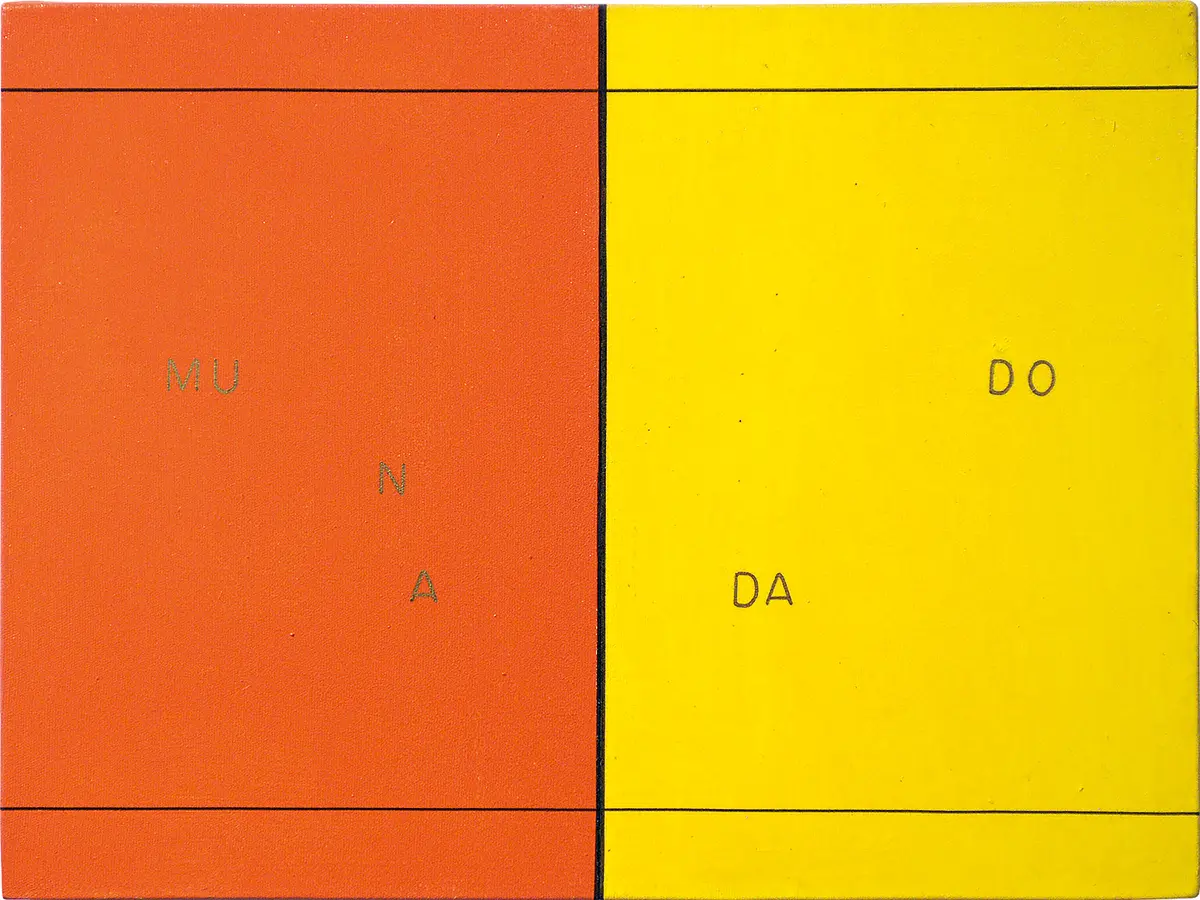
In Brazil, the Northeast region is famous for its bonecos, doll-like figures that are often built using wood planks articulated into surprising shapes. There is even a type of toy whose strips produce the illusion of switching in an infinite loop so that it is difficult to stop watching it. It is also important to remember that one of the most astonishing collections of such toys belonged to the architect Lina Bo Bardi. Significantly, Almandrade’s sculpture finds nourishment in that northeastern tradition, in those wooden planes, and puts it together with the Modern Avant-Garde as I wrote at the beginning of this essay.
Visual poet, sculptor, and essayist: a selection of his critical and historiographical articles appeared as Writings on Art. In that book, I found a couple of artists about Carybé, and I asked Almandrade why, being a practitioner of abstraction, he defended in such strong terms a figurative, folk-inclined artist. Almandrade answered that he was a defender of the Bahia tradition, a legacy that needed to be protected and preserved. In summary, he said, “I don’t have any modern dogmas because, in the end, that Modernism is over: one cannot wake up every day with a new idea.” And he added: “This is why we are all contemporary now.”
NOTE
1. The most comprehensive publication about this movement appeared in OEI Magazine Issue 66, Edited by Jonas Magnusson, Cecilia Grônberg, and Tobi Maier, Stockholm, 2014 (English).
JULIA BUENAVENTURA
Critic and art historian with an emphasis in Latin America.