The 11th edition of the Mercosur Biennial opened to the public and April 6, in the Brazilian city of Porto Alegre, and ran through June 3. Curated by Alfonso Hug, the exhibition proposed The Atlantic Triangle as its subject, in an attempt to bring into focus the historical dynamic that took place between America, Africa, and Europe more than 500 years ago.
In his presentation essay for the catalog, the curator—who has Paula Borghi, from Brazil, as his adjunct in the organization of the exhibition—introduced readers and visitors to the importance of the central problem brought to the surface by the Biennial’s thematic choice: “All oceans are immense warehouses of history and culture; none, nevertheless, surpasses the Atlantic in terms of its accumulation of dramas and catastrophes that changed the course of world history forever.”
Thus, at the 11th Biennial, a thematic proposal focused on highlighting the interface between European, indigenous, and African cultures became a focal point for artists to think, by means of their art, the historical reality subjacent to that triangle and the social dramas that unfolded there.
Intense interest has emerged recently in the Brazilian art circuit for the Africa matter. To take the city of São Paulo as an example, and besides the excellent work carried out by the Museu Afro-Brasileiro, last April saw the opening of a show titled Ex-Africa, at the Banco do Brasil Cultural Center (the exhibition was presented before that at the Center’s locales in Rio de Janeiro and Belo Horizonte, and it was also curated by Alfons Hug); in June, the MASP (Museu de Arte de São Paulo) and the Tomie Ohtake Institute hosted, simultaneously, the exhibition Historias Afro-Atlânticas (Afro-Atlantic Histories), featuring four hundred works on loan from such international institutions as the Metropolitan Museum, the Victoria and Albert Museum, the Galleria Degli Uffizi, and the Musée du Quai Branly, alongside works from the MASP’s own collection. The Mercosur Biennial, then, was a significant contribution to an ongoing debate, from the standpoint of contemporary art.
A key issue that needs to be emphasized is that contemporary artists today work as researchers in the social space, observers of reality who extract from it the raw materials for aesthetic thinking; they act as social scientists that communicate by means of visual poetics. Today, an artist is to a certain degree an ethnologist, sociologist, and a student of the humanities. From this perspective, we can say that the 76 artists brought together for this exhibition were prompted to observe “the voluntary and involuntary migratory flows that developed in the Atlantic Triangle, and their consequences. Their works brought to the surface central historical issues: the transculturation of religions, languages, and knowledges, as well as, naturally, the relevant politico-economic dynamics. Along this spectrum, and by means of aesthetic practice, the artists engaged sides of the exhibition’s subject matter connected to the contemporary juncture.
The issue posited by the experienced Curator, a German national who has lived many years in Brazil and Nigeria, is profoundly relevant for any consideration of the historical reality of Latin America and of the world as a whole, since it leads straight to the subject of historical modernity and the history of Capitalism, indirectly bringing into relief the matter of the capitalist mode of power, past and present: the matter of coloniality, which left a deep imprint on life in the Triangle of the title.
It is worth remembering that these historical mechanisms were under sustained study in the Human Sciences throughout the Twentieth Century, and continue to be forcefully debated today. In Latin America, one of the outstanding experts on the subject is Peruvian sociologist Aníbal Quijano (Coloniality of Power and Eurocentrism and Latin America, among other books.) Quijano approached the Atlantic Triangle in its economic, political, and cultural aspects, showing how it is the fundamental engine for the development of the current conjuncture of Capitalism at its point of origin. Quijano notes that the root of “racial” prejudice can be located there since from the start Europeans associated forced, uncompensated labor with the subjugated “races” that were deemed “inferior”. Based on Quijano’s work, we can see how the indigenous genocide of the early decades of colonization was not caused by the violence of conquest itself, nor by the infections that came with the invaders, but by the fact that the indigenous peoples were converted into a disposable labor force and worked to death. Enslaved Africans suffered under the same conditions. In consequence, the wounds of memory remain open for peoples of Indigenous and African descent.
In his essay, Alfons Hug highlights other facts of interest with respect to this historical issues: “More than sixty million Europeans fled poverty in search of a better future in the new lands to the west, and at least twelve million Africans were sold as slaves in Brazil, the Antilles, and the United States.”
It must be noted that among the results from this process are the “transculturation” analyzed by Fernando Ortiz; the “creolization” studied by Édouard Glissant; the acts of anthropophagy highlighted by Oswald de Andrade in his Manifesto Antropófago; a hybrid culture whose traces remain lodged in the social process and in collective memory, as Néstor García Canclini explained.
In what follows we will review some of the works on exhibit at the 11th Mercosur Biennial, organized under the headings Atlantic Journey; African Matrices; Migratory Flows and Diaspora; and Individual and Society.
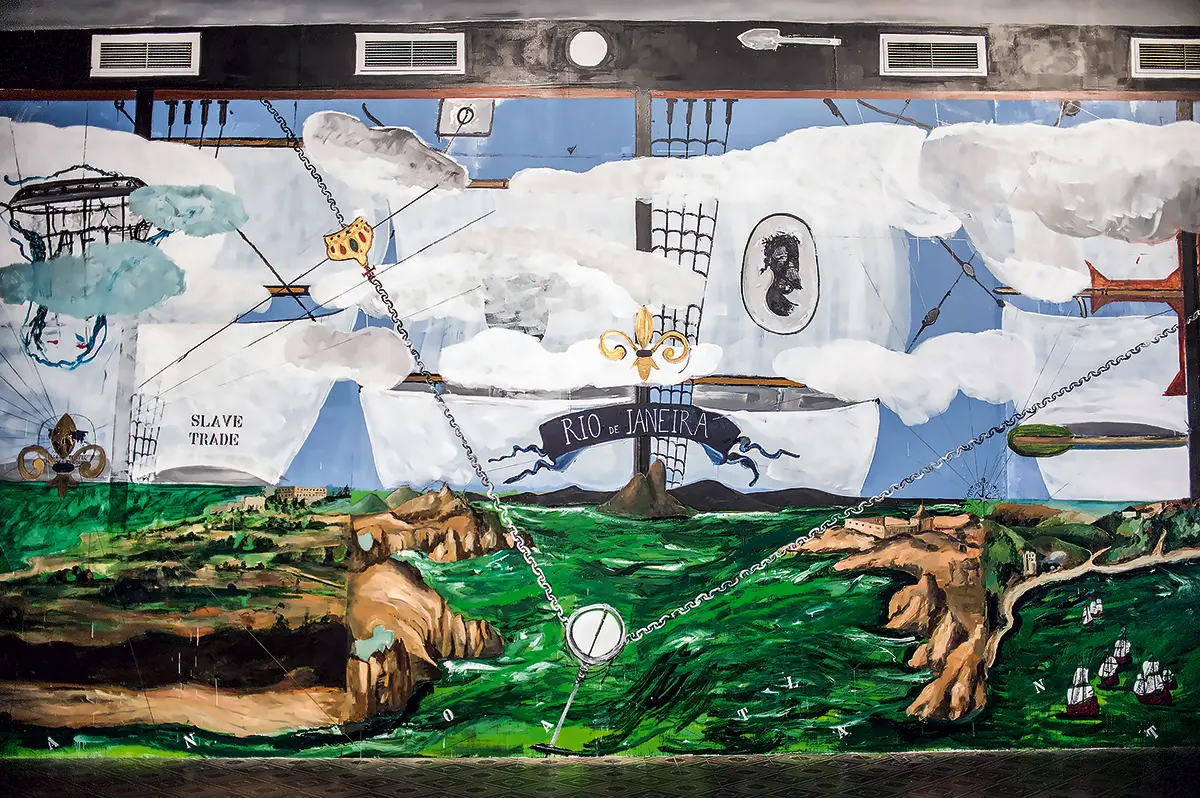
In considering the general topic, the work of Arjan Martins acquires particular relevance. Martins created a large panel with a cartographic approach to bring up the subject of slave ships and their dramatic passage through the Atlantic, from Western Africa to the Americas. This artist has previously produced murals that foreground images connected to black consciousness, ethnic identity, and the refugee issue.
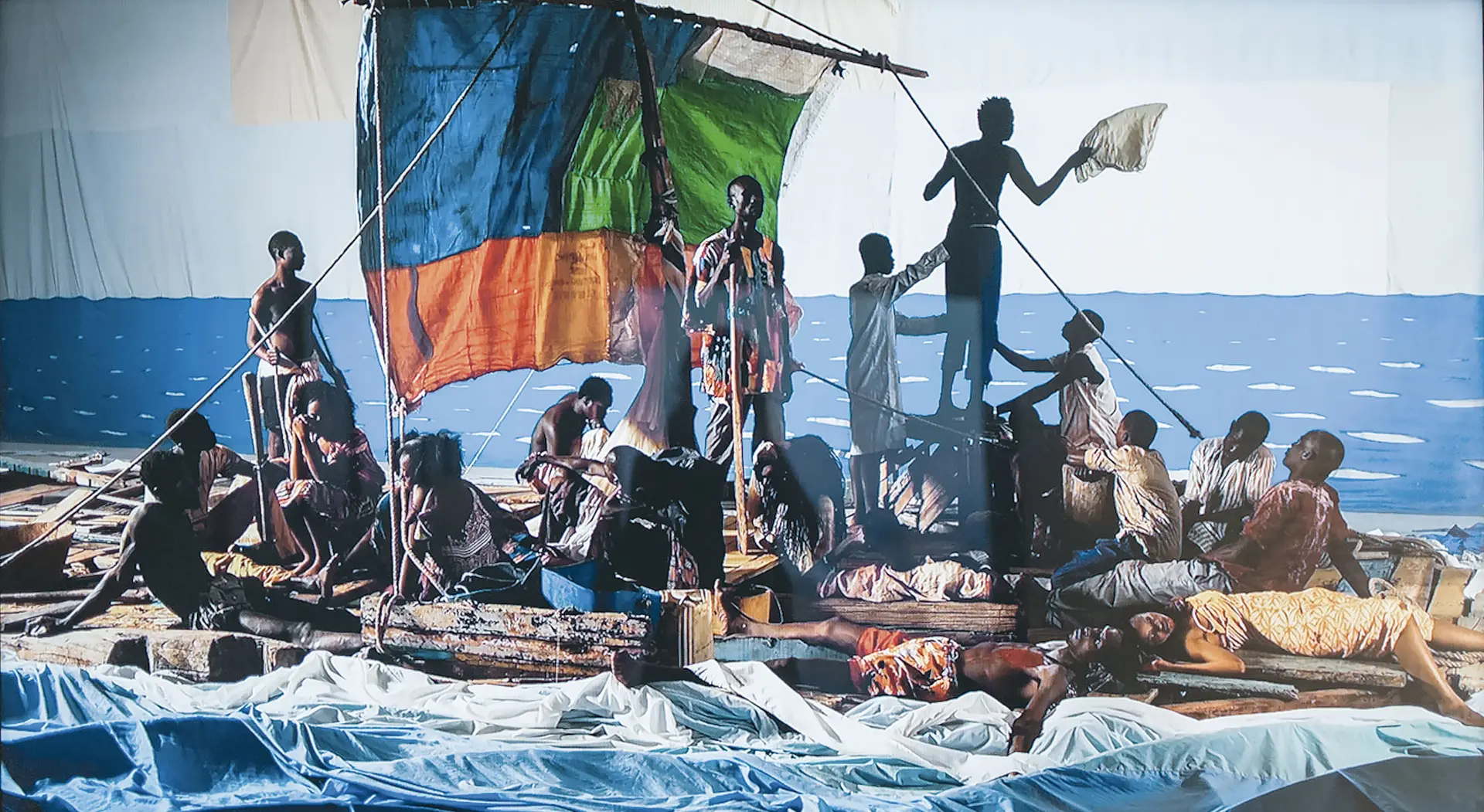
The subject of the crossing of the Atlantic is also present in the work of Adad Hannah, an artist who has had the experience of living in the midst of different cultures, from his childhood in Israel and his current residence (since the 1980s) in Vancouver, Canada. Hannah presented The Raft of the Medusa (Saint-Louis), a video that proposes a dialectical engagement with Géricault’s painting of the same title, now in the Louvre collection and originally submitted to the 1819 Salon. Gericault’s painting caused a profound impact in its era by illustrating the suffering caused by a shipwreck off the coast of Senegal and generated critical reactions that compared that accident with the political situation in France at the time.
Adad Hannah’s project began with a five-week residence in Saint-Louis, at the northern tip of coastal Senegal. Working with the local community, Hannah produced a theatrical representation of the famous shipwreck on a large sound stage. At the Biennial, his work came across as a “living painting.” There was also a photography version, and the project set both languages to interact with one another.
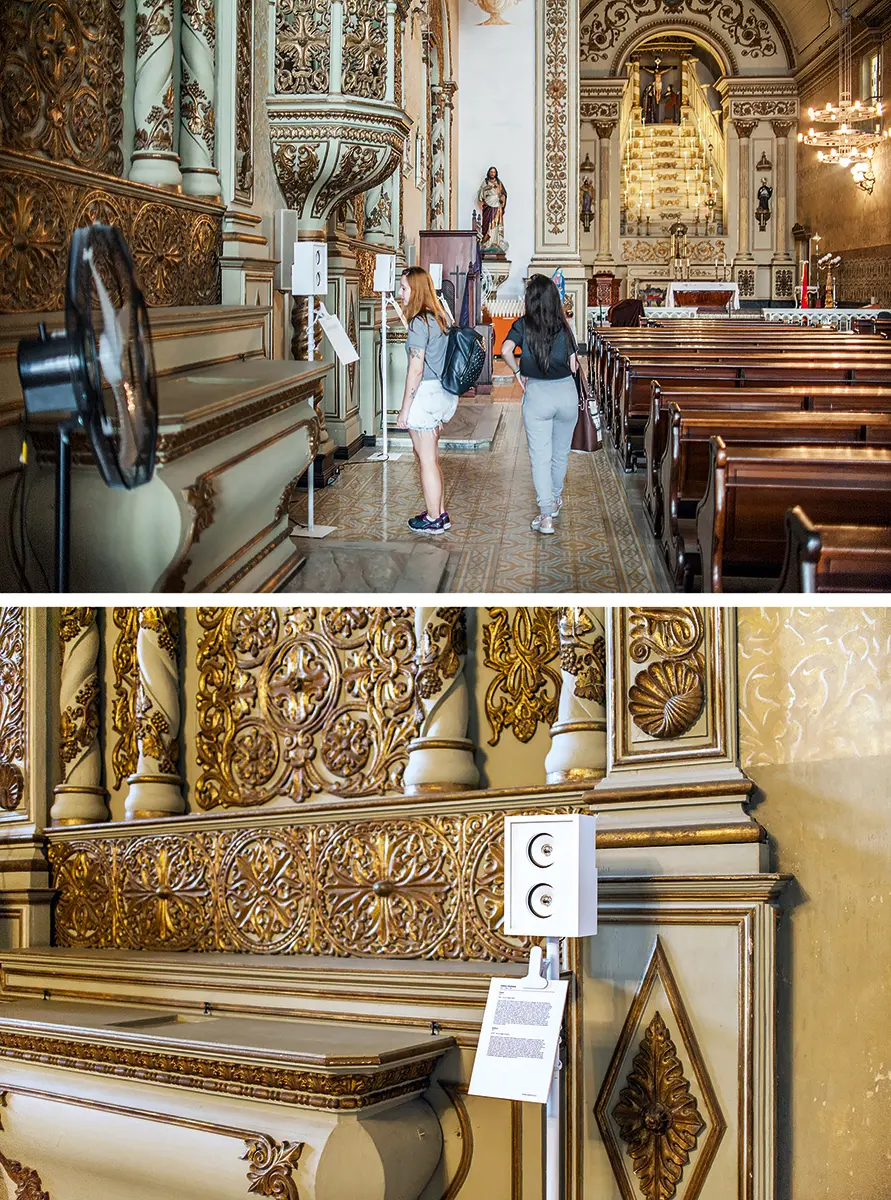
Another important, communicatively powerful work was the installation in the Nossa Senhora das Dores Church. As they entering the church, visitors heard, as Alfons Hug put it, “an undefined, polyphonic murmur, sounds that resemble those of group prayer. But as they came closer to the sound boxes, the different languages became more clearly distinguishable.” This work was based on speech in different American Indigenous and Nigerian languages, reproduced in unison to form a multifarious cultural tapestry that was highly representative of the heterogeneity that defines indigenous and African societies. For this segment of the exhibition, the curators chose language as their criterion, not only in terms of the historical and cultural importance of a language and its associated ethnic groups but also in terms of their risk of extinction and their aesthetic appeal.
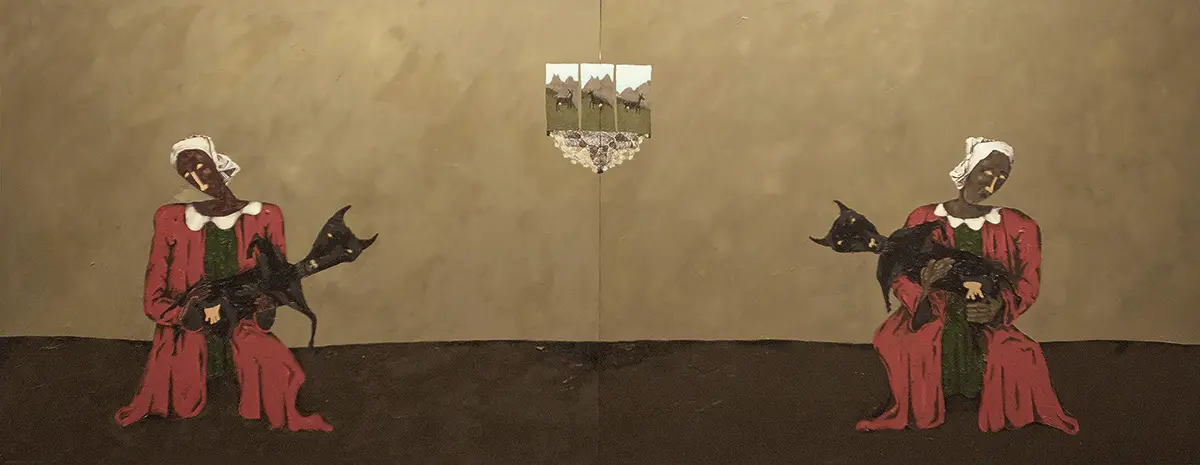
Participating in the context of The Atlantic Triangle, Dalton Paula reaffirmed the imprint of omnipresent temporalities in the imagination of Afro-Brazilian populations. His Sem título (Untitled) echoes a debate that has occupied his recent visual explorations. Giving a different meaning to painting, the technique that accompanies him and has defined the character of his creations, the large-format image depicting two black female figures—two black effigies—arranged symmetrically at each end of the scene, has as its background a landscape that at the same time separates and brings together two worlds: remote past and current reality.
Brasilia-born Dalton Paula, a young artist belonging to a prominent generation in the contemporary scene, has gained a place in the debate about negritude in the country’s exhibition circuit. Paula’s noted presence in the Histórias Mestiças (Mestizo Histories) group exhibition held at the Tomie Ohtake Institute in 2014 and his participation at the 32nd São Paulo Biennial—as part of the main exhibit curated by Júlia Rebouças—in 2016 established his poetic investigation. Recently he took part in the group exhibition Agora somos todxs negrxs? (Are we All Black Now?), promoted by the Video Brasil Cultural Association, in the context of a visual panorama expanded with the critical creations of Afro-Brazilian artists, curated by artist Daniel Lima.
Juliana Stein has carried out a surgically precise investigation about the context and the process of a photographic work that reveals (and at the same time, veils) its intentions as the record of an unfinished time. A young artist of international projection, Stein has participated in important events across the art system. She was included in the project of Latin American representation at the 54th Venice Biennale, titled Between Always and Never, and curated by Alfons Hug for the Italo-Latin American Pavilion, in 2011.
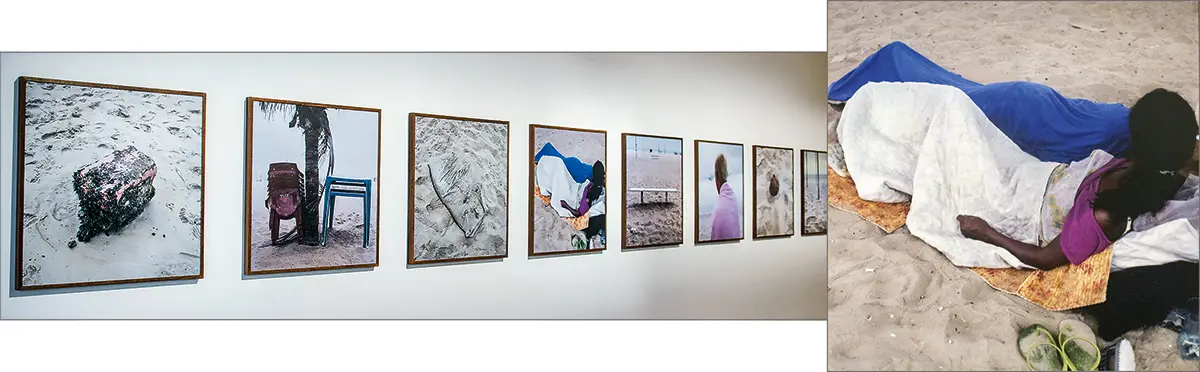
Attentive to her environment and interested in the symbolic dimension of the image, Stein has given her photographic series a specific reality and conceptual existence. At this edition of the Mercosur Biennial, in accordance with the exhibition’s general theme, she presented Antropologia da Água (Anthropology of Water), part of a series of the same title. There, her gaze captures the gaps and doubts present in a common, everyday beach scene. Each framing establishes a version of a scene that can be the interpretation of a single photographic art understood as a blind attack towards an unknown environment.
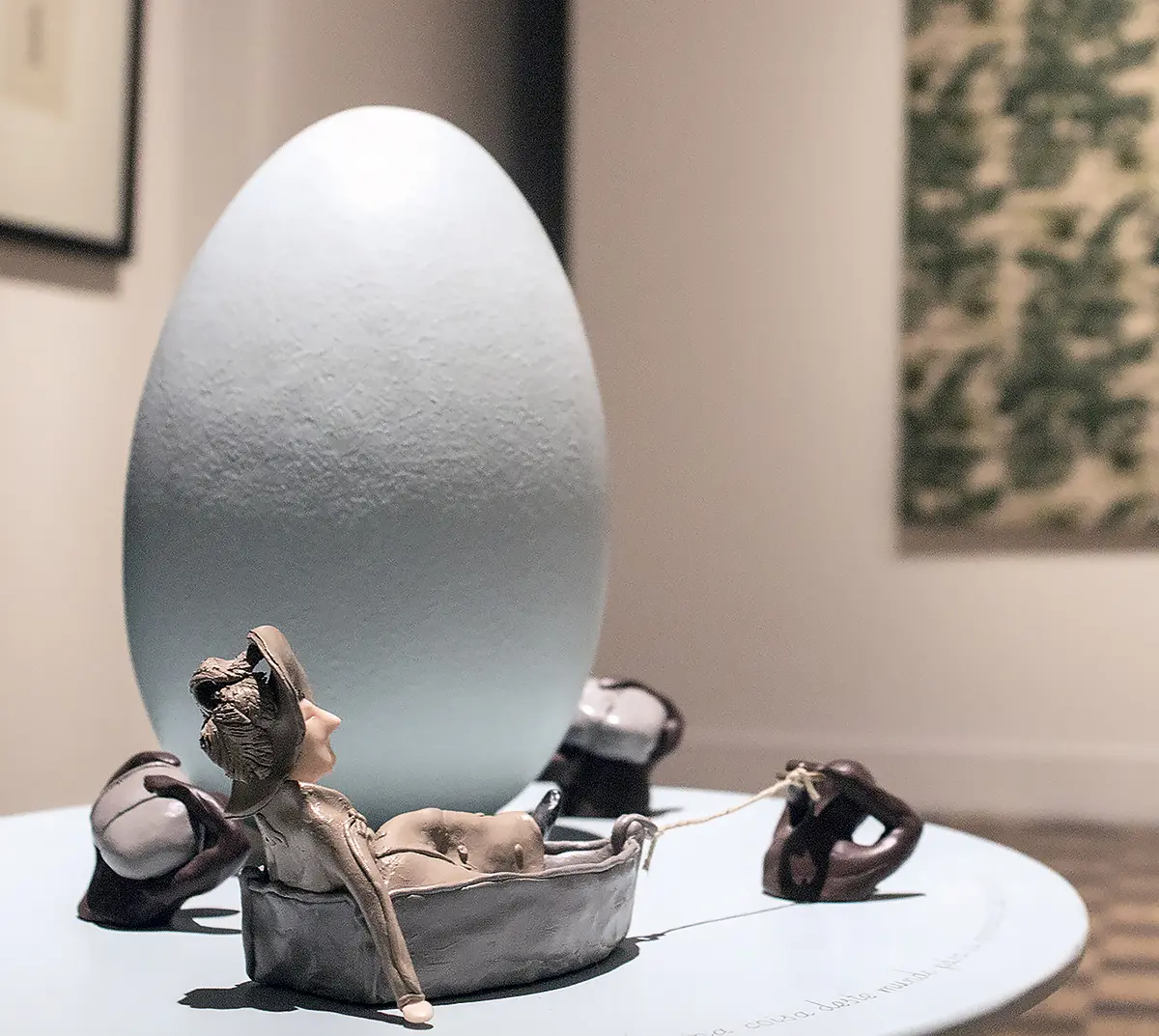
The composition of É nos sonhos que tudo começa (It Is In Dreams That It All Begins), by Portuguese artist Vasco Araújo, engages a field of research that has accompanied the firm convictions of an artist who assumes the responsibility of being the author of “another version of events.” For the current edition, Araújo puts on display the conscience and construction of a provocatively lucid narrative about colonization that, while acknowledging the dynamic of cultural representations established in society, inverts the poles of a complex logic fueled by the coexistence of sculpture and literature.
Araújo’s mise-én-scene reestablishes points of a reading of the past anchored on the colonizer-colonized relationship, which prompts thought and demands attention for the urgency of the critical posture that the artist, wholly committed to the present, imbues it with vis-à-vis contemporary realities.
Mark Formanek’s installation, Standard Time, presented the subject of time in its relative dimension, emphasizing how it can be experienced in a different way and with varying intensities. The work of this German artist is a critique of the human mode of using time, and it focuses on how it can be shifted in its particulars. Formanek’s installation was in a central urban space, Porto Alegre’s Praça da Alfândega, and involved a group of people that updated a giant clock by hand. From Friday through Sunday, this group of people acted in a performative way. Each minute, the operators change the 4-meter tall numbers to mark the passage of time, in the representation of a hard effort to fulfill an obligation that was ultimately absurd. Two teams took turns to carry out this task, from 9 a.m. to 7 p.m., on the days the work was activated.
The 11th Mercosur Biennial brought together 76 artists from countries in the three continents that form the Triangle, presenting its public with a dense and complex narrative that defies interpretation. There was also a relevant educational program, as has been the case with every edition of the Biennial.
LISBETH REBOLLO GONÇALVES
Professor, Universidade de São Paulo. President, International Association of Art Critics.