The artist’s keenness of sight and his uniquely personal interpretation of history are on display in this exhibition at Xippas gallery. In recent years, the work of Waltercio Caldas (1946, Río de Janeiro) has expressed the conceptual complexity of the history of Concrete art in Brazil, his country of origin. The aesthetics of these “constructions” lend themselves to the sobriety of the gallery space; they seem to have been made specifically for the site where they are situated. The atmosphere is sober, yet the style is not exempt from sensibility and courage. For the viewer, the result is a surprising effect of very real contemporariness. The ten works on exhibit absorb our curiosity, move us towards questioning, and prompt us to reflect. A note of humor is added to the selection and the encounter with matter: threads, letters, and other transportable or modulated accessories.
We could start by stating that there is in Caldas’ art a unique way of inventing new conceptualism by means of pure forms that define and redefine shapes in Space. Be it because of the light that outlines his itinerary between subtle materials or the virtual character of the reflections. Surrounded in his youth by the main representatives of Brazilian art and art theory, Waltercio Caldas participated in the trying efforts to assert abstract art as a form of freedom. A self-taught artist at first, he began as a viewer. He attempted to reinterpret works of art in the way he would have made it and to understand the problems artists had encountered to overcome a tragic political situation. “It is not only a matter of making works of art but also of creating conditions or it. To that end, an experimental room had been set up at the Museu de Arte Moderna in Rio de Janeiro. Everything that was done was a conquest: it was a possibility that was created time after time. We were alternative because we had no alternative (…) From very early on I opted to create drawings that were not drawings, paintings that were not paintings (…) I do not classify myself. It is others who classify me,” says the artist, reasserting his will to break the borders between these disciplines. This involves cultural resistance; a cultural struggle was established to preserve the artistic language and to prevent the work of art from being censored. “To express freedom. Art was a work dynamic rather than a craft. There is also some coincidence with the work of Oiticica. And we could use a statement by Mario Pedroza as an example: ‘Art is an experimental exercise of freedom’.”
Neo-Concrete art began in the 1950s, the product of Brazil’s great industrial expansion and its launch into modernity. As many different tendencies came together on the landscape of Brazilian abstract art, a new aesthetic radicalism had emerged. Since the 1920s, Brazilian art had a language of its own, and under changing circumstances that language was producing a forceful artistic movement that not only achieved durability but also continues to give value to its practitioners. Minimalism was to have a sensual and subtle counterpart. The playful possibilities and subtle transformations that objects could undergo when subjected to the viewer experience provide some guidelines. But these do not correspond to closed or dogmatic definitions. “The intent is to create authorship of art, a poetics that connects objects. I am interested above all in transparency as the key issue (…) Art is a possibility of constant estrangement attached to aesthetic dynamics,” the artist says.
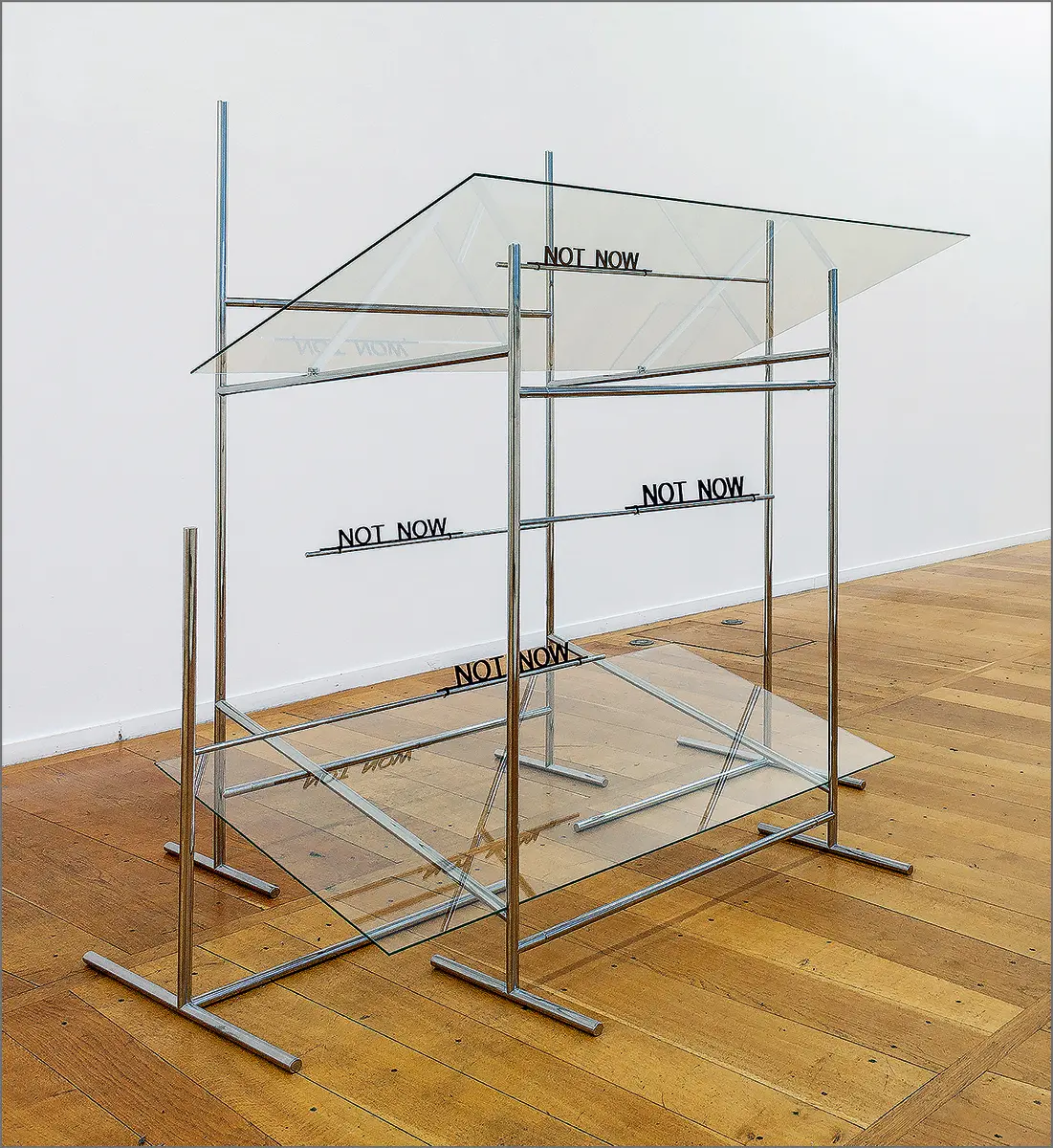
The use of the transparency of ideas took Caldas to form, as in Not Now (2014). This work prompts the discovery of a new here and now. A paradox of the visible-invisible, immateriality, and opacity. This is how Caldas’ experience situates him as a countercurrent to the era, an artist who assumed the contradictions of his time. In his way, he achieves virtuality of language and of appearance in order to synthesize new logical contents. A unique fully admitted way of functioning in history.
Caldas studied with Ivan Serpa, and his first solo exhibition was held at the Museu de Arte Moderna in Rio de Janeiro in 1973. He represented Brazil at the 47th Venice Biennale, in 1997, and participated in the Italian event’s 52nd edition, in 2007, as well as in the 1992 documenta in Kassel and the 5th Mercosur Biennial in 2005. The São Paulo Biennial was a landmark in his career, as was his participation alongside such artists as Picasso, Morandi, Max Bill, and Hélio Oiticica. Caldas has exhibited at prestigious institutions like the Stedelijk Museum (Schiedam, The Netherlands,1992), the Calouste Gulbenkian Foundation (Lisbon, Portugal, 2008), the Blanton Museum of Art (Austin, Texas, USA, 2013), and the Pinacoteca do Estado de São Paulo (Brazil, 2013). His work is part of the collections of the Centre Georges Pompidou in Paris, the Museum of Modern Art in New York, the National Gallery of Art in Washington D.C., the Museu de Arte Moderna in São Paulo, and the Museu de Arte Moderna in Río de Janeiro, among others.
SUSANA SULIC