The exhibition Waldo Balart: Propositions on Color, Rhythm, and Light, organized in collaboration with New York’s Henrique Faría Gallery, was in view at Miami Biennale in October and November of 2017. The show featured paintings, works on paper, sculptures, and one “light sculpture,” all from the 1970s and 80s, that brought into high relief Balart’s concerns with color, order, planes, light, and space.
Waldo Balart is an iconic name in abstract art in the Cuban exile. Born in 1931 in the small town of Banes, Cuba, after high school he wanted to study architecture, but lacking the required financial resources he went into accounting, a profession he practiced alongside his work as an amateur painter. Balart emigrated to the United States as the revolution led by Fidel Castro was coming into power in 1959, settling in New York City. There, he studied at the Museum of Modern Art (MoMA) and in the 1960s became part of an artistic and intellectual milieu that included Argentinean artist Alejandro Puente as well as Sol Lewitt, Mark di Suvero, and Andy Warhol. Warhol’s irreverent personality was a forceful influence on Balart, who was, however, already interested in an art unconnected to references in reality. His approach to geometric abstraction developed when he studied under Josef Albers at Princeton, where he had his first contacts with the aesthetic of the Bauhaus school. But it was Balart’s study of the work of Kazimir Malevich and Piet Mondrian that defined his engagement with geometric abstract art, which understood pure form as a way to access the realms of the spiritual and the transcendent.
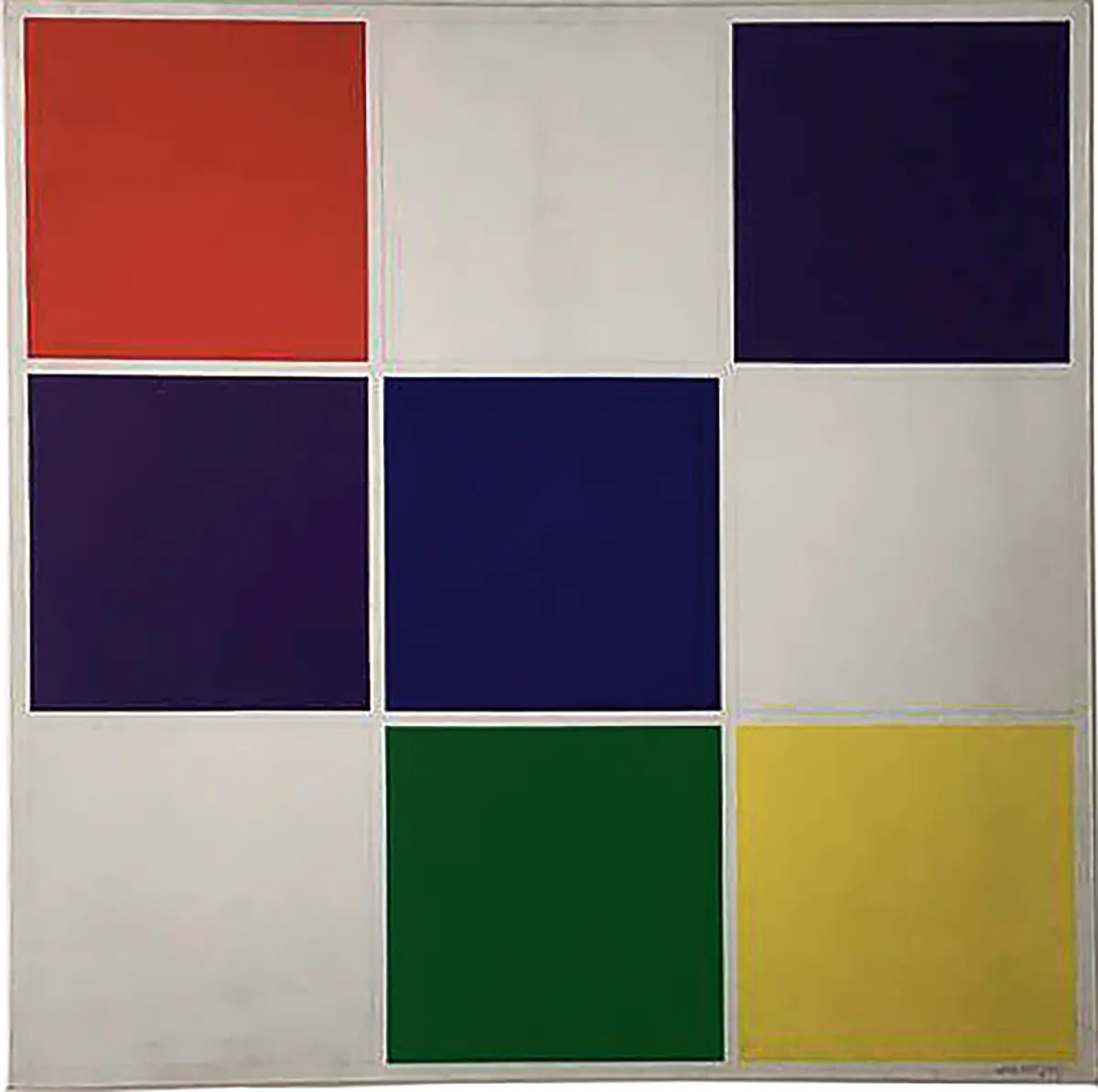
Waldo Balart’s aesthetic proposal inscribes itself in the framework of Concrete art, where the elements of visual expression are engaged from a standpoint of formal asceticism—flat colors and orthogonal grids, for example—in order to prompt their autonomous pictorial valuation. Hewing closely to the tenets of the historical abstract art avant-garde (constructivism, Bauhaus, suprematism, neoplasticism, among others), Balart sought to develop a language that moved away from the representational and staked his essential elements on visual creation. Nevertheless, his poetics give preeminence to perceptual autonomy, freeing his viewers to connect with the forms rather than directing the contents that are to be derived from the contemplation of his work.
For Balart, light, as the sum and origin of the entire color spectrum, is a key element not only from a formal perspective but also because of its transcendent connotations. His Escultura de luz (Light Sculpture, 1980-2002), featured in this exhibition, gives testament to this. It is an interactive sculpture that recreates the inverse process of the nature of light. Balart arranges three light bulbs in primary colors at the vertices of a metal triangle. As these overlapping lights are projected at the same time on a single wall, a white beam forms. The sculpture is produced as a person or an object that comes between the light sources and their projection.
Balart’s exploration of abstract forms and color systems drove him to create works in which colors behave like notes in a musical score, suggesting rhythms and melodies by virtue of their composition. The works in the series Proposiciones (Propositions) are based on what for the artist is the “intellectual” nucleus of his entire oeuvre: the “structural code of light” he refers to by its Spanish acronym, “CEL”. It is a system of numerical coding based on the eight colors into which white light breaks down and the axiomatic sequence that they originally possessed. From this ordering, principle Balart derives the combinations that are to give shape to his paintings or sculptures. For him, this organization of the components of light by means of their systematization opens up an infinite series of rigorous creative possibilities. Its artistic dimension is nevertheless inscribed in an activist humanism in which Balart assumes, in his own words, “an ethical commitment to life through aesthetics, where rigor and discipline provide the form while structure and color provide the element of fantasy.”
The belatedness of the recognition gained by Balart’s work is due in part to the silencing imposed for many years upon Cuban artists not living in the Island, and in part to the lack of interest in Twentieth Century Cuban abstract art. Today, however, his explorations and his work are better understood and valued in the context of the multifarious proposals of Latin American geometric abstraction.
KATHERINE CHACÓN