Vik Muniz, who resettled in New York City more than thirty years ago, is one of the most recognized Brazilian artists on the international scene. He began to gain recognition in the 1980s mainly on the strength of compositions using uncommon materials often thought of as not “noble”, such as sugar, catsup, and even dust, which Muniz photographs and exhibits with titles that make reference to the substance used, almost always perishable. This nominative expedient ultimately dispels any doubt about what we are seeing, revealing the transfer of the images as they are created: from photography to their reconfiguration, and from their reconfiguration to a new photographic register of the resulting composition. At the center of Muniz poetics is an investigation of our perception of images, what is implied in memory, and the concepts we build on the basis of the visual culture to which we are exposed. What is original? What is copy? In this operation, Muniz deploys several techniques ranging from drawing to painting, photography, printmaking, and earthwork. This interplay between perception and artistic event produces an estrangement that is, according to Muniz, the axis of all interrogation and, as such, of the shaping of critical judgment not only with regards to art but also to life itself, to our everyday experiences and the ways in which we process them.
Handmade, Muniz’s solo exhibition at the Río location of Nara Roesler Gallery, was originally presented at the São Paulo site in 2016. The Río version, on view between November 2017 and February 2018, features new works specially produced for the occasion. These new additions possess a somewhat “Brechtian” character, where the process of manufacture is more in evidence even if the element of illusion insists on remaining in place, besieging the tenuous line that separates reality from representation. In her essay presenting the series, Luisa Duarte tells us that “Handmade retraces the artist’s sustained concern with transcending the symbolic dimensions of the image.” Differing from the works that made him renowned and celebrated, the images here are not from a pop-cultural universe, from the mass media, or from the history of art, reworked and given new meanings for Muniz as he did with Caravaggio’s Medusa transferred to spaghetti and sauce (Medusa marinara, 1988) or with the iconic visage of Marilyn Monroe (Marilyn Monroe, Pictures of Diamonds, 2004). This exhibition is entirely comprised of abstract works that require a different kind of engagement, more in tune with the materials as such and the techniques explored, without the establishment of a dialog with original images from other media and by other creators, appropriated by Muniz. These are compositions that bring Vik Muniz’s process into contact with other movements in the history of art; if his appropriations situated him in greater proximity to Pop Art, even as he retained manual techniques for the manipulation of his materials, now his exploration is more aligned with an investigation into pure form, into the Gestalt, with no reference to previously elaborated contexts. There is no way to establish a narrative line; on the contrary, what the audience can do is give itself to the appreciation of shapes, textures, colors, and shadows. There is a celebration of the present, of what was built at the moment of making art, and, once again, not of the viewer’s retinal perception.
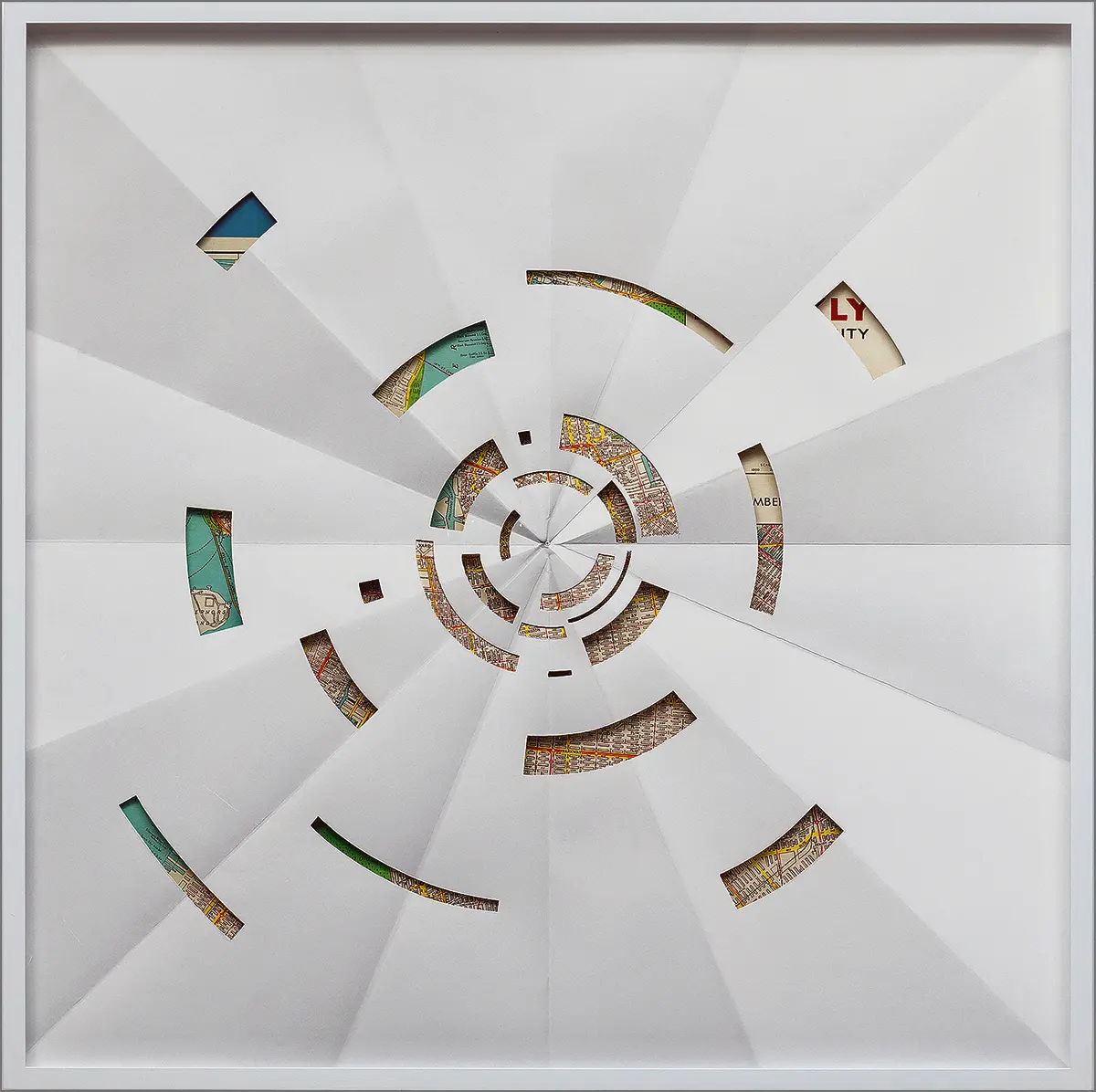
One salient element in most of the works on exhibit is the limpidness of their composition, using few elements and a degree of minimalism in the repetition of forms and the inclusion of the space around them, leaving it untouched yet participant. An example is Handmade: Sem título (yellow blue hashtag) [Handmade: Untitled (yellow blue hashtag)], from 2016. Here we find a conceptual play with an element that is becoming ubiquitous in our everyday lives, as we do in Handmade: Hung, also from 2016, which is just a frame, a piece of thread, and a nail. Would a single frame, hung outside the gallery, be considered a work of art? Here and there we also see reliefs, be it real or perceived, as in Handmade: Sem título (Radial Cuts Over Map), from 2017. Already in Handmade: Rabiscos (with Blue Circles) [Handmade: Scrawls (with Blue Circles)], from 2017, Muniz established a more sustained dialog with his previous production, in terms of the artisanal effort involved, as the resulting work displays the intricate lines he traced by hand. All the works in the exhibition use paper and inkjet printing, along with other procedures.
Another characteristic of this new period is the prevalence of geometric shapes, as well as the use of solid colors in layers. A few of the works include appropriated images, but their content is used in ways that differ sharply from those of Muniz’s previous practice. Handmade mostly represents this new phase of artistic exploration. It becomes obvious that a new impulse is emerging towards a pictorial vocabulary, coming—perhaps even with a reference to the modernist issue of the autonomy of the work of art—as a swerve in the artist’s career and a breath of fresh air.
SYLVIA WERNECK