For his latest exhibition at the Galerie Karsten Greve, Argentinean artist Sergio Vega (Buenos Aires, 1959) summoned the literature and figure of Jorge Luis Borges in order to approach aesthetic inquiries associated with memory and the gaze. In this third exhibition by Vega in Paris,1 he solidifies his presence in France. In fact, during the last edition of ParisPhoto, one of the videos included in the exhibition, Borges in the Alhambra (a Hypothesis of Blindness), was selected for screening at the Grand Palais in the context of a partnership with MK2 Films for the promotion of videos created by artists.
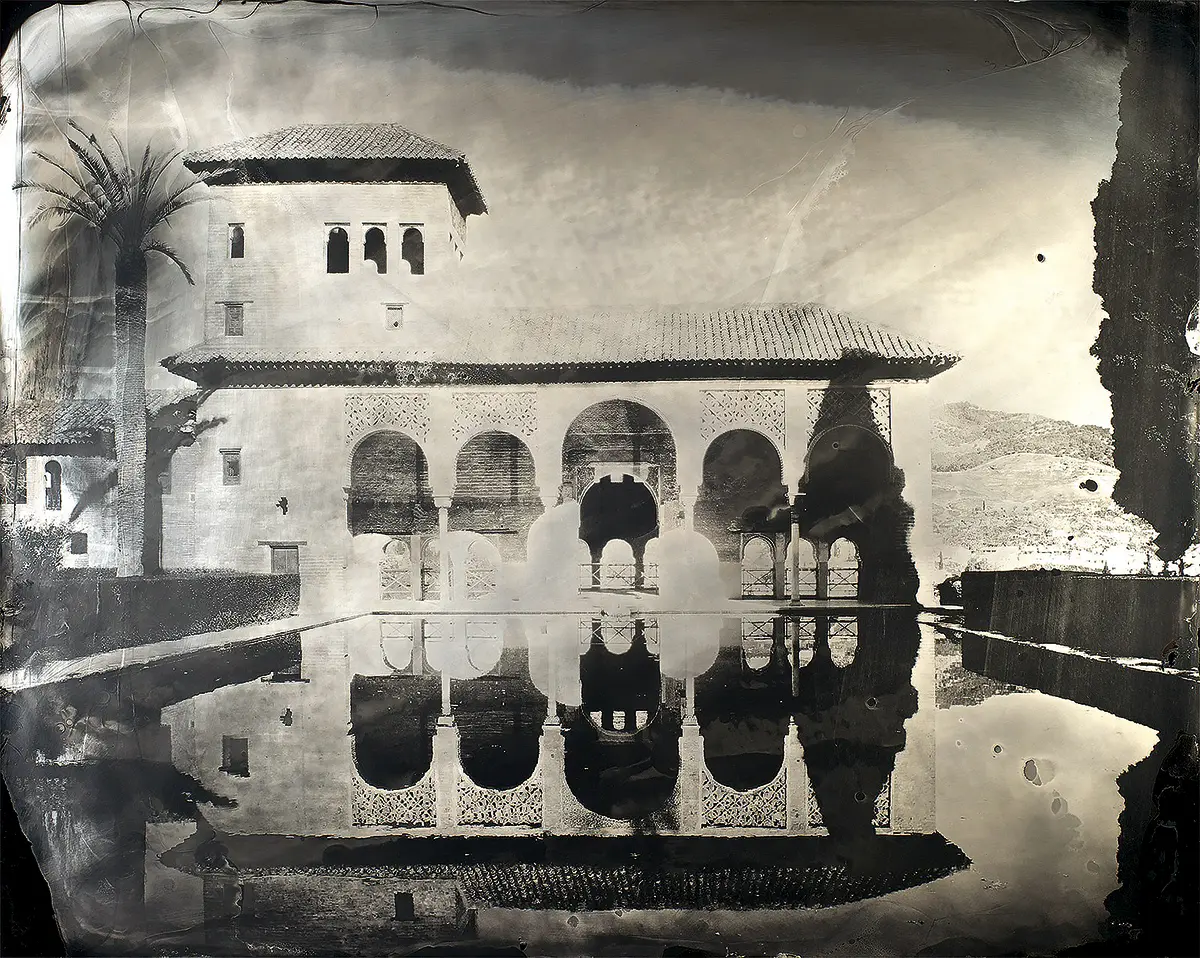
Titled Borges in the Alhambra, the exhibition consisted of twenty-two black and white photographs (40 × 50 cm each) and two videos. It offered a sensitive and refined visual and sound exploration aimed at retracing the steps of the Argentinean writer through a wisely selected artistic language, revisiting architectural spaces and gardens in order to aesthetically imagine his perception of the place during his last visit in 1976.
Built in the 14th century, the Alhambra has seduced writers and artists with its richly ornamental beauty and the musicality of gardens covered from edge to edge with fountains, ponds, and other bodies of water. Whether in Victor Hugo’s Les Orientales (The Orientals, 1829), Washington Irving’s Tales of the Alhambra (1832), or Gustave Doré’s illustrations (from around 1860), the magic of the place described by most of the creators that have seen it continues to inspire the same fascination. Borges visited the Alhambra on two occasions, the first, in 1918, at the age of 18, and the second, in 1976, when he was already blind. It was Borges’s wife, María Kodama, who described to him the magnificence of the Alhambra’s architecture and decorative motifs. Through her eyes, Borges was able to “see,” as he regarded his own blindness as “modest” for it only allowed him a vision of the world veiled by a yellow film cast over a subtly greenish background; a sort of “reality” sometimes tinted with gold. The poem Alhambra was born from the singular experience of relying only on the voices of other persons (his wife’s and those of other visitors) and sounds (birds singing and the sound of water), invoking memories of the writer’s distant past that forged his perceptive imagination and developed a “phantasmatic,” chimeric, and poetic vision of the Alhambra.
It was based on this trip by the writer of the closed eyes that Sergio Vega, inspired by an aesthetic, literary, and, why not, also anthropological, curiosity, and convinced by the extraordinary warning offered by Mexican poet Francisco de Icaza—written on a stone plate by the entrance of the Alhambra that reads: “Give him alms, woman because there is nothing worse in life than to be blind in Granada”—decided to reflect on the construction of an imaginary memory to explore the echoes of a nostalgia tested by time and, above all, by blindness. For this purpose, Vega chose to use a photographic technique from 1852, the ferrotype, which consists of spreading collodion, a chemical solution, on a photosensitive metal plate. Upon contact with light, the image is forever fixed. The aluminum plate conserves traces, spills, haloes, and stains from the expanded liquid, which confers the image a washed-out quality, sometimes even translucent, mysterious and evanescent, insofar as the images observed are no longer black and white photographs but rather shades of gray and silver and a veiled white that generate subtle and velvety light and shadow interactions.
Sergio Vega reclaims the Alhambra of times past, frozen in a former empty and secret magnificence of which nothing remains except for the motifs on the calligraphed walls, the Kufic or cursive calligraphy, and the poems written by three poets from Granada to the glory of the sultan. Through this labyrinthine trajectory, absence suddenly becomes a presence, the furtive presence of memory and of visual memory, the presence of sounds, smells, and voices; the presence of Borges and, through him, a writer’s sensitive and tactile perception. In this manner, we wander alongside Sergio Vega through this nearly ethereal Alhambra barely caressed in some places by streams of light. We go from semi-darkness to blinding brightness, as we walk through narrow doors and admire domes full of low reliefs; we become immersed in soft contrasts and forget time. Two videos accompany the photographic work. In Borges in the Alhambra (a Hypothesis of Blindness), 11:46 minutes long, Vega ventures into the last visit of the blind writer to Granada by way of a visual sensorial experience. The wandering barely succeeds in discerning a few architectural forms; the yellowing background is pierced by pale lighting flashes and a sound background made of voices that from time to time accompany visitors. The second video, titled Un Ciego en Granada (A Blind Man in Granada), 28:02 minutes long, reconstructs the visit that led to the creation of Borges’s poem while we walk through the halls and gardens of the palace with the help of the author’s quotes. The walk occurs to the beat of themes that follow one another, describing the palace as the story is narrated; addressing the meaning of the ornaments on the walls that reproduce verses of the Koran, the joyful presence of water, and, lastly, the beauty of the place. The movie ends with a reading of Borges’s poem Alhambra by María Kodama. It is in this manner that the exhibition comes full circle. While the show allowed visitors to go back in time, there is no doubt whatsoever that Sergio Vega created a sensorial and imaginary journey that Borges would not have shunned.
NOTE
1. Karsten Greve, 2013 and 2015.
CHRISTINE FRÉROT