With the curatorship of Ramón Castillo and the collaboration of the Universidad Diego Portales, Isabel Aninat presented the audiovisual work titled Verás un Dios de Hambre, (You Will See a God of Hunger, 2017) by Chilean poet Raúl Zurita (Santiago, 1950), winner of Chile’s National Prize for Literature in 2000.
Isabel Aninat is a prominent gallerist with a prestigious 35-year career in the national and international art world. Raúl Zurita is one of the artists represented by the Galería Isabel Aninat.
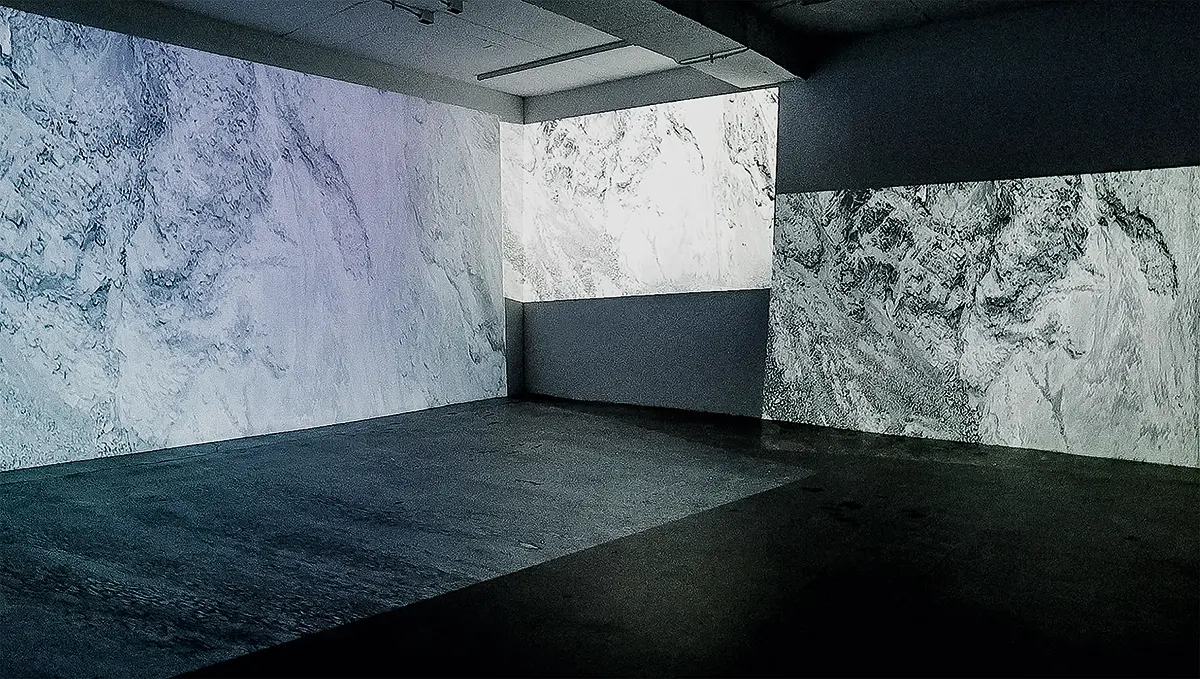
On this occasion, the audiovisual work presented by Zurita represents the development of a major project that includes—along with other images projected over cliffs, from a perspective that can only come from the water—twenty-two phrases of a poem recited by Zurita that address the life experiences of a person. In this manner, Zurita concludes the dialog with the landscapes as he metaphors his own end.
Zurita developed the conception, elaboration, and direction of the audiovisual project. It was produced by filmmaker and writer José “Pepe” Torres: “We traveled on a navy ship and then by helicopter to get there. Several dangerous maneuvers were needed to find the location chosen by Zurita and to capture the images,” said the producer of the Arts and Letters section of El Mercurio periodical.
The audiovisual work exhibited represents a draft for a monumental work that will become part of a trilogy. The first piece is titled La Vida Nueva (The New Life) and the second Ni Pena ni Miedo (Neither Sorrow nor Fear). The third part will be titled Y Verás un Mar de Piedras (And You Will See an Ocean of Stones).
In the 2012 edition of Chile’s International Contemporary Art Fair, Ch.ACO, Zurita presented La Vida Nueva. Ethereal like a vapor, its writing required flying over the New York sky five times on June 2, 1982. This work was purchased by the Fundación de Artes Visuales Asociados (FAVA), during the 2017 edition of Ch.ACO, and donated to the Guggenheim Museum in New York.
This third piece has been under development for many years and was conceived in 2002. It occurred to Zurita while he was flying over the northern coast of Chile. About this, the poet said the following: “I immediately imagined a poem written over the cliffs that could only be seen from the ocean and that represented what a human being sees during his stay on Earth, all the way to the end of his life.”
In a November 2012 interview with journalist León Álamos, Zurita talked about the endeavor of writing on cliffs formations in the north of Chile, between Pisagua and Iquique, the twenty-two phrases contained in his Diálogo de Chile (Dialog of Chile), a poem that is part of the book titled Zurita (Ediciones Universidad Diego Portales, 2011).
The poem is clearly representative of Zurita’s work because of the translucency of emotions that emanate from a critical moment.
Dialog of Chile
You will see an ocean of stones
You will see daisies in the sea
You will see a God of hunger
You will see hunger
You will see figures like flowers
You will see a desert
You will see the ocean in the desert
You will see your hate
You will see a country of thirst
You will see cliffs of water
You will see names on the run
You will see thirst
You will see loves on the run
You will see little love
You will see flowers like stones
You will see her eyes on the run
You will see mountain peaks
You will see daisies on the mountain peaks
You will see a white day
You will see it leaving
You will see not seeing
And you will cry
Zurita continuously resorts to the geography of Chile in his poems. His poetry is bounded to the landscape; he repeatedly makes nature talk about a relentless sorrow drawn from personal experiences as well as from the experiences of hundreds of Chileans who for many years were subjected to prosecution, torture, disappearances, and death.
Framed by that context, Diálogo de Chile shows a way to the beyond. It is the story of a person who gradually dies but does not want to die from crying. When everything ends, the sound of the ocean is all that will remain.
About this work, Zurita said: “A while back, I understood that [this work] represented the image of my own death, that it was my last project. Like it occurs in a film, the last scene is not necessarily the last one to be filmed. But I know that this is the end.” And adds: “If my life has been the source material for my work, then the images of my death should also be part of it.”
ERNESTO MUÑOZ