The temptation is always present, in the first instance, to connect—from the experience of a national imaginary—the themes and protagonists that inhabit (the metaphor is treacherous but necessary) the work of Chilean photographer Paz Errázuriz and the work of several of her Mexican colleagues, among which I highlight Maya Goded and Lourdes Grobet, to a large degree because they have—like Errázuriz—devoted themselves (and dared) to portray marginal groups in border zones, as an act that, beyond its element of denunciation, is coming closer, and as such, a humanization, breaking with beautism of the exotic that—regardless of its importance—establishes itself as a commonplace that is comfortable for being familiar. There is no possible comfort to be found in the images captured by Paz Errázuriz in almost forty years of activity devoted to displaying the everyday life of individuals living outside of social conventions, be it out of necessity, because of their political inclinations, for their sexual preferences, or for their disability.
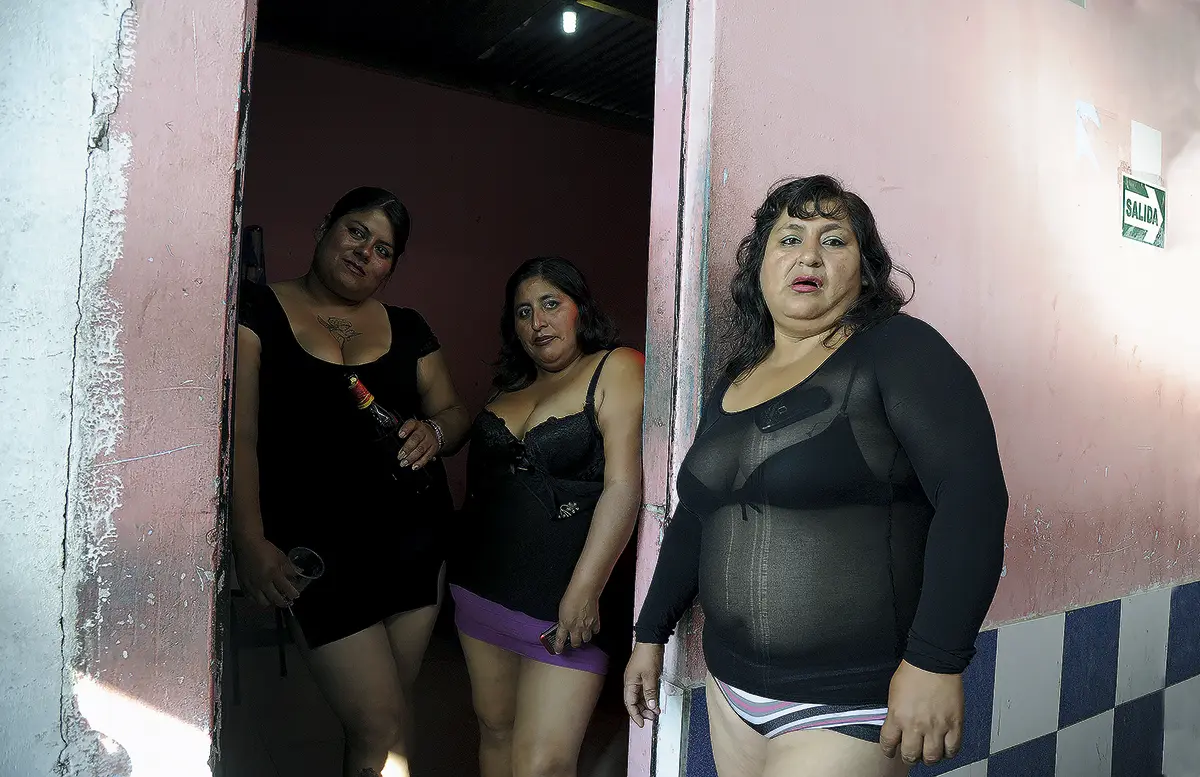
Errázuriz describes her work as a private, intimate pursuit: she carries out the entire process, which is why she has always preferred the use of black and white film. The camera becomes an extension of her gaze and her life, the public and the private alternate in quick succession, ineffable, trapped in a hand-to-mouth time that can be mischievously subjected to ellipsis at the contact sheet stage and has come to define her work as much as her life. As she confessed to Denisse Espinoza of the CULTO web portal: “In a contact sheet is the stuff about AFI [the Asociación de Fotógrafos Independientes, which Errázuriz helped launch in Chile in 1981], the protests, and the last two shots are from your little grandmother’s birthday.” Despite her preference for black-and-white work, there are—albeit rarely—color photographs in her oeuvre (as can be seen in the series La manzana de Adán [Adam’s Apple], which she put together based on the portraits of transvestite prostitutes she took in her visits to “red districts” in 1980s Chile). Errázuriz included these color photographs because when they were made, due to the demands of speed and immediacy, she had no black and white film on hand. And even despite the lab process involved in these images, there in them a patina that refers to the artisanal process that she has tried to bring into her oeuvre.
Paz Errázuriz is always after the precise moment to capture, on the fly, the gesture, the light, or the elements that will define the narratives that, beyond the mere document, overlap with the images in which compassion is sublimated that is always present in the denuding or revealing (so violent, yet filled with such tenderness) of these (and other) world and their inhabitants. Something that the photographer describes as silence, in reference to the inherent muteness of her images but also to an implicit gag rule, as subjugation or imposition on the experiences lived under the dictatorship (a silencing that even today seems in consonance with the neoliberal paradox that has ravaged Latin America and continues to play as ambient noise throughout the region). Even son, seen or revealed, it shares with the viewer the complicity and the validation that connects the photographer and her models, beyond any ideological agenda. In Errázuriz’s own words: “There are many silent pacts that one cannot betray.”
The series La manzana de Adán was acquired in its entirety by the Chilean collector Juan Yarur, who brought it to London; the series exhibition at Saatchi Gallery had such impact that in the end, the collector donated it to the Tate Modern, of whose Latin American Acquisitions Committee he was a member. The series was the basis for a book featuring, alongside the images, testimonies, and interviews made by Claudia Donoso, who accompanied the photographer in her visits to bordellos; having become a cult object, the book has been reissued with a number of additions that revise and celebrate the social, aesthetic, and political relevance of the series.
In the context of the Second FotoMéxico International Festival, Museo Amparo presented, with the support of Mapfre, a retrospective featuring more than 100 works between photographs, videos, and documents organized chronologically around several thematic nuclei: Agents and spaces of social evolution; The ages of life (and Death); Reclusion, struggle, ad resistance; Exeresis; The disappearance of an ethnic group; Strength and weakness; Obstacles to the gaze; The circus; and Sex, instrument for survival. It was curated by Errázuriz and (responsible in great measure alongside Gerardo Mosquera and Andrea Giunta, of the photographer’s international projection in the last twenty years).
Cenfoto’s Andrea Aguad is cataloging Paz Errázuriz’s archive, which holds more than 100,000 photographs where—because of the immediacy demanded by the image or the circumstance—the public and the private are scrambled into a single mixture.
RICARDO POHLENZ