The theft of masterpieces from important museums and private collections has always been news. Among the most famous paintings that have been stolen and then recovered are The Scream (1893) by Edvard Munch and the Mona Lisa (1503-1506) by Leonardo da Vinci. The latter served as inspiration for the screenplay of the film The Picasso Gang (2012) by Fernando Colombo, based on the true story of the theft of the Gioconda from the Louvre Museum, in 1911, and for which the writer Guillaume Apollinaire and the artist Pablo Picasso were interrogated like suspects.
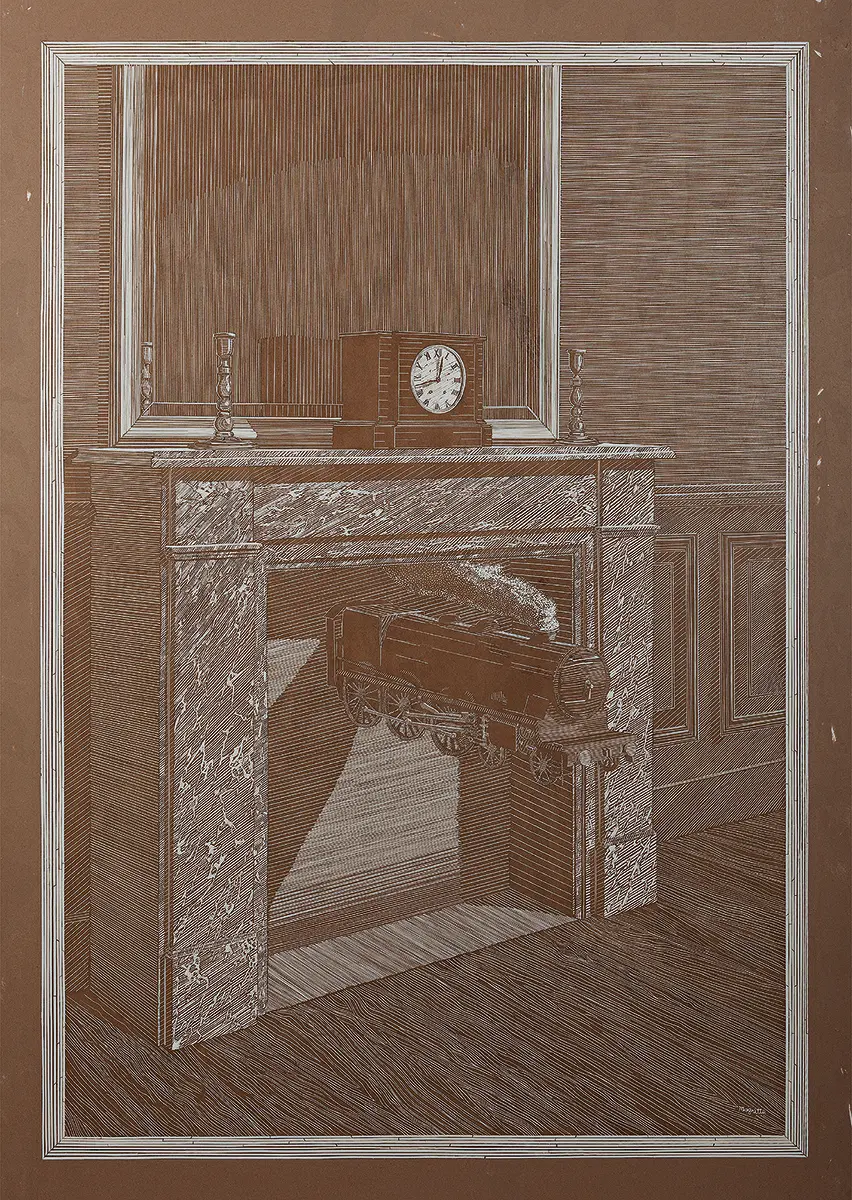
If Pavel Acosta had lived at that time, perhaps he would have also been under the detectives’ magnifying glass. After all, stealing is the core of his work. What more evidence than to include in his most recent exhibition precisely those two paintings? They may not be the originals, but they are detailed copies of these and other masterpieces he makes using techniques he has developed, gluing pieces of acrylic wall paint on plasterboards or delicately applying ink on paper.
The nine pieces included in the exhibition Pavel Acosta: New Paintings and Works on Paper correspond to reproductions of famous paintings belonging to museums in the United States and Europe. In each of the labels he includes the name of the institution to which the original painting belongs to and, with a sharp sense of humor, he identifies his own works as “stolen from”. He also places a QR code that allows the viewer to see the original picture by using his/her smartphone. Acosta’s piece becomes a kind of ghost because, unlike the original, it is devoid of color.
The idea of representing “stolen” images is a continuation of the work he made in Cuba after receiving his master’s degree at the Instituto Superior de Arte (2003). Among the architectural ruins of Havana, he found materials he used to produce works that explored the relationship between destruction, the execution of a crime (he took something that belonged to the State without permission), and artistic creation. At that time, he used pieces of dried paint from collapsed walls to make collages he called “stolen paintings”.
Upon arriving in the United States, he worked in the field of construction and became acquainted with new materials such as drywall. His first stop was New York, where he had the opportunity to visit museums and to appreciate in-person paintings that until then he had only seen in books or illustrations. It occurred to him to use construction materials to create conceptual works. The drywall used to make walls was not really a wall but a hollow surface, an illusion of a wall. That idea inspired him to create illusory paintings inspired by masterpieces of art history, reproducing them to the exact size including the frames, but instead of painting them in oil or acrylic, making detailed collages with small pieces of dry paint glued on plaster surfaces.
The first painting he made in the United States was Wallscape (2013), produced in one of the galleries of the permanent collection of the Museo del Barrio, within the framework of the Biennial. Acosta had to reproduce a work chosen by the curators, which was to remain on view as a model on the opposite wall to the one assigned to him. For a period of one month, he worked on the copy of the diptych Goat Song # 5: Tumult on George Washington Avenue, 1988, by Manuel Macarulla. First, he scraped the wall of the Museum to obtain the necessary material, and then he used the collected particles to reproduce a life-size copy of the painting on the same wall he had peeled off.
That experience made him think about the possibility of producing a series based on masterpieces of art history using the same technique, that is, making collages with dry acrylic of a specific white that is used to paint walls in museums. In this way, he created The Treachery of Images (This is not a pipe) by Rene Magritte, 1928-1929. From the series: Stolen from the Los Angeles County Museum of Art, 2017; The Woman in the Waves by Gustav Courbet, 1868. From the series: Stolen from the Met, 2017; Time Transfixed by Rene Magritte, 1938. From the series: Stolen from the Art Institute of Chicago, 2017; and Portrait of a Woman by Rembrandt (Rembrandt van Rijn), 1633. From the series: Stolen from the Met, 2014.
Later he developed a similar but inverse method using watercolor, placing the masking fluid in the areas he identified with the shavings of white paint, which would photographically by the positive space of the image, and applying brown pigment on the paper in the negative spaces. In this way, he produced the rest of the works included in the exhibition: The Crucifixion by Bartolomé Esteban Murillo (1675). From the series: Stolen from the Met, 2014; Mona Lisa by Leonardo da Vinci, 1503-1506. From the series: Stolen from the Louvre, 2017; Frida Kahlo’s Self-Portrait with Thorn Necklace and Hummingbird, 1940. From the series: Stolen from The Harry Ransom Center, University of Texas, Austin, 2017. The Scream by Edvard Munch (1983). From the series: Stolen from The National Gallery, Oslo, 2017; and Osprey and Weakfish by John James Audubon (1829). From the series: Stolen from The National Gallery of Art, Washington, DC, 2017.
At the time, Apollinaire declared that the Louvre had to be burned because it “imprisoned art”. Today, he would be happy to know that Acosta has managed to free it, at least in spirit.
FRANCINE BIRBRAGHER-ROZENCWAIG