The use of the mandala is among the most dearly held Western appropriations of Eastern elements in the context of artistic discourse. Starting with the rose windows that emerged in the Romanesque style and persisted through the entire course of the Gothic and into Modernity, with appearances in the work of Hieronymus Bosch and, later, in the therapies designed by Carl Jung and Piet Mondrian’s compositions in the language of Neo-plasticism, these structures have given shape to many approaches in the ways the world is understood. Mondrian’s approach has undoubtedly one of the most unique since his concept operates a shift in the notion of the center as a univocal instance of reconstitution, unity, and meditation towards any given point of the composition. Is it perhaps relative to the epistemological break introduced by the avant-garde? Is it the possibility of building a society with radical changes in the way in which authority is conceived? Possibly a reference to the “death of God” and the reformulation of Bourgeois moral values? Today, to speak of mandalas in the context of art may seem a mere mannerism. Yet, when the posture comes from an artist who is mostly self-taught and has sustained for over twenty years a line of work characterized by existential concerns, vouched for by a number of awards and projects unequaled in Ecuador, we come to a number of convictions.
Mandala, the most recent exhibition of works by Pablo Cardoso (Cuenca, Ecuador, 1965) at Galería Dpm, is an exercise in spiritual reconciliation. The way in which material culture has contradicted our relationship with nature is among the artist’s concerns, and he has decided to painstakingly observe the distortions that operate in his own life and family in order to calibrate the effects that take place at the social level. This is why he chose the mandala as an instance able to make possible an observation that is never dissociated.
A few years ago Cardoso considered the possibility of moving with his family away from his native city, seeking refuge in a remote coastal town (Ayampe, Manabí) from the malaise of life in Cuenca, where he had lived for more than twenty years. His reading of The Forest Unseen: A Year’s Watch in Nature, by the British poet and biologist David George Haskell, was sufficient motivation for the launch in this exercise in meditation, which, among other activities, includes the keeping of a diary and the production of a set of mixed-media artworks. Haskell the scientist makes the forest into an allegory of the mandala as used by Tibetan monks, in order to access the deciphering of certain personal and social relationships with the universe. For his part, Cardoso, who says that Haskell’s book became an epiphany for him, develops his proposal by means of organizing a diary that emerges from observations of the family and personal environments, connected like an ecosystem to the exterior space. On the basis of these memories, Cardoso speaks to us about the energies that flow in and out and provoke significant inner shifts.
The traditional notion of the mandala as a circular structure with a defined center has changed on this occasion. The show becomes, rather, an exercise in atomization from a formal point of view. Similarly, the artist does not use the well-known structures on the basis of their spiritual meaning or the ways they exist in Eastern traditions. He is interested in them from Haskell’s conservation stance, which takes a section of the forest around his home and uses it as a platform to analyze the environment. In Cardoso’s work, there are no mathematical or symmetrical relationships; rather, the opposite is true. He wanted to be faithful to what happens on a daily basis in an artist’s process of production and in any person’s everyday life. The series in the exhibition sought different technical solutions, responded to different behaviors, and their narratives differed constantly. Pablo Cardoso says that working on a diary involved sustaining a tension above whatever happened around him, taking notes, and deciding which associations would be plausible with regards to a specific object or state.
The show begins with La cuadra (The Block), comprised of nine canvases, a pictorial register (based on satellite images culled from Google Earth) of Cardoso’s neighborhood in Cuenca. This work reveals the transformations undergone by a residential district that saw a boom in the 1960s and 70s and has suffered drastic changes in the last six years due to the commercial pressures generated by the growth of the tourism industry.
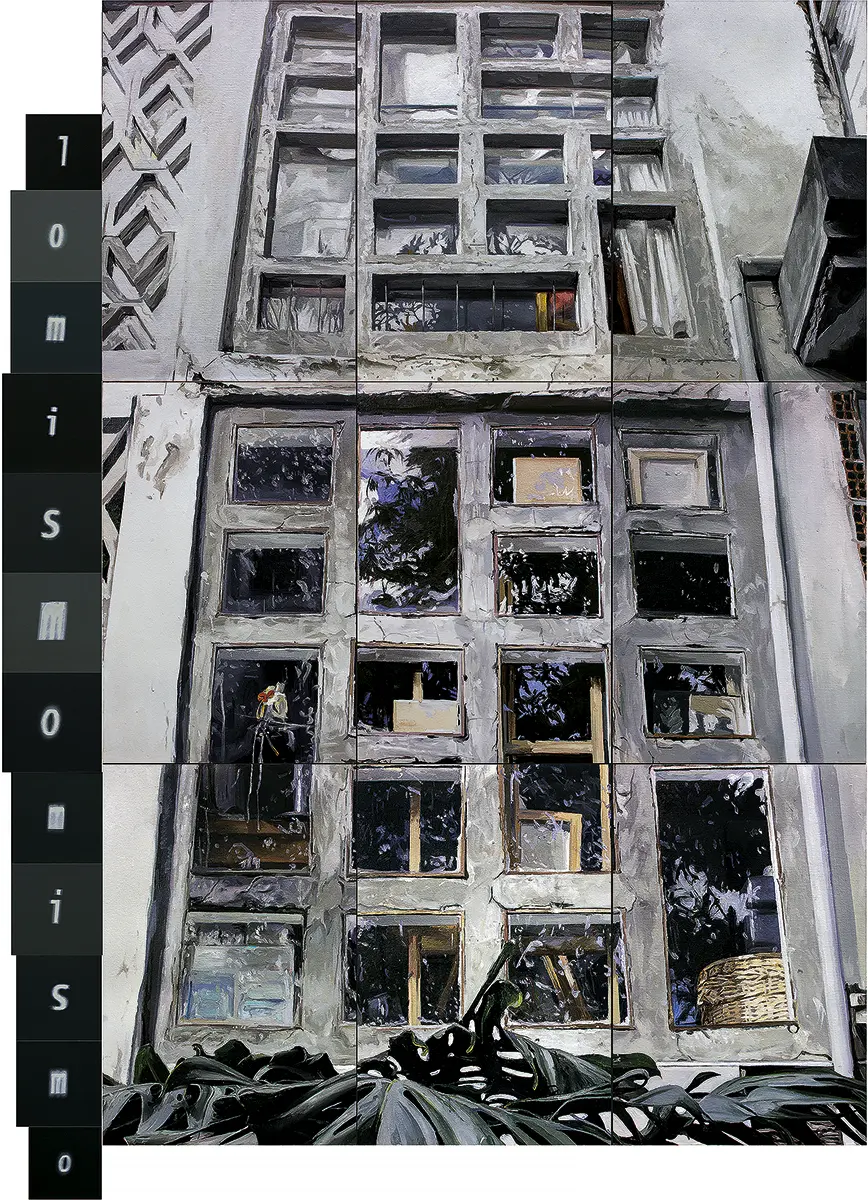
In 16.I.17, Cardoso foregrounds a perspective on a building with Art Deco reminiscences and a glass-heavy façade through which some of the canvases that comprise the exhibition seem to peek. We see their backs, isolated, anodyne, in their comfort zones. Outside, in what constitutes the collective space, the withering branches of a recently trimmed tree rest on the ground, like an inexcusable remainder of the closest crime.
Cardoso’s modus operandi for most of his projects is similar. He uses photographic images (often from satellites or shot by him) as his starting point and reformulates them with his brush adding subtle commentary as needed. In this way, in 19-V-17, the exhibition’s sense of randomness becomes denser when our dialog with the work is activated from two images that seem emerged from the hyper-virtual world. Double screens, monitors, glass panels, and a text that could well have been excerpted from a science fiction story, submerge us in a labyrinthine narrative that resembles Borges’ with its metaphysical concerns about time.
Mandala could be explained by two sentences in Haskell’s book: “Winter seems to have inflicted a harsh defeat. Yet, life goes on.” The wide-ranging nature of the diary fills us with questions, a virtue rather devalued in Ecuadorean art of recent years. Cardoso’s meditative exercises retain their introspective and questioning power, clearly staking a terrain of their own in that context.
AMALINA BOMNIN