When The Horizon Becomes Vortex and Vertigo. The horizon saves the friends we have lost, the shipwrecks. The doors to cities that existed when David was alive.
Gaston Baquero, Words Written on Sand By An Innocent.
The horizon, that tangible ideal plane that separates crawling from flying, excising like a scalpel that which anchors us from that which redeems us, is the foundation and support of the trilogy On The Horizon: Contemporary Cuban Art from the Jorge M. Pérez Collection, at the Pérez Art Museum of Miami Dade (PAMM). Featuring more than 170 works by Cuban artists living on the island and abroad, the exhibition is structured by the notion of horizon, which functions as a connecting thread for a large-scale exhibit organized in three chapters journeying in a circular timeline: Internal Landscapes, Abstracting History, and Domestic Anxieties.
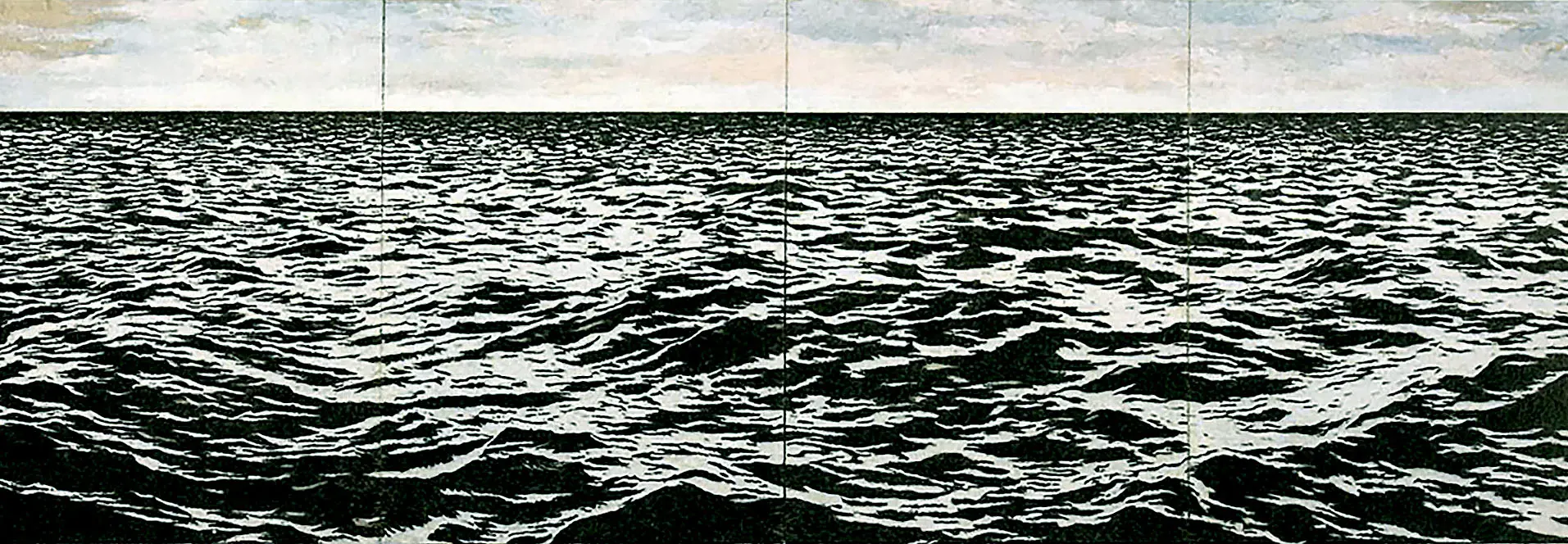
Some of the works—proposed by the curatorship as an introduction—emphasize the notion of the horizon in a kind of immersive experience and preamble that functions as a unifying landmark between the chapters. Some standouts among them are Fire (America) 5, 2017, by Teresita Fernández; Sin título (2/10) [Untitled (2/10)] and Sin título (4/10) [Untitled (4/10)], from the series Aguas baldías (Barren Waters, 1992-1994), by Manuel Piña; Summer/Verano, 2007, by Enrique Martínez Celaya; Island (See-scape), 2010, by Yoan Capote, and Oráculo (Oracle, 2017), by Tomás Esson. In all of them, the landscape becomes a psychological element and the Spatio-temporal starting point for that journey across time and somewhat into a no-man’s land that is On The Horizon…
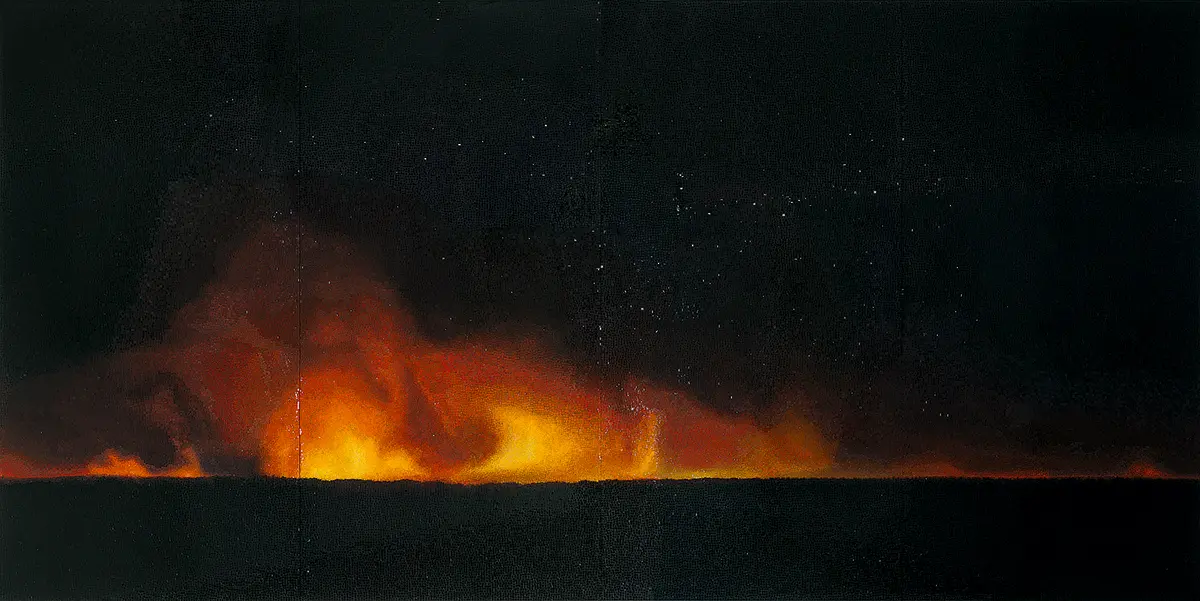
In the specific case of Fire (America) 5, 2017, by Teresita Fernández (Miami, 1968; lives and works in Brooklyn), we are confronted with an iconic work, highly representative of the universe of a unique artist interested in the psychological relationship associated with the four essential elements (water, earth, air, fire). Here, a nocturnal horizon engulfed in flames is built from an exquisite glazed-ceramic mosaic. Without the installation Nocturnal Landscape Engulfed in Flames, which functioned as its perfect complement in the artist’s most recent solo exhibition at Lehmann Maupin Gallery, Fire (America) loses much of its drama and its immersive character, diminishing its impact on the viewer.
Sin título (2/10) and Sin título (4/10) are both parts of the Aguas baldías, 1992-1994 series, an outstanding photographic essay by Manuel Piña (Havana, 1958; lives and works in Havana) made during a critical period in Cuban life that was deeply scarred by major events: the declaration in December of 1991 of the Special period in peacetime, and the mass flight of balseros in the summer of 1994, in what was known as the Maleconazo. Piña’s work is an effective record of the Cuban population’s generalized feelings during the period when all hope and even everyday survival were centered across the seas.
Right before entering the Internal Landscapes room, visitors encounter two paintings that act as antinomies at either side of the horizon: Summer/ Verano, 2007, by Enrique Martínez Celaya (Palos, 1964; lives and works in Los Angeles) and Island (See-scape), 2010, by Yoan Capote (Pinar del Río, 1977; lives and works in Havana). What we see in both cases are rough landscapes in which individuals, present or absent in the image, are confronted with a borderline situation. Carrying the imprint of lived experience, both works reflect the existential drama that characterizes contemporary Cuban identity, weighted by inner conflict and renunciation. Like mirror images of each other, the felicitous confluence of these works summarizes the migratory condition of the contemporary Cuban drama by means of its two opposing facets: exile and insile.
Internal Landscapes, the exhibition’s first chapter, is dominated by works of art of a visceral character, the majority of them associated with the leitmotiv of the sea as a means of escape and a mark of identity for Cubans as island beings. Among these works, some highlights are Nacidos para ser libres (Born to Be Free, 2012), by Juan Carlos Alom; I Scream, Therefore, I Exist (2011), by Antonia Wright; Imitación de vuelo (Imitation of Flight, 1990), by José Bedia; Beso en tierra muerta (Kiss in a Dead Land, 2016), by Elizabeth Cerviño; and Es solo agua en la lágrima de un extraño (It’s Just Water In A Stranger’s Tears, 1986-2015), by Gory (Rogelio López Marín).
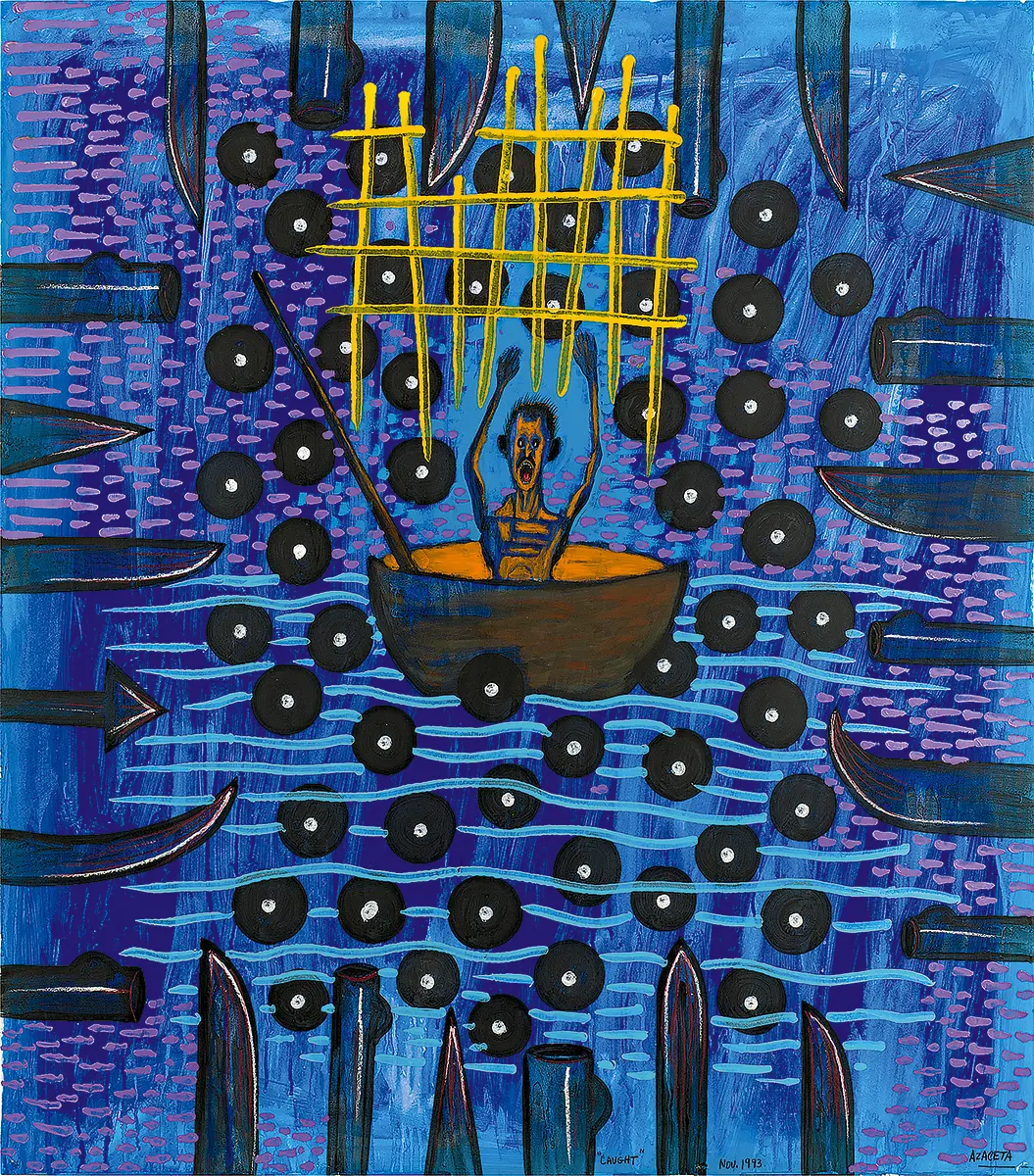
The theme of migration appears repeatedly in this initial chapter, with particular importance in De la serie Migraciones II (From the Migrations Series, 1994), by Sandra Ramos, and Caught (1993), by Luis Cruz Azaceta.
Sandra Ramos’ De la serie Migraciones II, from 1994, summarizes the anguish of an immigrant who must condense his or her entire existence in the limited baggage they can carry, and at the same time the contradictions and challenges implied in the act of migration for individuals who have been indoctrinated against it since their earliest childhood. This work represents a period when the exodus of Cubans from the island reached one of its most critical moments, and when leaving meant leaving forever, and often in the most difficult conditions: some of the pieces of luggage in Ramos’ series became diving capsules, rafts, fishbowls, in a kind of mutation and compendium of the life and expectations of Cubans of the era.
Luis Cruz Azaceta’s forcefully striking Caught (1994) is also a reflection of the drama of migration but seen from the other side of the ocean. Cruz Azaceta has been one of the artists able to capture the drama of migrants most vehemently and viscerally. The notions of abandonment, violence, and renunciation are constantly present in his work. Caught depicts the drama of the migrant who has braved uncounted dangers (leaving behind home and family, a dangerous crossing of the strait of Florida) in search of a space of freedom, in order to find himself besieged in the high seas.
Special mention among the works included in Internal Landscapes should be made of Tania Bruguera’s Sunflower # 2, 2002. This striking work, superbly economical in its use of resources, is a powerful compendium of Cuban feelings. While from a formal Sunflower # 2 signals inescapably in the direction of the long American tradition of dripping, what we encounter here is, more than that, direct aggression to the canvas. The trace of ink-saturated sunflowers violently thrown at the fabric generates the ambivalent yet effective sensation of flowers that are also bullets. In Cuban tradition, sunflowers are associated with the island Patron Saint, the Caridad del Cobre image of the Virgin Mary, which represents protection and an improved future. This image was closely connected to Cuba’s struggle for independence and was invoked by many of the independence-era heroes for protection before their battles. The Caridad del Cobre Virgin Mary is also the last hope of those that leave the country in the most difficult conditions and brave the dangerous passage to La Florida. The yellow ink used by Bruguera refers both to the sacred image and to luminol, a yellow solid crystal used in criminal investigations to render visible any trace of blood. We are being presented with the scene of a crime. In Tania Bruguera’s En Sunflower # 2, the gesture of throwing sunflowers—faith and hope—against an empty, uncaring wall possesses an unsurpassable power.
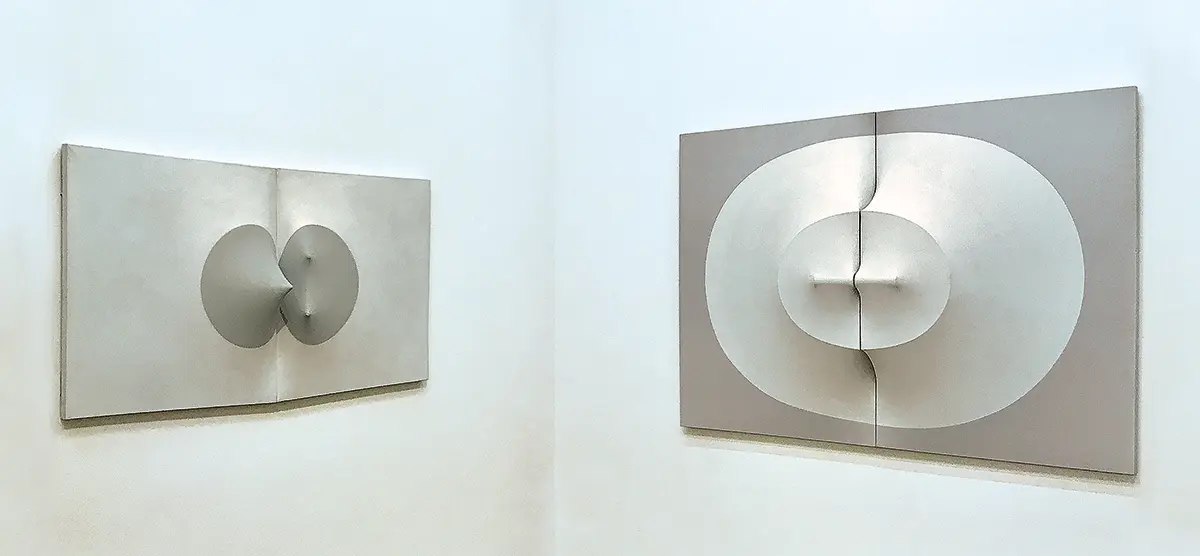
The second chapter of the exhibition, titled Abstracting History, leans on the notion of abstraction that is implied in the very concept of a horizon as the starting point for poetics connected to the vast tradition of abstraction as a significant discursive line in Cuban art. The inclusion of artists who were pioneers in the tradition of Cuban abstract art—such as Sandú Darié (Romania, 1908-Havana, 1991); José Ángel Rosabal (Manzanillo, 1935; lives and works in New York); Zilia Sánchez (Havana, 1926; lives and works in San Juan, Puerto Rico); and Waldo Díaz-Balart (Banes, 1931; lives and works in Madrid, Spain)—is key, as it becomes a kind of tribute to that essential historical moment when for the first time modern Cuban art was in sync with the leading edge of the international scene, which was moving towards a culmination of the tenets of the European avant-garde.
Special attention within Abstracting History should be paid to Frijoles negros Núm. 2 (Black Beans Number 2, 2014, by Flavio Garciandía (Villa Clara, 1954; lives and works in Mexico City), which functions as an essential bridge between the pioneering works of abstract art in Cuba and the resignifying conceptual strategy of abstraction as it is deployed in contemporary Cuban art. Flavio Garciandía is a central figure of what is known as the Cuban Renaissance or New Cuban Art, both thanks to the versatility of his proposal, always shifting and incisive, and his unsurpassable role as a teacher at the Instituto Superior de Arte between 1981 and 1990. The dynamism of his oeuvre, where carnivalesque and postmodern elements connect with high and low culture as well as with sarcastic couplings of art, politics, and everyday Cuban life, is fertile terrain for a kind of playful metalinguistics between modern and contemporary art.
Frijoles negros Núm. 2, 2014, included in the current show, connects with works that Flavio Garciandía began as early as 1994; on this occasion, the beans served as a pretext for a dialog with modern art figures like Ad Reinhardt, Malevitch, and Ryman, among others.
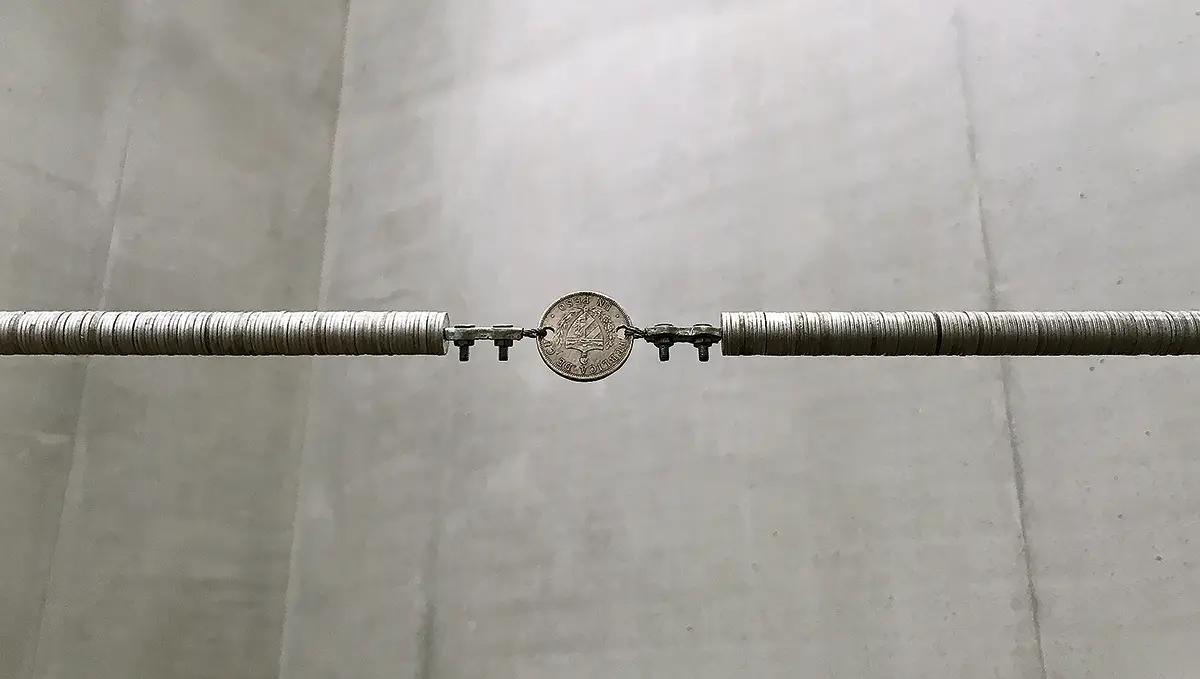
Hundido en la línea del horizonte (Sunk in The Horizon Line, 2007), by Eduardo Ponjuán (Pinar del Río, 1956; lives and works in Havana), is a sculptural installation comprised of a tensed cable traversing 1-cent coins. At its center, metaphorically supported by the aluminum coins devoid of any significant transactional value (all dated in 1983), is a silver peso from 1934, both faces showing. With remarkable economy, Ponjuán establishes a spot-on metaphor about Cuban society. The coin at the center was minted under the May 1934 act by which the National Monetary System backed by silver, sought to establish parity with the US dollar. It displays the slogan “Fatherland and Liberty”, which after the system’s 1961 reform, two years after the triumph of the Revolution, was replaced by “Fatherland or Death”, still in use.
Sin título (Untitled, 2009), by Leyden Rodríguez-Casanova (Havana, 1973; lives and works in Miami), is one of the most powerful items in this second chapter. The installation was part of Rodríguez-Casanova’s outstanding 2009 solo show at David Castillo Gallery, where the artist, on the basis of dysfunctional fragments, sought to recover an original space and a personal memory that had been excised by spatiotemporal coordinates. The work’s rarefied, markedly aseptic atmosphere, dominated by reminiscence, becomes in this way the anchor for the reconstruction of memory.
While the process that drives the work of Leyden Rodríguez-Casanova is based on exploring fragments as the activators of memory and personal identity, in the case of Aimée García (Limonar, 1972; lives and works in Havana) what we see is the opposite move. Her Sin título (Untitled, 2014) consists of a series of collages from mass publications, their images, and text blurred on the basis of the plots created by fields of color. As a kind of Penelope, García dewrites the cacophonous of the print media in an attempt to rewrite our own personal history.
Another work that finds its foundation on a notion of the vacuity of contemporary political discourses in Cuban society is 9 leyes (9 Laws, 2014), by Reynier Leyva Novo (Havana, 1983; lives and works in Havana) from his series El peso de la historia (The Weight of History). It presents us with a kind of anthropology of the historical text. Leyva Novo takes as his starting point a selection of official documents of the Cuban Revolution of 1959—nine in total—and reduces them to the volume of ink they contain. The result is a sequence of aligned fields of black color.
Domestic Anxieties, the third and final chapter of On The Horizon…, is based on architecture and everyday life as fertile soil for an existential critique of contemporary Cuban society. In the specific case of the work of Douglas Arguelles, Douglas Pérez, René Francisco Rodríguez, and Carlos Rodríguez Cárdenas, architecture becomes wall and impossibility.
El espacio no existe (Space Does Not Exist, 1991), y Carlos Rodríguez-Cárdenas (Sancti Spíritus, 1962; lives and works in New York), deals with the annihilation of personal and private space and that characterizes contemporary Cuban society.
The works of Carlos Garaicoa, Atelier Morales (Juan Luis Morales and Teresa Ayuso), and Los Carpinteros (Marcos Castillo and Dagoberto Rodríguez) are similarly focused on architecture. In the cases of Carlos Garaicoa (Havana, 1967; lives and works in Havana and Madrid) and Atelier Morales (a collective based in Paris), what dominates is a desire to recover historical memory on the basis of architectural reminiscence, while Los Carpinteros (the members of the group live between Madrid and Havana) present us with impossible and non-operational architectures.
In turn, Glexis Novoa, Ernesto Leal, and Lázaro Saavedra make use of the logos as the cornerstone of their proposals.
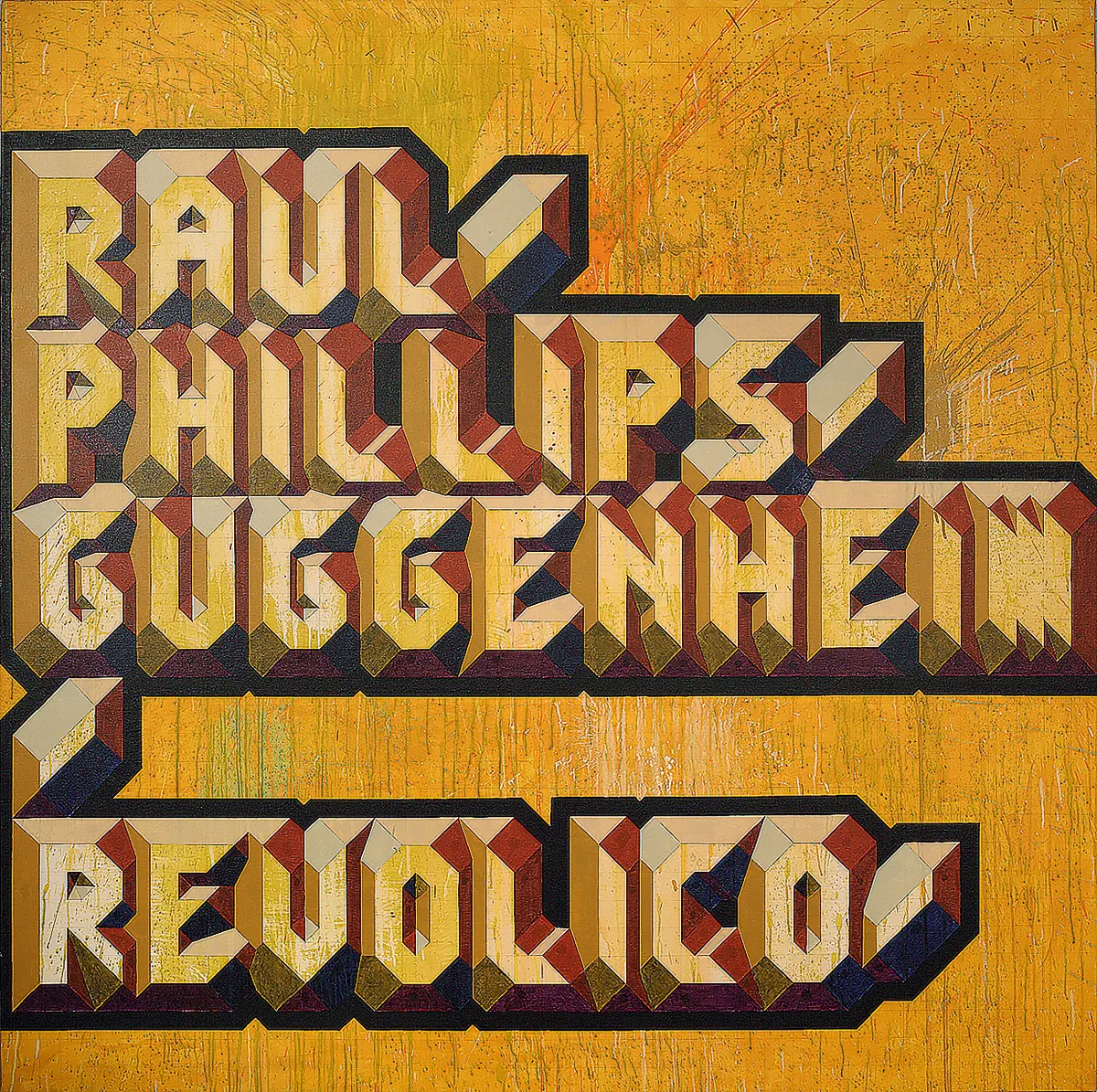
In Revolico, 2014, by Glexis Novoa (Holguín, 1964; lives and works between Miami and Havana), cryptic calligraphy halfway between brutalism and the Cyrillic alphabet, displays words that are common in contemporary Cuban slang.
From Double-Language to Triple-Language, 2016, by Ernesto Leal (Havana, 1971; lives and works in Havana), encompasses a series of graphite-on-paper works based on typography. Indistinctly using Spanish or English words, Leal creates a visual anagram where noncommunication, censorship, and impossibility progressively build a kind of Tower of Babel.
Meanwhile, Software cubano (Cuban Software, 2013-14), by Lázaro Saavedra (Havana, 1964; lives and works in Havana), appropriates the syntactical rules of programming languages in order to reveal the consequences that result from the initial problem: “To distance oneself from the common doctrine, belief, or behavior.” The binary chains that follow (1 and 0, translated here into YES and NO), derived from each set of alternatives, in every case with no possible middle ground, delineate an incisive panorama based on the initial premise, which portrays, not without irony, the stark quandaries faced by Cubans in terms of ideology.
The three chapters that comprise On The Horizon: Contemporary Cuban Art from the Jorge M. Pérez Collection were conceived as a kind of sustained crescendo, with each chapter delving deeper into issues of contemporary Cuban art and society. Not included in any of these chapters are such landmark figures of contemporary Cuban art as Ana Mendieta, Félix González-Torres, Antonia Eiriz, Umberto Peña, Juan Francisco Elso, Luis Gispert, Fernando Gómez, Chago Armada, or Carlos Alfonzo, to mention just some of those names that are inescapable in the landscape of contemporary Cuban art on both side of that horizon that, more often than not, has regrettably functioned as a wall rather than as a bridge.
We must mention that the exhibition focuses only on the most recent bequest to the museum, and so excludes works by artists who were already present among the institution’s holdings, such as The Spy Ship, 1994, by Julio Larraz—also bequeathed by Jorge Pérez—which would have connected us more successfully with the show as it was conceived than the work by the artist actually featured in it. This is also the reason why artists like Ana Mendieta, Carlos Alfonzo, and Luis Gispert have no presence in this exhibition even though the museum owns their work.
On The Horizon: Contemporary Cuban Art from the Jorge M. Pérez Collection is, in this way, that pinch of salt required for the PAMM’s continued efforts and commitment in favor of Cuban art, a laudable task that could, in the long run, defeat the absurd stigma of the inside/outside that has characterized contemporary Cuban culture.
* Pérez Art Museum Miami collection.
JANET BATET
Art historian, essayist, and art critic.