The Museo de Arte Latinoamericano de Buenos Aires (MALBA) was the stage of the first retrospective by Mirtha Dermisache (Buenos Aires, 1940-2012) in a museum. Curated by Agustín Pérez-Rubio, the exhibition titled Mirtha Dermisache. Because I Write! included the entirety of her artistic production—until her death, in 1967—which ranged from the visual arts to writing and developed into two facets: the work created alone in her studio and her work as a teacher that reached a large audience.
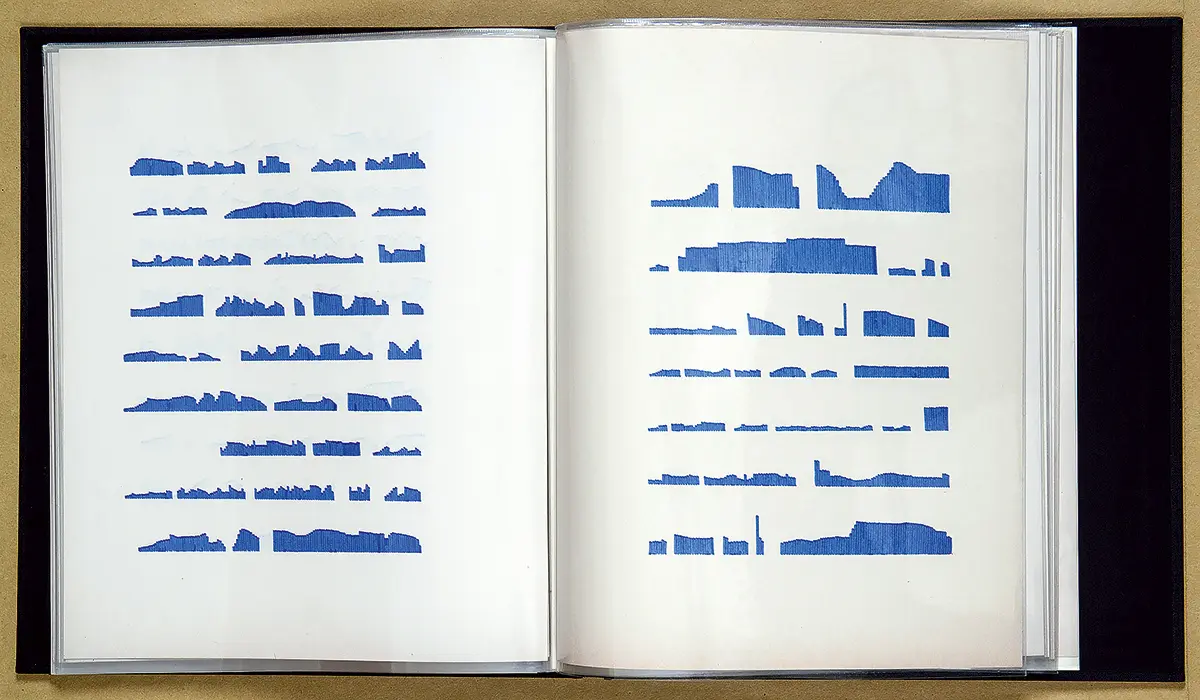
Author of works with graphics, by way of words transformed into images, beautiful scripts, and lost vocables, Dermisache would have felt pleased about the nearly lab-like aseptic environment in which the 140 works were presented (in the Silvia N. Braier exhibition room). The mounting of the exhibition optimized the vision of her calligraphic work, which is present through drawings, signs, and landscapes, with strange graphics drafted in lines that mimic traditional writing and appeal to the sensibility and intelligence of viewers. While it is possible to discern words or phrases in some of the lines on the paper, in most instances Dermisache created graphic signs that did not convey any meaning.
The images drawn in the works reveal the contradictory and necessary coexistence between art and the absent word. The dichotomy between the absence and presence of writing finds its reason for being in the definition “Art is that which cannot be said with words,” no matter how much art needs words, and even if art could be explained with the help of words. There are no pretensions about the truth but there is also no intention of erasing the alphabet, which, whether ambiguous or comprehensible, conserves the possibility of being reassessed; art appears to guard the potential of the written word.
Roland Barthes showed great interest in her work and, in 1971, wrote her a letter in which he expressed the following: “[…] I was very impressed, not only for the highest artistic quality of your strokes (which is not irrelevant) but also, and especially, for the extreme understanding of the theoretical problems related to writing that your work entails. You have managed to produce a certain number of shapes, neither figurative nor abstract, which could be defined as illegible writing–leading to suggest its readers […] the essence of writing. In a 2011 interview with Annalisa Rimmaudo and Giulia Lamoni, Dermisache remembered that “It was incredible because from that moment on I understood what I was doing. To me, it was as if he was explaining to me what I was doing […] it was so important that for the first time someone was calling my work writing that I, of course, could not even for a second think about anything else.”
The exhibition was organized around incomprehensible and essential writings—silhouettes edited like books or newspapers—that have an energy of their own, in addition to letters and postcards— "legible" everyday writings that attest to Dermisache’s creative process—as well as documents associated with her teaching at the Taller de Acciones Creativas (TAC) and the Jornadas del Color y la Forma (Days of Color and Form, 1974-1981). She developed six editions of the Jornadas… in museums and cultural centers in Buenos Aires, with the goal of disseminating artistic techniques that would stimulate and develop creative skills. The workshops were offered to whoever wanted, and was able, to attend, from amateur enthusiasts to consecrated artists like Eduardo Stupía and Marta Minujín. The last workshops welcomed more than 18,000 people in ten days.
Few remember that Mirtha Dermisache was associated with the Instituto Di Tella, the CAYC, and the Grupo de Los Trece led by Jorge Glusberg with clear conceptual inclinations. The recovery of Dermisache’s work can be even contextualized today, a time that favors a reassessment of the various conceptual manifestations that have emerged in the region.
According to the curator of the exhibition, “From the start, Dermisache’s work seems to be traversed by a duality between the search for creative freedom and submission to a series of rules, a discipline. And, when one assesses her entire body of work, such duality becomes a constant that is inextricably linked to her teaching practice, understood as the experience of an inverse learning process: the unlearning of certain ideas that hinder free creative expression.”
For many, the exhibition represented a rediscovery of the work and of an artist who from 1982 to 1996 was confined to the intimacy of her studio for personal reasons, as her work became part of exquisite curatorships about books and artistic publications at the international level. Dermisache’s oeuvre is part of important collections in cultural institutions like: the Museo Nacional de Bellas Artes, the Museo de Arte Latinoamericano de Buenos Aires (MALBA), and the Museo de Arte Contemporáneo Rosario (MACRO), in Argentina; the Bibliothèque Kandinsky of the Centre Pompidou (Paris); the Museo Nacional Centro de Arte Reina Sofía, in Madrid; the Museu d’Art Contemporani de Barcelona (MACBA); and Tate Modern, in London, among many others.
It is important to mention the major role that the Archivo Mirtha Dermisache played in making the exhibition possible as well as the remarkable 300-page bilingual catalog book. Thanks to good decision-making on the part of the artist’s heirs and executor, several collection and archival experts—like Cintia Mezza, among others—were invited to participate in the conservation-oriented organization of the works and catalog, and the creation of a website: www.archivomirthadermisache.com
VICTORIA VERLICHAK