Unlike others searching for all forms of signification, Marcel Duchamp found an approach in the absurdity of such a quest,1 and never wanted disciples. But Mika Rottenberg (Argentina, 1979) belongs to the tribe of those who, while close to Dadaism and the Surrealist movement that followed, cannot be labeled as part of a specific movement no matter how many things her work shares with it. Just like Alice ran after the rabbit, falling straight into the rabbit-hole and ending up in the other side of a very deep well, or when she went through the looking glass, in many of her works Rottenberg relies on a similar tendency to explore the reverse of everything, turn the world upside down or inside out. This strategy is part of the “metalepsis” operations that allow her to delve into the boundaries between reality and fiction, move across different worlds and confirm the omnipresence of the absurd.
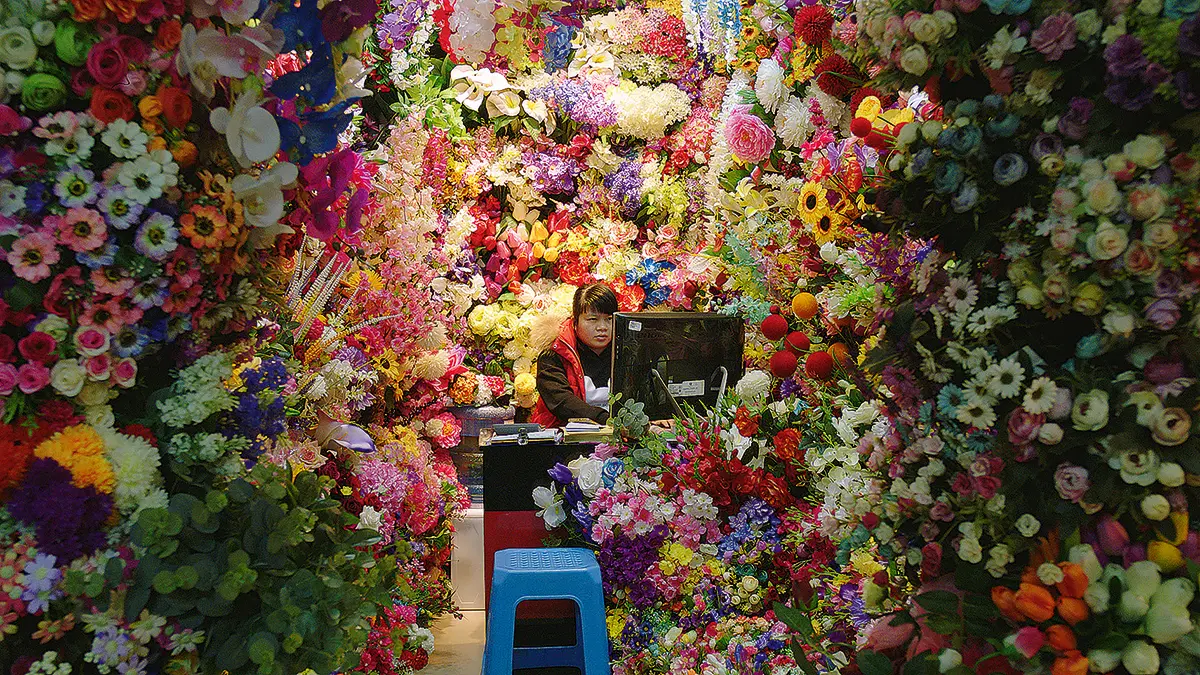
The masterful videos by this Argentinean artist, who grew up in Israel and completed her academic education in New York, are also connected to the origin of the Large Glass, a work by Duchamp in turn influenced by the sonority—oblivious to the usual models of signification—of Impressions d’Afrique (Impressions of Africa) written by Raymond Roussel, who also proposed the idea of painting mechanisms. According to Duchamp, Roussel’s word plays “had a hidden meaning. […] It was the obscurity of another order.” Rottenberg knows how to construct sound, singular looking, mirrors from a reality overflowing with an imagination that is not very different from the global universe in which it takes “virtually” a second to travel from China to Mexico, and where the simultaneous nature of absurdity is within anyone’s reach. This is precisely what happens in Cosmic Generator (2017), a video installation in which, like in The Aleph by Jorge Luis Borges, the universe fits in an orifice; or in the plate of a popular restaurant in a border town full of signs in different languages. The transversality of the locations, the use or repetitive gestures useless to produce mythologies of consumption, the irritating noise, the saturation in the excess of market objects and the confining spaces, in addition to the idea of the butterfly effect from one place to the next in a world where everything—architectures, mechanisms, inflatable forms, plastic—is (poorly) imitated, respond to the concept that Nicolas Bourriaud defined as “alter modernity,” at a time of “transnational entities, short or long-distance journeys in a chaotic and teeming universe.”
The exhibition titled Mika Rottenberg presented at the Bass Museum of Art covered two opposing exhibition wings—with a kaleidoscope-like structure—and favored an eclectic vision. In one wing, with the installation titled Ponytail (Blond) from 2016, Rottenberg introduced visitors to her interest in the connections between the female figure, mechanisms, and reiterative sounds. The banal humor in the piece lacks the physical connection achieved in Helen Chadwick’s Loop My Loop (1991), or the poetic that characterizes Jannis Kounellis’s Untitled metal plate with braids of hair. The mechanical movement of the hair marks the incorporation of new explorations by Rottenberg, like in the magnificent film Cheese from 2006, with six mythical women from whose hairs spring the milk and water of the world. In the opposite wing, the installation Tss, Tss, Tss, from 2014, intervenes the architecture of the museum with obsolete air conditioners that generate another reiterative image, the relentless drop of water, turned into vapor upon falling on a hot frying pan in a stove. This condensation reflects the appropriation process of the exquisite museum as a stage for precarious domestic economies. The installation titled Lips (Stude #3), from 2016, evokes the visual mechanism that was preceded by the contemplation of the interaction between light and the female anatomy in Duchamp’s Étant Donnés.
It is only at the end of each spatial wing, where the insightful films No Nose Knows (phonetically similar to Duchamp’s Squeeze Noze) and Cosmic Generator are projected when the installations become cohesive and reveal a vast language. In No Nose Knows, the dystopia of modern architecture has produced a desolated urban setting inhabited by a single plump, blond woman whose time at work is spent in gloomy interiors (despite their colorful walls) that contain a small dry plant and pots with withered flowers. While she smells the flowers, she activates a pulley connected to a world below to initiate a process that will grow her nose and make her sneeze. Each sneeze produces in an industrialized-like manner a disgusting pasta dish. In contrast to the woman’s isolation, dozens of oriental women occupy the world below, enveloped in the dirt that has been accumulated from the production of pearls. The video also shows an exhausted woman in deep asleep with her legs submerged ankle-deep in a large bowl filled with pearls, who is perhaps dreaming of the blond woman that at that moment is refreshing her feet. The scene is connected to the installation at the Bass Museum consisting of rabbits made with cultured pearls from China and large sacks containing the harvested jewels. The installation is also a wink to her film Sneeze (2012), in which, as a result of another type of allergy, a man with a nose like Pinocchio sneezes rabbits in a manner similar to the character in Cortázar’s Bestiary, who involuntarily vomits white rabbits.
Mika Rottenberg transforms the museum into a stage in which she fits the absurdities articulated by the world. In the end, we fall for the endless sounds and images of a type of “social surrealism” that makes us feel—truly “feel” (a verb that in Spanish can be synonymous with “lamenting”) the oppression of the crazed modes of production in the voracious capitalist and slaving communist systems. Because in both systems the dehumanizing cult to things parallels the environmental excesses that erode Earth.
NOTE
1. Michel Sanouillet, 2012.
ADRIANA HERRERA