Miguel Rio Branco’s solo exhibition at Oi Futuro opened on November 16, occupying the entirety of the Flamengo, Rio de Janeiro gallery’s spaces and buildings. Curated by the artist with Paulo Miyada, and co-curated by Alberto Saraiva, the exhibition includes Rio Branco’s controversial video installation Sob as estrelas, as cinzas (Under the Stars, Ashes), created originally in 1992 for Arte Amazonas, a show at the MAM in Rio curated by Alfonso Hug, and built on the basis of high-impact photographs published in the police blotter section of the now-defunct O Povo (The People) newspaper.
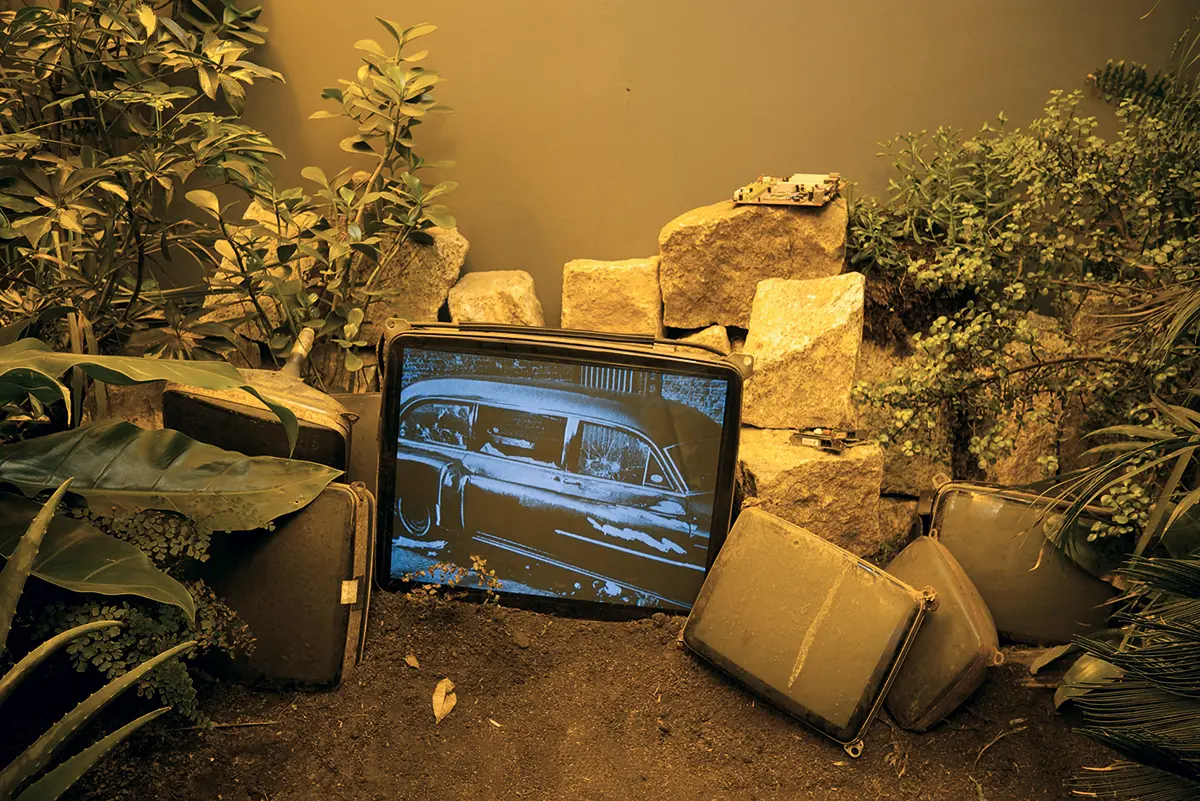
The exhibition begins at ground level in the Oi Futuro Cultural Center with an immersive installation, a direct unfolding of the artist’s Wishful thinking (2015), where real plants are distributed among rocs, debris, rubble, and dirt. This 40-ton assemblage refers to the ruins of a civilization invaded by nature. The situation created, reinforced by videos presented on monitors distributed around the dirt floor, speaks of what will survive the fall of contemporary cities after an unspecified catastrophe.
Despite its unsettling content, the environment created by Rio Branco is surprisingly welcoming. The heat, the humidity, and the color of the plants that surround the visitor all point to a certain hope for the return of the exuberance and sovereignty of nature.
The idea behind this exhibition emerged after the artist’s visit to several ruins of ancient civilizations now invaded by forests, which always overtakes human constructions. Miguel Rio Branco’s work hinges on a dialog between the destruction of the environment and its conservation, with the resulting resistance of nature as such.
The material on exhibit, distributed among three levels in the cultural center, is harmoniously punctuated by videos and photographs depicting conflicts in contemporary cities, as well as alternative ways to think about time, space, nature, and society.
In Gallery 2, which occupies the 4th floor of the cultural center, the video installation Sob as estrelas, as cinzas includes a double projection of alternating images of mining and destruction; scenes of indigenous gatherings and rituals; a starry sky; images of residues and fragments of large cities, related to the police-blotter images culled from O Povo. This work, which caused controversy and was censored by China’s Ministry of Culture, which banned it from the 6th Guangdong Triennial of Photography to be held later this year, is a rereading of the original 1992 installation. The Chinese government banned it on the pretext of its being “too violent.”
According to Miguel Rio Branco, this work is “tense, but not overly violent.” The installation sets up a dialog about everyday stories, salvaged from mass-media images. For the artist, what Sob as estrelas, as cinzas puts on display is violence as exerted upon human beings, something we witnessed on a daily basis and that the artist has been engaging in his work as he explores themes of indigenism, environmental occupation, and society.
Inside the same Gallery 2, a series of photographs titled Maldicidade (Slander) brings together snapshots of the decadence of city life in metropolises across the world. Also on display here is the installation Ofelia, given a new set-up for the occasion, the poetic meaning of which is built from on the basis of objects from a diverse provenance: red neon light bulbs, automobile windshields and pieces of glass, magnets, a jacket, a photograph printed on translucent fabric.
Inside Gallery 3, as the exhibition comes to a close, is Diálogos com Amaú (Dialogs With Amaú, 1983), an audiovisual installation comprised of five projections on translucent fabric arranged in a dimly lit space and surrounded by sounds recorded by the artist during an indigenous ritual in the village of Gorotire. In the images projected, visitors see a series of photographs of Amaú, a child of the Caiapó people; the discrimination he suffers as a hearing and impeaches impaired person is presented. Rio Branco’s work sheds light on a marginalized sector of society. A child who can’t speak or hear in a society that is based on oral tradition. The projections alternate between scenes captured at different times and in different places.
This exhibition presents visitors with a transversal cut of Miguel Rio Branco’s oeuvre, organized and edited by the artist in dialog with the curators, and positions the sustained experience that connects the various periods of his production. At the same time, this provides an opportunity to reconnect with Brazilian scenes that the country at large tends to ignore because they do not match its idealized appearance, and to debate, with the linguistic and poetic help of art, urgent issues and possibilities of contemporary life, as understood by Miguel Rio Branco.
Miguel Rio Branco has gained international recognition as a photographer—his images are part of the Magnum Agency archive—and uses different formats in accordance with each work’s proposal. At this juncture, sculpture dominates.
HÉLCIO MAGALHÃES