This Colombian artist, born in Bucaramanga, trained professionally as an architect, like many sculptors in the last century, and in the course of his nearly fifteen years of activity, he has sustained a permanent dialog with that discipline. Already his earliest works explored a principle that is shared not only by architecture and the visual arts, but also by all disciplines oriented towards processes of projection of images, objects, or ideas, as is the case of draftsmanship. Draftsmanship has been present in the sciences and the arts as a mediation between the experience of the real, though, and social and cultural conventions. Mathematicians draw, as do engineers, industrial designers, and artists, to the point that draftsmanship can be understood as a kind of parallel reality, or as a virtual equivalent of the real.
Máximo Flórez’s drawings began as installations made directly in the architectural space from thread and nails; later, the artist explored the possibility of creating situations, images, and potential spaces inside wood boxes, in which he created configurations with thread both black and in a variety of colors. In replacing the virtual line of the draftsman with a real line—the thread—Flórez connects the resulting images with the materiality of the world, a feature of everything from the most solid and robust object to the most fragile and subtle.
Despite its sculptural nature, Máximo Flórez’s work is in a sustained dialog with the different visual emblems that pictorial abstraction has generated in the course of the last one hundred years. This has resulted in a paradox of sorts, given that sculpture has real depth (because it occupies a place in space) while the depth of painting is an illusion produced by cultural conventions. For this reason, Flórez’s works render the cultural conventions that shape the visual emblems mentioned before literal, causing in viewers the experience of “falling into the trap of a frontal structure” only to escape later, as they are able to study the way in which it was materially built. Many of Florez’s works have featured an affiliation with the grid as an emblem (systematically explored by artists like Piet Mondrian or Agnes Martin, among many others); in other instances, he has explored the emblem of the monochrome (revisited by artists like Robert Ryman or Ad Reinhardt); and in yet other cases he has developed the visual emblem of concentric structures (such as those often engaged by Josef Albers or Frank Stella).
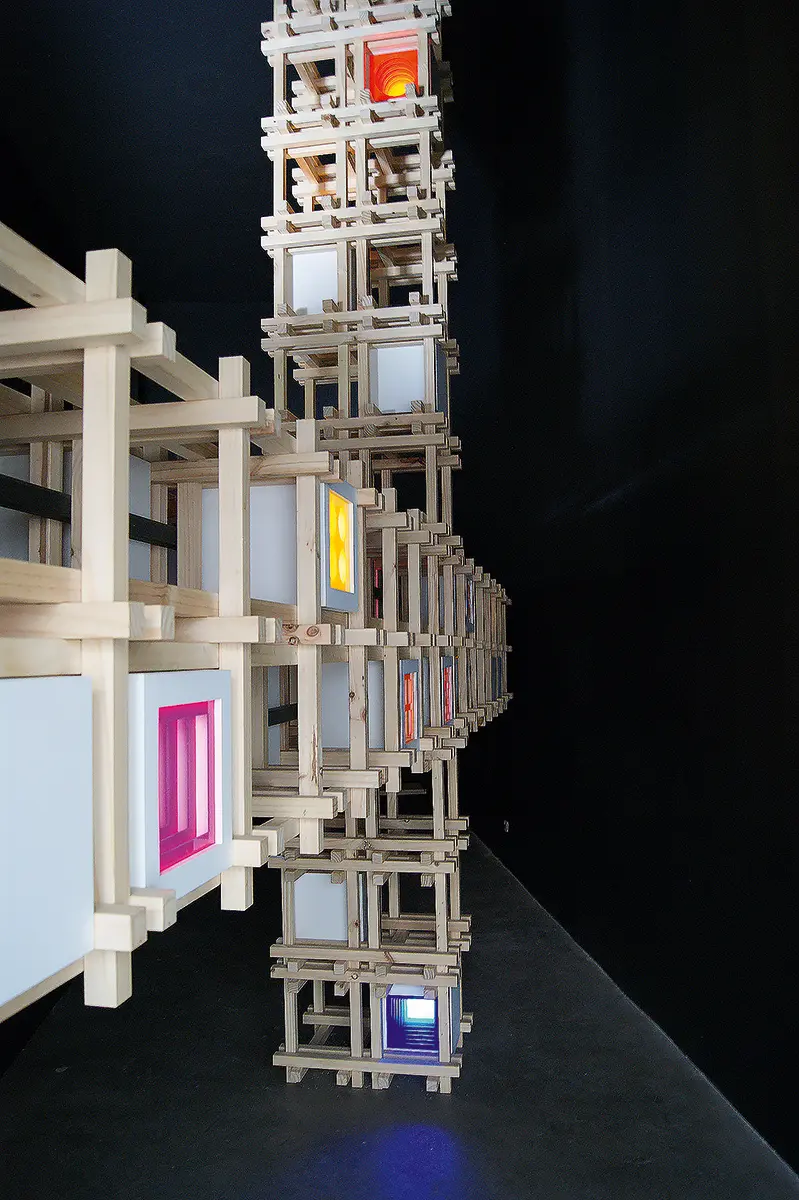
These emblems have been analyzed within several artistic movements and styles in the arts of the last century, and have given shape to abstract images that do not appear to describe the objective world but exist purely in the realm of the visual. The latter term in the arts encompasses both the social dimension of visuality and the visual dimension of sociality. When a person sees anything, she is inscribed in the framework of a set of codes that make her see what she “should see”. In the context of the arts, the viewer’s experience is anchored to all the aesthetic conventions that shape the image. In his project Inventario (Inventory), presented between October and December of 2017 at SGR Gallery, in the San Felipe district of Bogotá, Máximo Flórez returned to the genre of installation but going beyond the aspect of drawing in space that characterized his initial works as he articulates the virtual and discontinuous spaces of his boxes to a constructive framework that entered into a direct relationship with the specific architecture of the space and directly enlisted color and light into its functioning. One part of the project was situated in an area of penumbra, and it was there that the items with light appeared; the other part was in a well-lighted space, and situated there on a shelf were the more objectual works, a series of translucent sheets in flat, bright colors. In the experience of the viewers, the images in the first part of the project were perceived as chromatic atmospheres, connected to the principles of concentric structures, while those in the second part resembled a greater degree the artifacts that can be related to the realm of the body, and appealed to the notion of the monochrome.
The exhibition operated as a large-format installation that functioned as an expanded painting, with the building itself playing the part of the frame to ultimately present the entirety of the work as a single image, while at the same time making us perceive the wooden structures as the boundaries of the work and the white cubes and their chromatic and light spaces as their constitutive images.
JAIME CERÓN