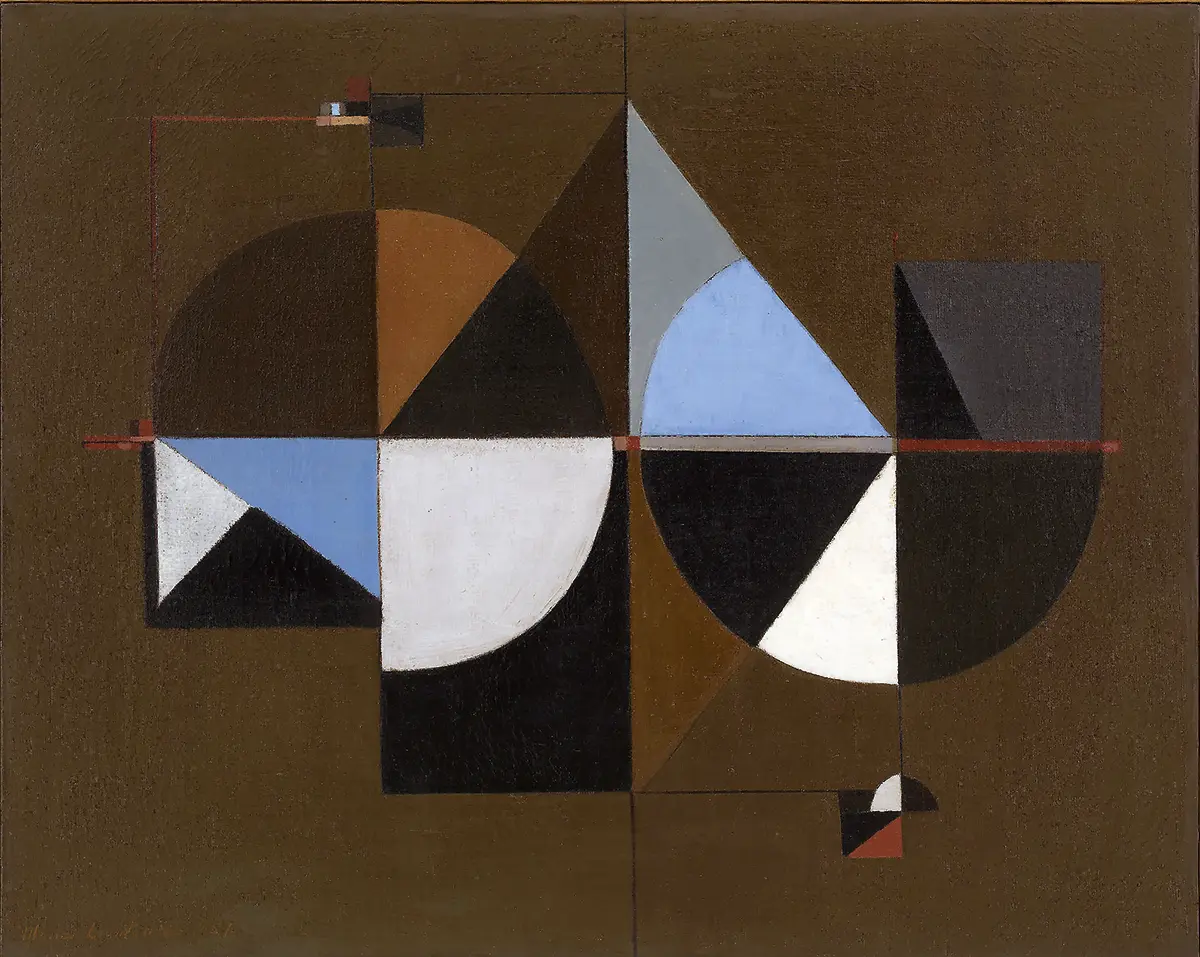
Conteudismo1 and metaphysics are combined in the work by Brazilian painter Maria Leontina (São Paulo, 1917). This was revealed in the exhibition at the Dan Galeria, in São Paulo, featuring 73 of her works, many of which had never been shown before, to mark her 100th birthday. Included among the works never seen publicly before was the self-portrait titled Maria Leontina: Poética e Metafísica (Maria Leontina: Poetic and Metaphysics), whose title reveals the evolution of an abstractionist style continuously permeated by the paradox between rationalism and subjectivity.
This portrait, as well as other rare canvases and drawings, were kept by her son Alexandre Dacosta in Rio de Janeiro. For years, Dacosta has been trying to produce a catalog of his mother’s work. The exhibition follows a chronological order: small figurative canvases from the 1940s, created many years before her first solo show; still-lifes from the period of her participation in the first edition of the São Paulo Biennial (1951); abstract canvases from the series titled Games and Enigmas (1954); paintings structured with fragmented strokes; works from the series titled Forms (1960s) and Pages (1970s); and a series of pastels on paper that dialogs with Mira Schendel’s monotype experiences.
As art critic Paulo Braga explained in the catalog, the exhibition surveyed the enigma of time that Maria Leontina began exploring during the 1950s and that would also influence a great part of the artistic production created by other Brazilian constructivist artists like Lygia Pape and Hélio Oiticica. This is very evident during the period in which Maria Leontina’s formal vocabulary turned to geometric abstraction—after the 1940s—when her portraits began to combine expressionistic strokes with a singular serenity. In her still-lifes from the end of the 1940s, Paul Cézanne’s influence is noticeable in the metaphysical density expressed through planes that merge the figure with the background.
Of an Intimist and religious temperament, Leontina was always careful to keep her working space separated from her husband’s, Milton Dacosta. Surrounded by books, figurines of baroque saints, offerings, and works by other artists she admired, she developed a disciplined artistic practice in which she created millions of compositions. Leontina participated in several editions of the São Paulo Biennial (1st, 3rd, 4th, 5th, 6th, 7th, 9th), the 26th edition of the Venice Biennale, the 1st and 2nd editions of the Panorama of Brazilian Art of the Museu de Arte Moderna (MAM), and in the exhibition titled Constructive Project in Brazilian Art, to name just a few among the dozens of solo and group exhibitions on which the critical acclaim that surrounded her work was built. Some of the great names of Brazilian art criticism that wrote about her work included: Sérgio Milliet, Lourival Gomes-Machado, Mario Pedrosa, Federico de Morais, Ferreira Gullar, and Lélia Coelho-Frota, among others.
Leontina began to study drawing in 1938 with Antônio Covello, in São Paulo, and during the first half of the 1940s studied painting under Waldemar da Costa (1904–1982). In 1946, in Rio de Janeiro, she frequented the studio of Bruno Giorgi (1905–1993) and, between 1946 and 1948, completed a course in museology at the Museu Histórico Nacional (MHN). In 1951, Leontina was invited by psychiatrist and art critic Osório César (1895–1983) to serve as advisor of the visual arts section of the Juqueri Psychiatric Hospital in São Paulo. In 1952, with a study grant awarded to her by the French Government, she traveled to Europe where she frequented the engraving studio of Johnny Friedlaender (1912–1992).
Maria Leontina’s exposure to the modern art scene and complete commitment to painting occurred in 1940 when the artist regularly visited the studio of artist Waldemar da Costa, cofounder of the Artistic Family of São Paulo (FAP). Her series of still-lifes started in 1949, in which allusions to Cubism can be observed, attracted the attention of art critics. Leontina arrived at geometric abstraction in the mid-1950s through the continuous depuration of figurative elements.
The works in the show are reflective of the environment of debate surrounding contemporary abstraction in Brazil and of her experience abroad, where the constructivist art movement occurred. Many of her paintings evoke the urban space and its constructions. The “constructivist” period of Maria Leontina, which lasted until 1961, is regarded by many critics as the highest point of her artistic production. Her colors, for instance, were no longer bound to the dogmas of primary colors, as she worked in a very singular way with warmer but more subdued tonalities.
In the series Forms from that period, the works are subjected to a process in which angular shapes are rounded and softened until the images eventually become patches. From that moment on, Maria Leontina developed another series in which abstraction, geometric or otherwise, is sometimes predominant while other times what prevails is a synthetic figuration of a symbolic nature.
In her series Banners, initiated in 1962, variations of form, line, and color are reduced to their essential manifestations, in a process that reinforces the search for a metaphysical environment. In this manner, Maria Leontina developed a distinctive “sensitive geometry” in which the rigidity of lines and the geometric rigor of the compositions are replaced by the intuitive arrangement of imprecise forms.
NOTE
1. Translator’s note: A tendency to value content over form.
ALESSANDRA SIMÕES