In her interventions in architectural spaces, Chilean artist María Gabler (Santiago, 1989) encourages us to reflect on the way we interact with the surroundings by breaking with our usual daily experience inside, and in relation to, the spaces that we inhabit. In this manner, time (the unfolding experience) and space (the intervened architecture) converge in her work. Such experience implies movement and perception, namely, how we move inside a particular space and the manner in which we are led to perceive it. And Gabler does this without resorting to effectisms, although at first glance her works can appear highly complex works of engineering. While her approach to transforming a spatial idea into a rich sensorial experience requires meticulous planning and refined building solutions, the end result is something almost immaterial: a possible approach to that which constitutes a work of art.
The works by Gabler can be felt, observed, assisted, and enjoyed by both the well-versed and the general public alike. Since 2011, Gabler has been developing in situ installations in which viewers have an active role. She makes us aware of the space we transit through and how we relate to that which has always been there. Her works Ruina (Ruin, 2011) shown at the Galería Bech, and Mirador (Lookout, 2015) exhibited at the Galería Tajamar, just to name a few, are especially effective in helping us redefine our expectations about what constitutes an exhibition space as well as an artist’s own expectations when showing his/her work.
In Ruina, by inserting in several angles about thirty pillars similar to those that support the gallery’s architecture, Gabler disrupted the usual walk through that section of the exhibition and, by doing so, she made us aware of the relationship between our bodies and space. To confront the inaccessibility of a place is part of the intention of her work.
Gabler offered the same condition in Mirador, a work that also involved a replica, this time of the exhibition space. She built a second gallery, attached like a cyst to the distinctive architecture of the Galería Tajamar, a hexagonal display window located in a small square of Santiago with 24-hour access. Only that the new alternative construction made with MDF was not accessible or transparent like Tajamar. One could enter the gallery but not the adjacent space. We could only look at its interior through one of Tajamar’s glass panels.
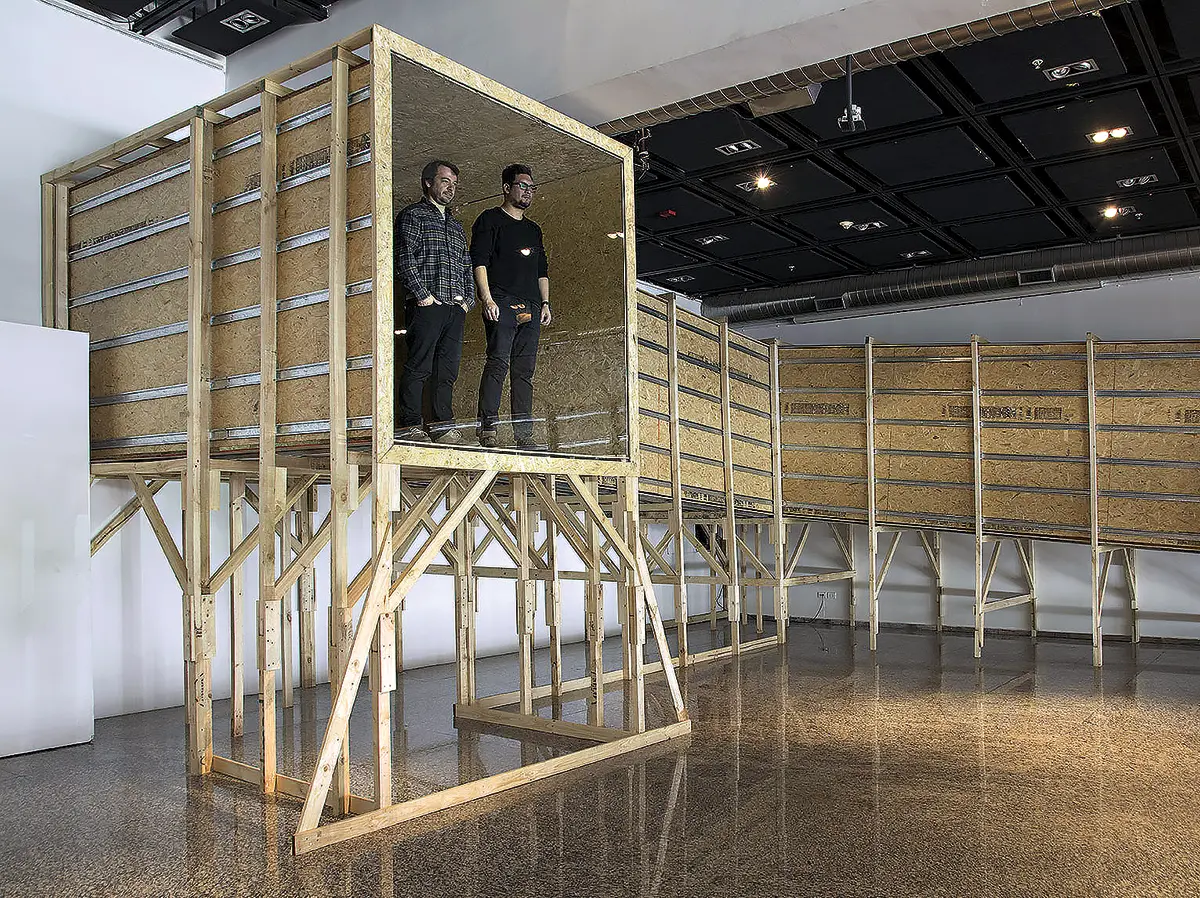
Similar operations take place in her latest intervention at the Sala de Arte CCU, where the very space in which the exhibition is presented is nothing more than a container of the work. So, what is it then? La Galería, the title of this piece, is a reflection of the exhibition space. Upon arrival, viewers had to walk through a 50-meter long corridor, a precarious-looking construction fashioned with MDF boards and similar to those temporary constructions installed in open spaces under repair.
Walking through that ramp was pretty unsettling. We did not know where we were going and thought that we would eventually arrive at “the gallery,” but we were actually already walking through it. We continued our ascent and arrived at a sort of lookout or observation area located two meters high from the floor. The view is at once the exhibition area itself as well as the structure that we had walked through in order to arrive at it. María Gabler made us part of a non-event: the exhibition area is empty, there are no artworks or people picking them up or contemplating them; there are no activities or objects to observe, only a call to be present in and with the exhibition space, to observe it just as it is in its purest essence. Space emerges and we are not interacting with the work per se, but rather we are taking charge of our role as spectators.
The direct reference of La Galería is “Klein bottle,” a volume without interior or exterior. In this manner, Gabler makes us enter the gallery, access its interior through its exterior. However, in order to arrive at the interior, we must first move through the actual gallery’s internal space. And, once again, the walk involves the notions of space, movement, time, and perception. We do not access the interior of the gallery in a hurry, but rather in slow motion, which effectively changes our usual experience of entering an exhibition space. We rely on other physical and mental mechanisms as our movement occurs in a self-conscious manner. In addition, what initially was an access-related experience is interrupted in the end, because while we do indeed enter the gallery we do not, however, entirely access it. In La Galería, and in most other of her recent works, María Gabler offers access to the inaccessible and vice versa, like in “Klein Bottle.”
ALEJANDRA VILLASMIL