Between critical thought and humor, there is a thin gray zone. One would be forgiven for thinking that today that buffer has become even slimmer, thanks for the speed of images, social media, and the white noise that comes from saturation of memes and easy jokes coursing through the Internet—even if it is not all that seldom that such images are forcefully effective and can lodge-like viruses among the subjectivities of thousands upon thousands who ultimately understand and assimilate references so local as to be cryptic (which would have been utopian in the previous history of the mass media). Marco Mojica (Barranquilla, 1976) has explored that gray area between humor and critique at the precise moment when the Internet began to become massive. His artistic explorations anticipated some of the dynamics of the image that are much more “naturalized” today in our digital condition.
It is paradoxical, however, that Mojica’s instrument is pictorial photo-realism, a method that expands the gray area I have mentioned into vast expanses of time, and which above all slows down its referents’ signifying process. In that sense, it is interesting to consider the relative speed at which his topics adopt a position. Before the proliferation of the Internet, the sharp, paradoxical, humorous commentary that is present in Mojica’s work was positioned as a screen: a flattening of the symbolic conditions of his references, towards a semiotic contradiction that ultimately results in the joke or witticism. Now, this screen-like condition cannot be detached from the pictorial circumstance, and the contemporary viewer can perhaps bring to the fore the materiality of the flattening mentioned above since in everyday experience screens have come to occupy the place of the material.
In the exhibition, Marco Mojica - Dibujos y pinturas (Marco Mojica – Drawings and Paintings), at Museo Rayo, Miguel González revisits the artist’s production between 2003 and 2015, precisely a period that saw drastic changes in the way people relate to images and to one another. Social media like Instagram, Facebook, and Flickr, as well as software suites like Adobe, have evolved to the point of domesticating the editing, publishing, and circulation of content.
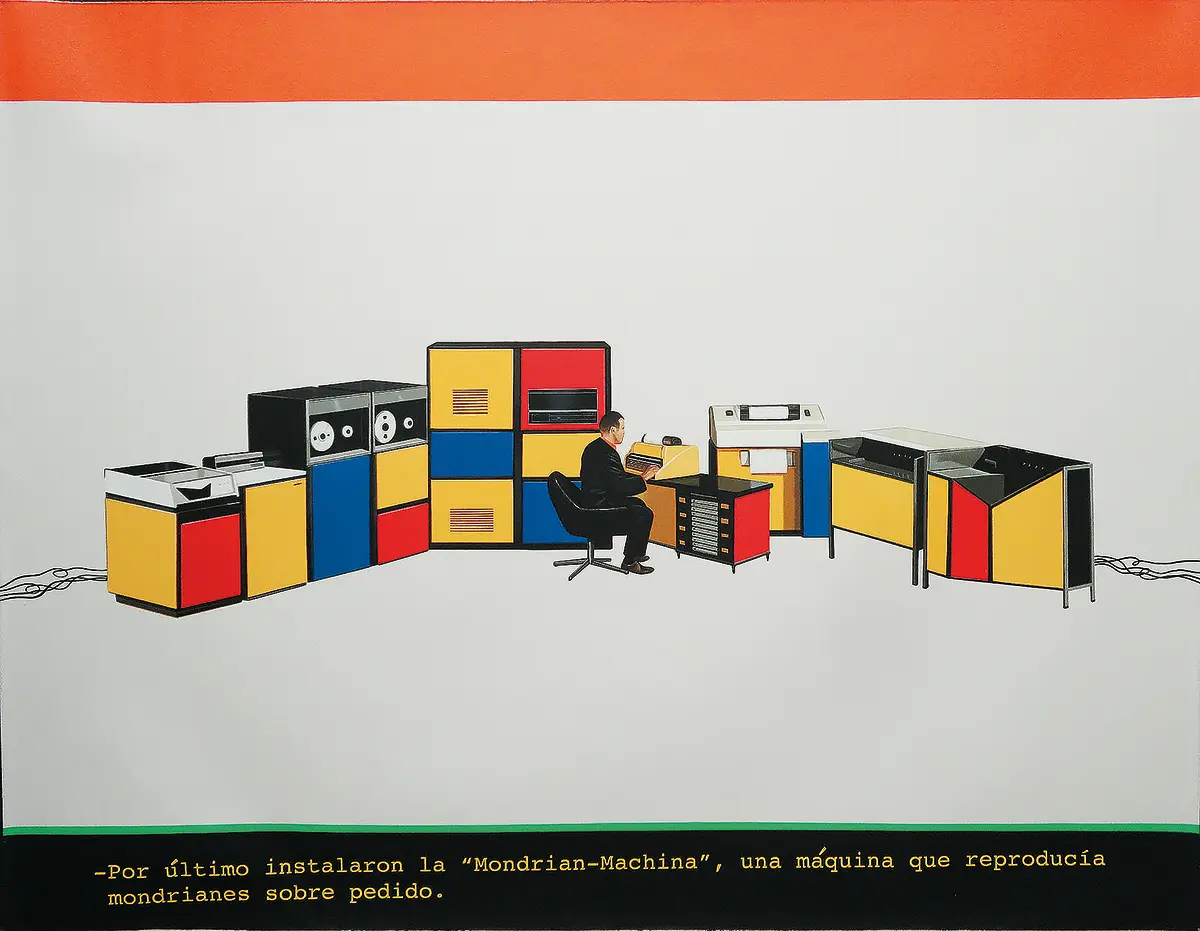
Mojica’s painting Mondrian machina (2011) prompts thoughts about the digital in connection to the image. In it, the topic is the dis-articulation of the author with regards to his or her product, and more than an issue of originality it is one of virality and viralization, in as much as Mondrian’s best-known colors and shapes are replicated as in a genetic chain in which mutations are inherited and become entrenched. It is not by chance that the smallest unit of cultural transmission, the one that travels from generation to generation, is called meme. In this painting we can read, by way of subtitle, the words: “Finally they installed the Mondrian Machina, a device that reproduced Mondrians upon request…” (like genetically designed babies, we could add).
Other works on exhibit, like Machina (2003, a machine with buttocks that can be caressed; El paisaje (The Landscape), from the Retratos series (Portraits, 2005), an oil work depicting María Elvira Escallón’s interventions in the countryside; and Felt Bed (2010), which alludes to Joseph Beuys’ materials and cosmogony, are examples of Mojica’s concern with critically reassessing the history of art, domesticating it for his own use and for his audience via the destabilization of the symbolic elements not only in the works themselves but also in the anecdotes and circumstances that surround them. Art is a highly self-referential field, and each work positions itself in connection with its own context even as it carries with it innumerable allusions—a fact that in turn becomes the artist’s space of operation.
In Instituto de investigaciones estéticas (Institute for Aesthetic Research) from the series Dimensiones variables (Variable Dimensions, 2015), viewers encounter several clues to Mojica’s procedure. The work is aboard an operative space, used by Mojica to display a painting that replicates the photograph of a barbershop, from which the artist extracts a small catalog of haircuts, reflecting each cut’s line on graph paper. Mojica positions himself like a neighborhood draftsman who has been commissioned to develop the local barber’s graphics in order to illustrate the range of possibilities on offer. The gray area between humor and critical thought (like a fading cut) appears in this space of conjugations that, like an editing table or a school billboard, situates the basic references about a topic, signals and assumes vernacular aesthetics, and delves deeper into the most contradictory properties. Perhaps this signage finds its pertinence in destabilizing what is considered a “non-vernacular” aesthetics, an established model of art.
BREYNER HUERTAS