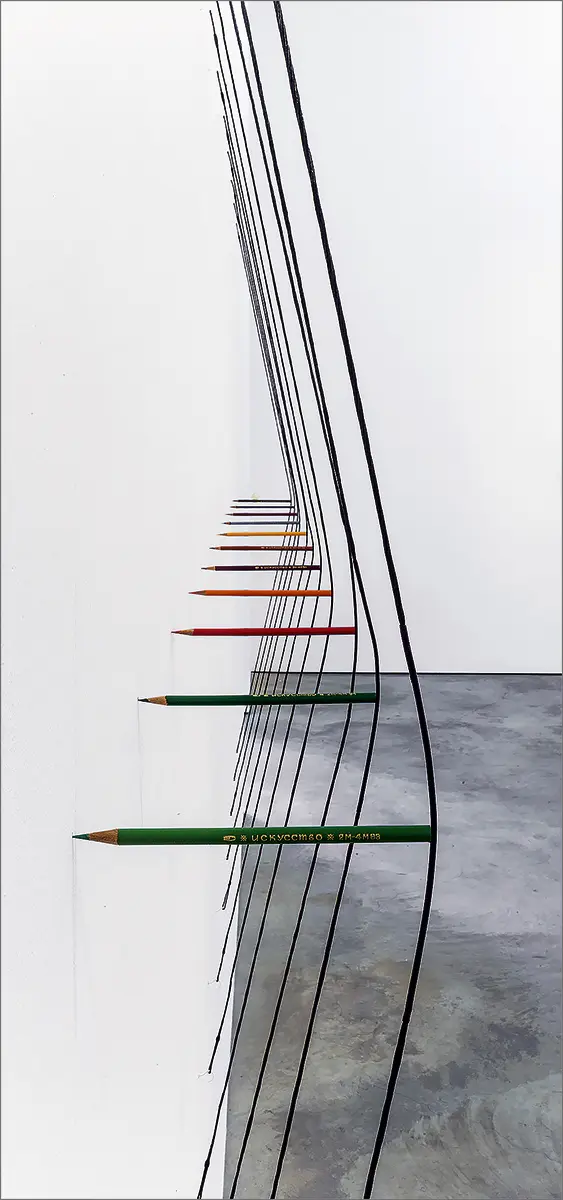
The work that gives its name to Marco Maggi’s exhibition at Sicardi Gallery is an installation consisting of 11 Russian color pencils pressed against the wall by bowstrings in a perfect and delicate equilibrium. Just the act of putting together this installation is more revealing of how Maggi creates than of the relation Putin may or may not have with color pencils. Although Putin is an impressive albeit despicable strategist, he is certainly not delicate. About delicacy Maggi has stated, “Our time is so concerned about the macro-drama spectacle that delicacy... has become subversive”.
We have yet to understand how, according to Maggi, delicacy can be subversive. He has stated, “I do not attempt to transform you. This is not an aggressive discourse about the world. I create an alternative world with its own rules.” On another occasion, he noted: “This is the possible revolution–we cannot choose big things, but we can choose little things.” (...) That’s why myopia is the best response to globalization: reducing the visual field allows us to discover infinitesimal details in the space of a square inch…”
From these words and the evidence of his works come together Maggi’s poetics, his way of doing art. Colored by his dialectic appropriation of Pop Art, objet trouvé, Constructivism, Minimalism, et al, is his penchant for the diminutive, a very unusual trait in contemporary art. The minute details of his oeuvre force the viewer to get closer, like people with myopia need to do in order to see objects clearly. That is why Maggi claims that myopia is at the center of his revolution, which is, in reality, a gentle subversion (as Linda Weintraub has stated) because the only thing that he intends to change is our posture as viewers before his work.
In the exhibit, Putin’s Pencils, the work that bears that name is the only one to which we do not need to get close as if we were myopic unless it is to make sure that the pencils are really balancing solely on account of the tension of the bowstrings. Whereas works like Black Letter, Vertical Complot I, II and III, and Growing Squares have two interpretations: one at the typical gallery distance, and the other one, at the myopic distance at which the viewer gazes at the details of a miniature.
Vertical Complots I, II, and III incite these two distances. At the gallery distance, they resemble Mondrian’s Constructivist compositions in white and the three primary colors. They are 6 x 6 arrays of the plastic frames of 35mm transparencies, an object that Maggi has resurrected from obsolescence and disuse. But hidden in their colorful and innocent appearance there is a mathematical challenge that Maggi has solved three times. The four-color map theorem states that, given any separation of a plane into contiguous regions, producing a figure called a map, at most four colors, are needed to color the regions of the map so that no two adjacent regions have the same color. The miniature distance reveals that the content of each slide is a paper whose surface has been cut with millimetric precision in order to give it tri-dimensionality. Maggi addresses this point, "I always work with soft materials that allow incisions or cuts; I draw inside the threshold between etching and sculpture. A crevice or embossing barely liberates a line from the plane; a cut on paper allows passing from the dimensionality of drawing to the tri-dimensionality of a micro-sculpture of folded paper."
Black Letter incites these very distances. At the gallery distance, Black Letter appears to be the night photograph of a large city like New York or Sao Paulo. But at the myopic distance that interpretation vanishes and is shown to be a deliberate illusion, and what we were interpreting to be lights on the windows of high-rise apartment buildings, are nothing more than precision cuts on color paper. In this case, the distances that the work incites are a kind of mirage: a lake that vanishes when we get close nevertheless reveals fish. Ambiguity pleases Maggi. He asks himself “Is this drawing a text or a texture? Are these ruins or foundations of an alphabet? Is it the aerial view of a city or the privacy of a computer system? Is that organic or technological tissue? Would it be pre-Columbian or post-Clintonian? This is why I refer to the “no idea.” It is simultaneously a micro and macro exhibition when in reality it only refers to what each one of us decides to understand after seeing it.”
Maggi is an artist whose work runs counter to contemporary art trends. On the one hand, he is an artist of many crafts, all of which he has invented: embossing aluminum foil, cutting and folding paper in minute pieces, balancing pencils on a sharpened point, etc. To add to the confusion of many, he chooses to do works with miniature details rather than monumental ones. By means of these strategies, he manages to change the viewers’ behavior.
FERNANDO CASTRO R.