As part of the ambitious and not entirely clear BienalSur—International Contemporary Art Biennial of South America, presented in several cities across the continent, and perhaps more successful for the participation it achieved than for its resulting exhibitions—the Espacio El Dorado in Bogota presented a solo exhibition by Argentinean artist Marcelo Brodsky (Buenos Aires, 1954) titled Foundational Myths. The exhibition featured four recent works: Mito Fundacional (Foundational Myth), Relación Carnal (Carnal Relationship) 1968, el Fuego de las Ideas (1968, the Fire of Ideas), and Migrantes (Migrants). The first work is a triptych consisting of map reproductions of South America from 1617, which intervened with hand-sewn photographs, crayons, and watercolor.
Thanks to the Archive of Modern Conflict directed by Timothy Prus—who recently published the brilliant photo book titled The Cow and the Orchid, Generic Colombian Photography, edited by Bogota-based publisher La Silueta—Brodsky had access to the family album of a Colombian army officer identified as JMG. With the inclusion of some photographs from that album thematically arranged across the three maps, Brodsky reconstructed the officer’s military life.
The first image addresses the officer’s training in the US. The second reconstructs his participation in the Korean War with the so-called Colombian Battalion sent by Colombia to support the US. In both images, Brodsky relies on his crayon notes to point, on the one hand, to the decolonization struggles during the second half of the twentieth century—Algeria, Vietnam—and, on the other, the US military intervention in Colombia, whether through logistical help, like with the Plan Colombia initiative or the military bases used by the US in Colombian territory—Malambo, Palenquero, Apiai.
The third piece of the triptych consists of images depicting the Colombian army’s airborne landing known as Operation Marquetalia in 1964, a military action against four villages in the south of Colombia whose people had decided to self-govern and live in relative independence from the central government. The brutality of the military attack had unanticipated consequences: the small group of peasants eventually became the Revolutionary Armed Forces of Colombia (FARC) and fought the Colombian government until 2017, when they became a political party.
Brodsky exhibited his work for the first time in Colombia in 2014. On that occasion, he was invited to participate with La Clase (The Class), one of his most important works, in which he appropriated the photograph of his class at the Colegio Nacional de Buenos Aires. Intervening the image with crayons, Brodsky wrote short phrases about the life of each of his classmates after the photo was taken. The resulting piece offers viewers an idea of the enormous damage that the military dictatorship in Argentina caused to an entire generation and to the country as a whole.
A human rights activist and founding member of the Parque de la Memoria (Remembrance Park) in Buenos Aires, Brodsky reused the image to commemorate the 43 students that disappeared in Ayotzinapa (Mexico) in 2014. This experience undoubtedly prepared him to approach the Colombian armed conflict, a complex theme that few artists who are not from Colombia dare to approach, and much less hope to do so as successfully as Brodsky, who became interested in the lengthy peace process with the FARC that, after 45 years, led the organization to pursue a legal political path.
The theme continued in another triptych titled Relación Carnal (Carnal Relationship), in which Brodsky borrows images from the aforementioned photo album and also uses press clippings, employing the same collage strategy, this time on a map of the West Indies—the Caribbean, in this case—with the goal of outlining the history of other military interventions in other countries of the region.
Not losing sight of the fact that Colombia is a country of immigrants—the war in Colombia resulted in millions of displacements—where a good part of the economic resources come from the remittances sent by those living and working in the US and Europe, Brodsky presented the work Migrantes (Migrants, 2016), centered around the mass exodus in recent years of people from the Middle East and Africa to Europe. Using images from the Agencia EFE, the artist once again resorted to interventions in color and phrases written on the images that give a voice both to the people portrayed and to the rest of us: “We are all immigrants,” for instance, is a phrase that Brodsky—a descendant of European immigrants—like many Argentineans, assumes as his own.
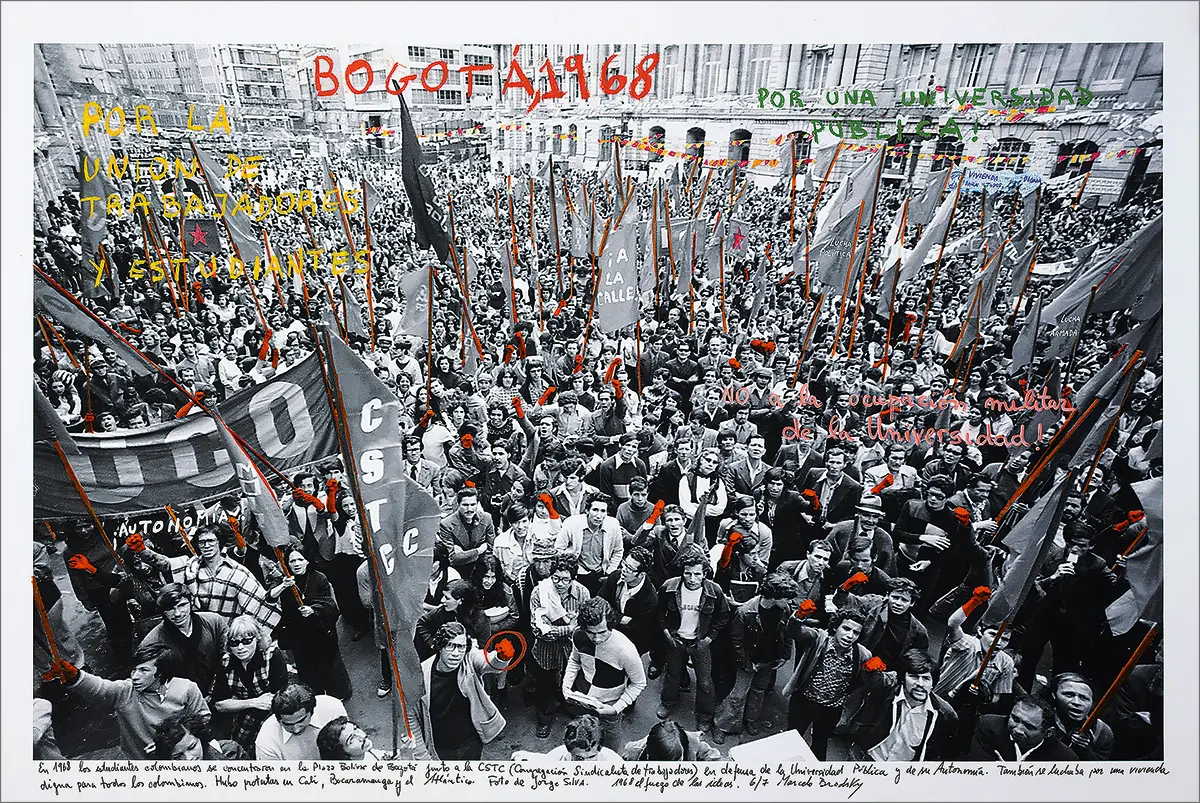
Lastly, the exhibition also included the work 1968, el Fuego de las Ideas (1968, the Fire of Ideas), based on the excellent collection of images of marches and demonstrations that occurred during that year in countries like Australia, Czechoslovakia, Spain, France, England, El Salvador, Mexico, and Colombia. In a year that marks the 50th anniversary of May ‘68, the relevance of this work resulted in Brodsky recently being invited to countries like Mexico and France, where that date is very important. In fact, Brodsky will be uninterruptedly showing his photographs in several countries around the world during this commemorative year.
For Bogota, the artist carefully looked for a photograph of the protests that occurred in that year, choosing an image by documentary photographer Jorge Silva, who was recently honored with the publication of the photo book titled Los Silva (The Silvas) by La Silueta publishing house, with the participation, as guess editor, of English editor and curator Tim Prus.
In 1968, the Fire of Ideas, Brodsky not only intervened paper but also the walls of the Espacio El Dorado by writing short, uplifting, and hopeful phrases with crayons. With his characteristically energetic idealism and activism, Marcelo Brodsky once again showed to be an artist interested in contributing to the interpretation of history, the discussion of urgent global themes, and updating the renovating legacy of May ‘68. It is worth mentioning the relevance of the exhibition at a time when other exhibitions in the city were also addressing the theme of migration.
SANTIAGO RUEDA