Being born and raised in La Guaira, the capital of the state of Vargas in Venezuela’s central-northern coast, made Manuel Eduardo González (1988) become interested in an emblematic architectural monument that is part of the history of the region: the legendary Miramar Hotel.
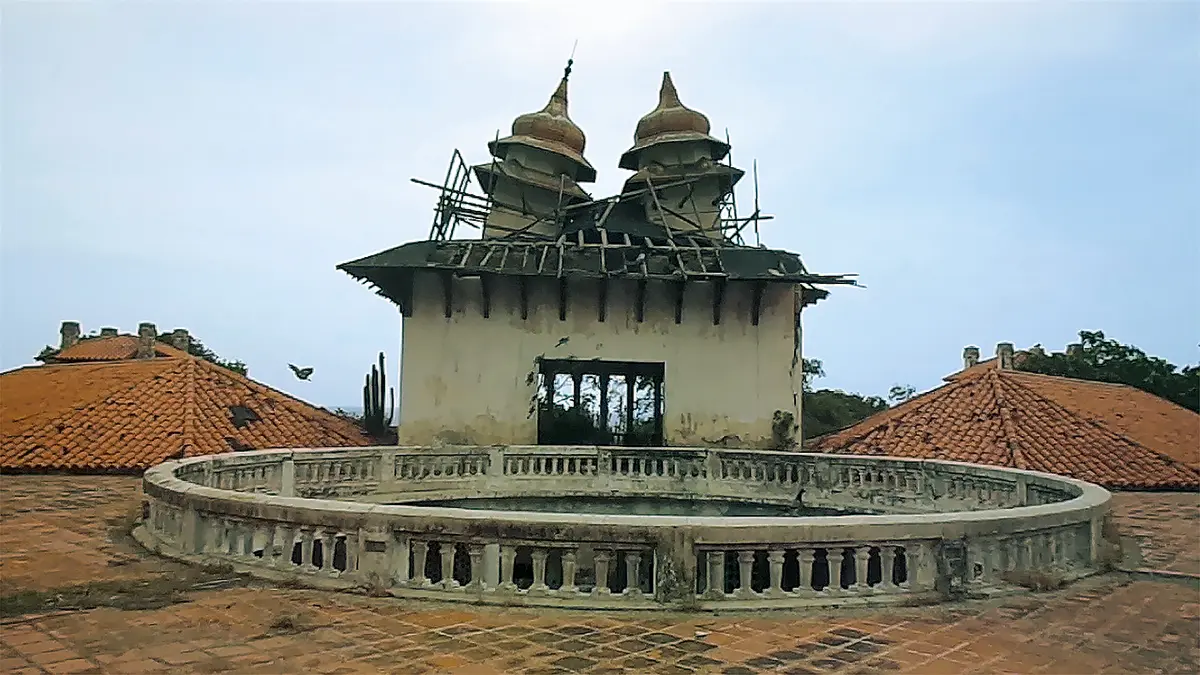
Designed in 1926 by Venezuelan architect Alejandro Chataing, the structure was inaugurated in 1928, becoming the first luxury hotel in that area of the Caribbean. Beginning in 1958, the same year that Marco Pérez-Jiménez’s dictatorship was overthrown, the building fell into abandonment. Since then, and to this day, the Miramar Hotel continues to stand along a street bend in the town of Macuto, easy prey of the ocean’s salty residue, the daily winds, natural disasters, and the inexcusable neglect of the government in turn. But in spite of its abandoned aspect, it continues to stand opulent and majestic.
Through the years there were failed attempts to recover the monument that eventually strayed from its original objective. In 1974, the building housed the Venezuelan Council for Children; in 1993, it was adjudicated to the Museo Armando Reverón, institution destroyed by the 1999 landslide caused by torrential rains and flash floods; in 2001, it was turned into a warehouse for the Galería de Arte Nacional; and, finally, in 2013, a restoration project was officially announced between the government of Vargas and the PDVSA Centro de Arte La Estancia but never came into being. The Miramar Hotel continues to be in a deplorable state.
Under a multidisciplinary perspective, Manuel Eduardo González reflected on, reconstructed, invoked, and even reinvented the steps that led to the Miramar Hotel in his solo show titled Modern Tropical, presented at the Spazio Zero Galería in Caracas. The exhibition consisted of drawings, photographs, collages, prints, installations, and videos. Its approach to the monument was, on the one hand, from memory—as this hotel was a constant referent in the place where González grew up—and, on the other, the result of historical research from the perspective of art and history.
In 2013, González gained access to the archives of art critic and historian Juan Carlos Palenzuela. There, he found newspaper records of press releases from the period transcribed by Palenzuela. This material was included in this exhibition. According to one such document from 1928, the hotel was built in a “picturesque seaside resort town […] [and is] a brilliant exponent of the era of civilization and progress that the Republic is striving for,” alluding in this manner to the period of General Juan Vicente Gómez’s government. In another document from 1932, the Miramar Hotel is described as “the pearl among the hotels in the Caribbean.” To consider this hotel as a source for visual art research was a way of working from memory on two levels: by evoking the past—personal and historic—and at the same time by capturing video images and photographs in the present in order to establish a reality that must never again be repeated.
González bases this project on the belief that architecture has an impact on our experiences. Being aware of the importance that this hotel once had and the way it impacted the lives of the citizens in the area, were enough incentives to reassess its value as a monument and image from several angles and perspectives. This resulted in the creation of the various pieces included in the exhibition. Some centered on the architecture of the hotel and others in the surrounding landscape. The video titled Miramar combines both elements. The hotel is approached from several angles. To allude to the Caribbean context, González had to add the sound of the ocean, which cannot be heard in situ as a result of the 1999 mudslide that expanded the distance to the shoreline. “The entire video—explains Manuel Eduardo González—can be read as a search for the ocean” (www.tráficovisual.com). In this sense, the exhibition evidences the topographical changes of the place.
The landscape is present in the collages titled Sedimentaciones (Sedimentations, 2015), where González created contrasts by combining urban or provincial views with the sky. He used images from the book titled Ferdinand Bellermann y el Paisaje Venezolano 1842-1845 (Ferdinand Bellermann and the Venezuelan Landscape 1842-1845), because—according to González—the past solidifies and “shapes our present.” He inverted the horizon line to create what to him represents “the geological formation of the territory.”
The architectural blueprint of the hotel is both document and a source of artistic expression. Based on it, the construction’s Greek-cross plan is reinterpreted pictorially in several series that generate synthesized images, a sort of serial rose windows with color variations. These can be appreciated in the installation Mirador (Lookout, 2017) and in paintings and prints like Proyecto de Hotel para el Balneario de Macuto (Hotel Project for the Seaside Resort Town of Macuto, 1926-2015), Quiebre (Break, 2017), and Tres Variaciones de Azul y Rojo (Three Variations in Blue and Red, 2017), among others.
In Modern Tropical Manuel Eduardo González once again showcased the vestiges of a type of architecture that is particular to a time: modern and tropical at once; an architecture that through generous balconies and large windows sought the integration with nature, with the light of the tropics, and with the voluptuous views of the Caribbean ocean. In this instance, art and its referent are summoned to use a landmark, above anything else, as a cautionary tale.
SUSANA BENKO