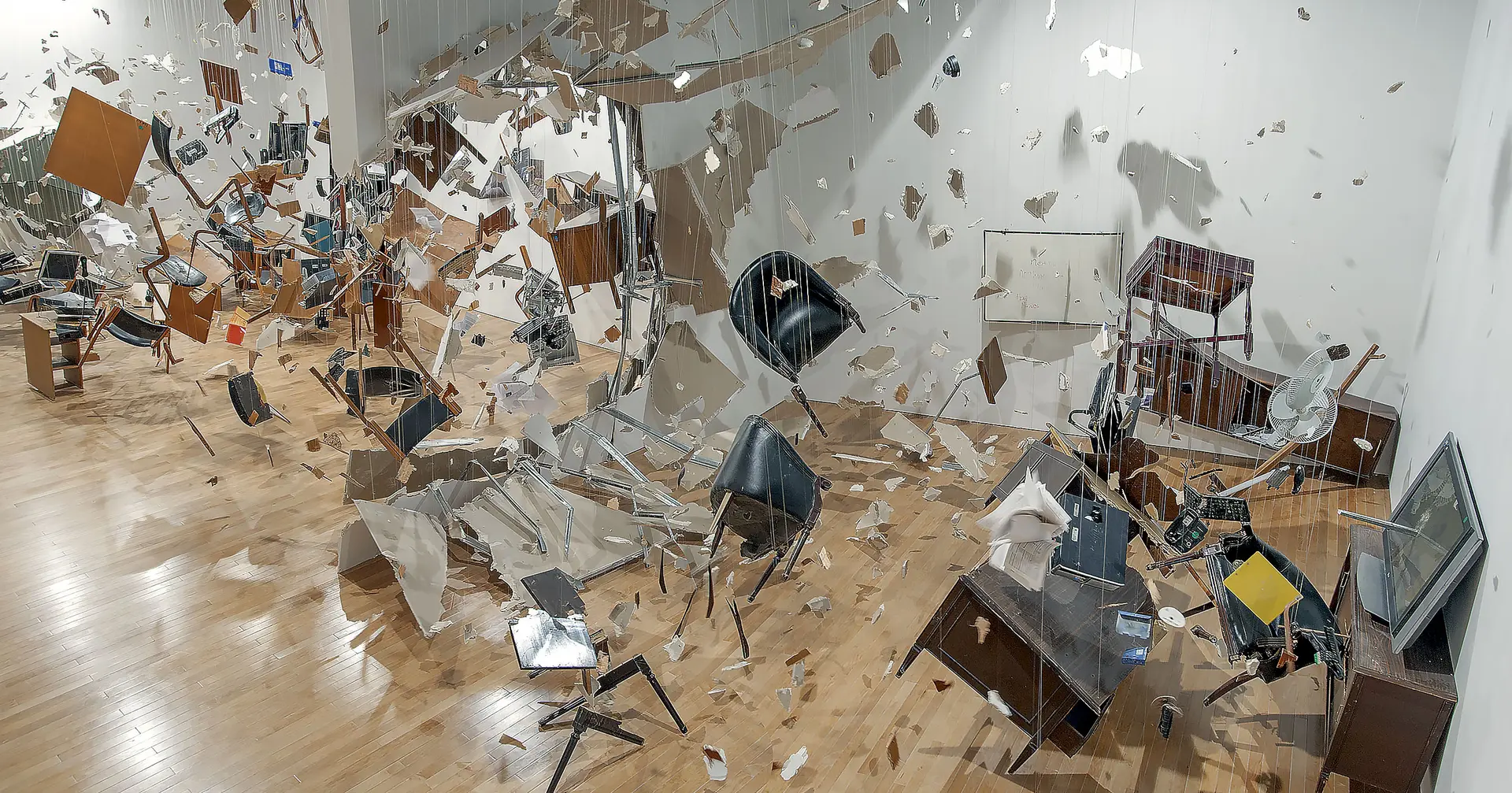
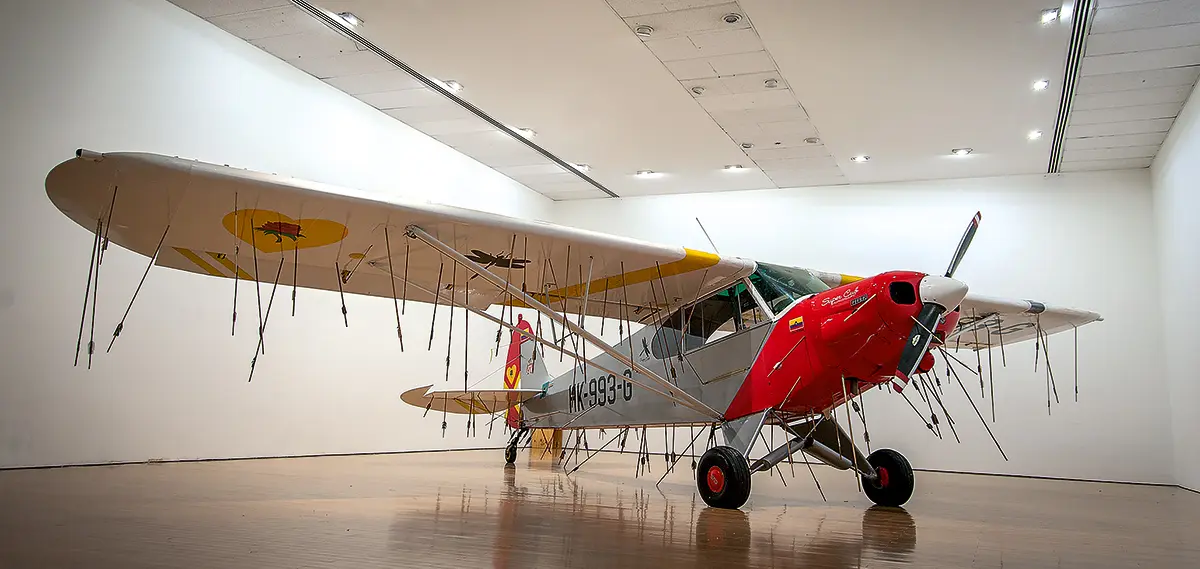
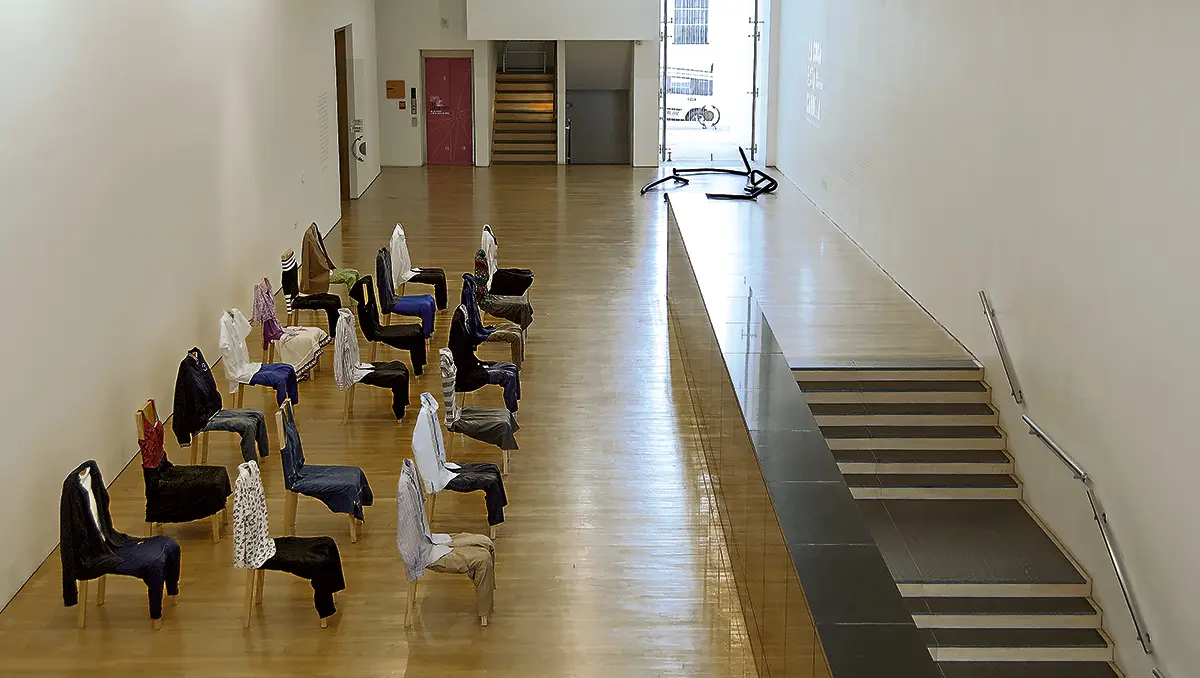
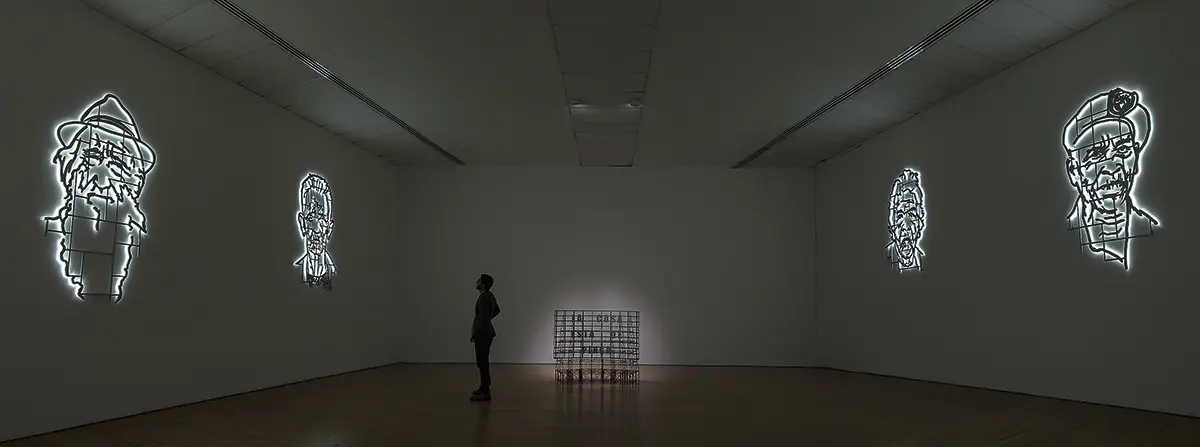
Two conga drums that melt on the floor; lines of seats “dressed” in everyday attire; an arrow-ridden small airplane; an office was blown to smithereens, as in the ending of Zabriskie Point; a watchtower set horizontally on the ground; the linear structures of the billboard depicting the face of Che Guevara in Havana’s Plaza de la Revolución, transformed into portraits of old people, Félix, Simón, or Isabel, with their watchful gaze and their creased skin.
I can say that Los Carpinteros came to Colombia with a manifesto about the object. Behind the equations that situate it in its function, design, commodity, and propaganda, Los Carpinteros execute complex labor towards the estrangement and separation of the objects from such passively accepted functional and symbolic bondage, enlarging, reducing, suspending, or twisting them in order to connect to everyday local experience, so that the object explodes in front of the viewer and his or her capacity for critical thought.
I believe it is urgent to reflect on the relationship between the contemporary subject and objects: excessive and discarded in capitalism, derelict and stopped in time in socialism. This exhibition of works by Los Carpinteros makes it possible to think about the relationship we have with material life, which is more and more mutable and in flux. It puts me in mind at this moment of a life in constant motion, filled with useless objects that one has to carry around and pile up. We already saw in a painting by Beatriz González many Colombians in flight from Venezuela, wading rivers with their beds and armoires on their backs. And we have seen ships atop buildings in the images left behind by tsunamis that redefine the landscape in a matter of minutes. In their materiality, objects signal the paradox of living between the illusion of eternity and the evidence of contingency.
The objects created by Los Carpinteros have a hunger for multiple meanings, as Paulo Herkenhoff said in reference to some works of Latin American art. What I mean to say is that they offer themselves up to viewers open to the possibility of many meanings. They allow themselves to be contaminated by the lexicon of street life, by the news, by the despair and the weariness of subjects with illusory goals to accomplish, by the small constructive details that we most often see as unimportant. They signal the course of systems of power, the absurdity of our defense, attack, and surveillance constructions, or the falsities that political discourses lay all around us.
It is worth noting that, in this exhibition, the processes behind the creation of some projects were on display upon viewing tables. The watercolor sketches for these projects grabbed my attention because they seemed to reveal that while Los Carpinteros—Dagoberto Rodríguez and Marco Castillo—studied in Cuba in the late 1980s in a highly traditional art school (watercolors 1 and 2), but also that this anachronism allows them to see many nuances of light and shadow. Hues that, in my view, ultimately translate into objects that breathe in space, establishing a fluid dialog with the walls and the floor.
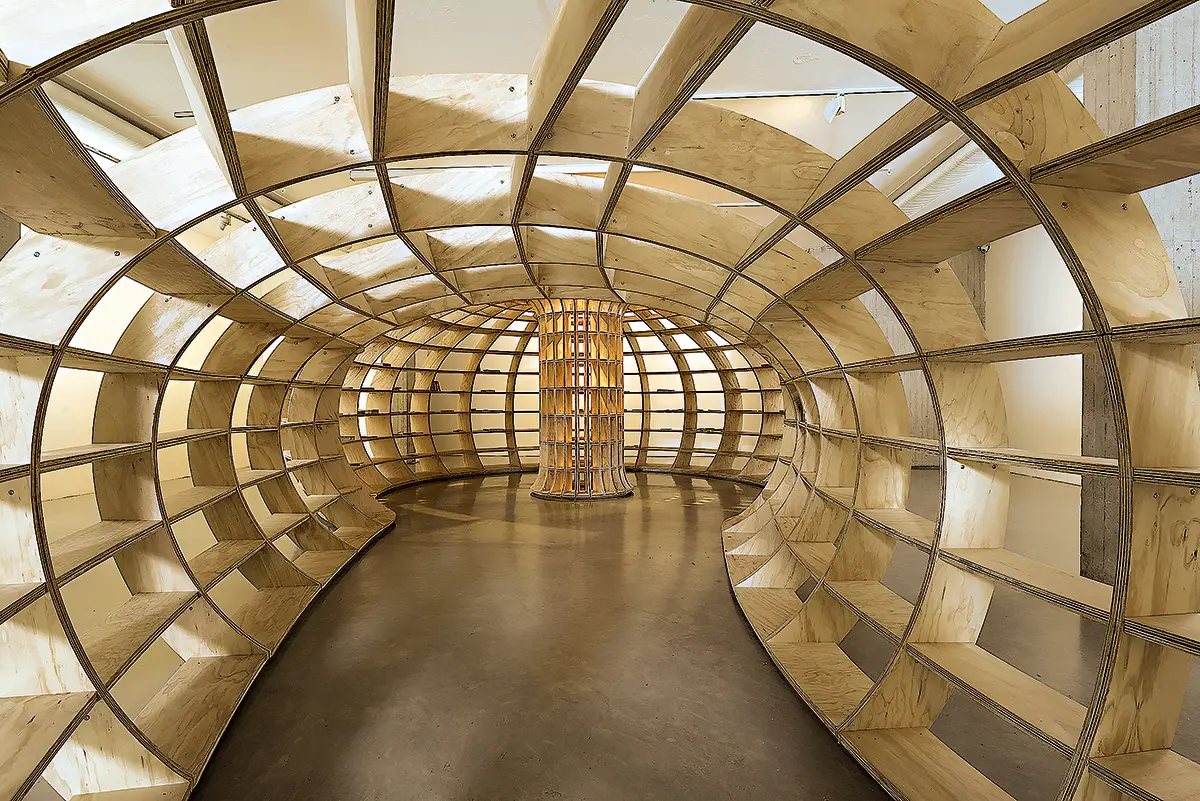
This permanent dialog of Los Carpinteros with objects and space has driven the duo to explore the relationship between art and architecture, especially with the kind of architecture, like Norman Foster’s, that conceives structures to cover the minimal actions of living, such as traversing a plaza or sitting down. In their visit to Bogotá, Los Carpinteros built inside a city gallery, NC-arte, one of their well-known “reading rooms”. It is a pity they didn’t build it near one of the existing reading rooms at the library, where they would have had a captive audience, but this is not a critique; what I mean to point out is that these porous domes that encircle the viewer, signal and protect real or utopian collective activities, at times impossible and in decadence, like reading are today, threatened by the impossibility of staying put in a single place and paying sustained attention. Hacia una lectura expandida (Towards an Expanded Reading), the title of the installation, invited visitors to walk around a strange library, taking down books from the shelves and leafing through them, to bring some with them to share with strangers, and to be willing to listen.
These structures, not for surveillance but for sharing, connect the interests of Los Carpinteros with other realms, not as much of the public arena—mediated by the State and private property—but of the commons, which is a construction of singularities, of the micro-experiences of people who get organized in response to vital needs and in that way gradually appropriate the public realm with a range of inventive and inclusive proposals. I celebrate this mutation of the object by Los Carpinteros towards the construction of a “campus”, which is to say, the artistic demarcation of a portion of the social space where life can unfurl in activities that will have to do with conversation and with encountering others, which is, in the end, the space of the political.
* View of installation in La cosa está Candela, MAMU, Banco de la República, Bogotá, Colombia. © Los Carpinteros. Photos: Daniel Martín Corona. Courtesy: Los Carpinteros.
NATALIA GUTIÉRREZ
Professor, Universidad Nacional de Colombia.