An almost geometric mound made from 280 kg of mud and 400 kg of dry and crackled cornmeal (2016) uncomfortably inhabits its own overflow—given the disparity in dimensions between matter and space, form and content—in one of the exhibition areas at Casa del Lago. Cavar en el surco (Hoeing into the Furrow), curated by José Roca, brings together recent works by Sinaloa-born artist Ling Sepúlveda (1982), the result of his residence in Bogotá (Colombia) thanks to an agreement between Casa del Lago and FLORA ars+natura. The works in this exhibition reveal a series of territorial plays of aesthetic, symbolic, and semantic containment/distension, between everyday practices of rural life and the extendibility of certain “agricultural policies,” visible and invisible, immune to any term, bridle, or border.
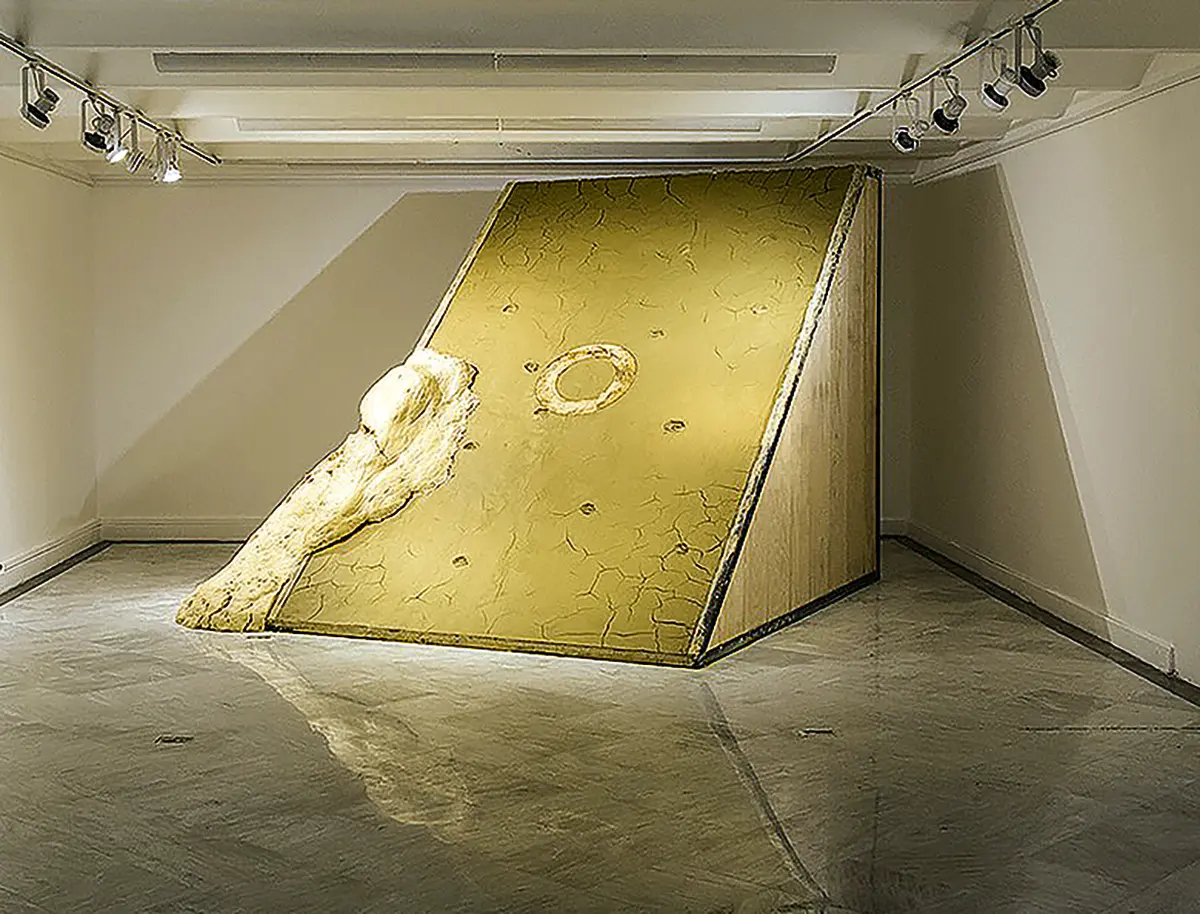
The monumental structure, whose frontal surface extends in an ascending diagonal (height: 3.5 m), almost contained by a structure in wood and metal (width: 2.1 m; length: 1.7 m), formally replicates the “white” of the popular game known as tejo (played in several Colombian regions and historically connected to pre-colonial indigenous practices), the center of which is demarcated by a circle called bocín; both teams seek to throw the tejo, a solid iron piece that can be held in one hand, towards the bocín, seeking to penetrate it.
In Poncho y guarito, 2016, a poncho “for tourists” 1—in the colors of the Colombian flag, hanging languidly from a peg in the wall—and a half-finished bottle emphasize, in “peasant mode”, a living, anonymous yet fully recognizable loneliness; weary self-absorption; lone loneliness reiterated in the exhibition’s one wall projection. Pointing forwards, the shot remains static upon the residual, which is to say, what merits filming is not the sellable body/product of corn, but the disorderly pile of “peeled” husks (Pelando mazorca, Peeling Corncob, 2016). Three cuts of synthetic grass situated on the floor at various points play with the distances and dimensions between the works. Resting on one of them, as if left there by mistake, is a self-referential text that contextualizes a temporally singular narrative about rancho life, authored by the artist (Yo nunca fui vaquero, I Was Never a Cowboy, 2017). In another of these fake green islands, five screens project landscapes that are as “resemble” as they ate anodyne, held fast to five wooden sticks (Paisajes y tejos, Landscapes, and Tejos, 2016).
A stuffed hen (Gallina, Hen, 2014), tied by the legs and hanging from the ceiling, brings into closer focus questions about the confusing pertinence/belonging of modes of interrelation between man and nature. A “positive” exercise that imagines its demonstration in the mastery of a horse that shows (off) its graceful and useless movements in a three-screen video installation titled Domar a la bestia (Taming the Beast, 2016). Missed encounters signal the unpredictable (i)logic of existence-by-execution. Four drawings whose title—Piedrotas (Large Rocks, 2016)—guarantees the representation of large boulders, evince, via a dimensional comparison polarized between a distended surface and the condensation of that which is represented, a silently violent designation of powers. The tiny traces of rock and the expansive, suffocating whiteness of the paper are put up as a gamble for the absurd, boasting of the value correlation that is assigned/able at will—in this case, the will of the artist.
Another formal/signifying cross-hatching takes place between two of the three series of drawings included in the exhibition. First one needs to note the brief, discrete lines traced by the figures and folds that form the triangular paper bodies named Mechas (Fuses, 2016), small packets of gunpowder actuated by a well-aimed hit of the tejo; explosive/exploited triumphs that, added together, will assign victory by reckoning. But these minimal, calm, patient drawings seem to blow up in the other series. This time around, the traces, the borders, and meanings of the imperfectly circular charcoal-on-paper lines are merely random residues displaced by a small remote control car (Carrito 1, 2, 3, and 4, 2016).
Ling Sepúlveda’s exhibition revisits the usual shapes of contemporary peasant life in Colombia, interrogating the present/potential of her/our ability to understand the “effects” of intraterritorialization as individual, local, social, cultural action-in-retention/resistance. The works anticipate the predictability of their own reading as formal deconstruction that resembles archeological records split from the first/last layer of a surface—seemingly obvious, but vital and incisive—participant/proof of recent continuity. Records, objects, representations, and actions of the other that Sepúlveda brings along as if attempting to corroborate the “unavoidable” fruitful(less)ness or re-furrowing a furrow, reasserting the meaning of the action that the title of the exhibition emphasizes. In other words, if the furrow—literally—already exists, to continue hoeing into it will end up becoming an unnecessary action, dogged reiteration, (in)consequential reaffirmation. When in fact it might be only relatable as “appropriable” by means of a set of bodily gestures that can be replicated. Otherwise, I suppose, we would be talking of “hoeing (in) a furrow”—one that would be another; a “new” furrow. Perhaps even, by sheer survival instinct, a somewhat different one, one that is almost imperceptibly shifted in its habituated functionality, furrowed by itself.
NOTE
1. From “Yo nunca fui vaquero” (I Was Never a Cowboy), a text written by Ling Sepúlveda specifically for this project.
MARCELA QUIROZ