One of the interesting aspects of the program Pacific Standard Time, sponsored by the Getty Foundation and presented in Los Angeles, was the organization of exhibitions centered on what the US academy calls “Latino Art.” It consists of art produced by Latin American migrants and their descendants in the United States. These artists have a very limited projection and debate in Brazil—my country of origin—as a result of our different geographic situation and colonial history; something that really intrigued me during my visits to those curatorships.
Clearly, one of the most impressive exhibitions was the retrospective by US photographer Laura Aguilar (San Gabriel, CA, 1959) at the Vincent Price Art Museum in East Los Angeles, a very interesting area because of its high Latino population. Being also of Latin American descent, Mexican to be more specific is the reason that her artistic production is often referred to as chicana. Born in the late 1950s, her first experiences with cyanotype and photography occurred during the 1970s and 1980s, in courses and in her early participation in exhibitions.
Show and Tell, the clever title selected for the exhibition, established a dialog between the mounting of the show and Aguilar’s inquiries. Her photographic production, based nearly exclusively on portraits, pulled our gaze in iconic fashion: the exhibition rooms were populated by images of small dimensions but powerful because of the themes that they covered. We first entered into contact with unfamiliar faces or the artist’s own face, and then try to rationally process them. Even in the works in which text became an important element to explore—and many of these—the contact established with the human figures photographed in black and white were the priority. In other words, Laura Aguilar is a great photographer of people.
As we walk through the exhibition it is remarkable to note the manner in which the interest in other people gradually turns into an exploration of the artist’s own body. In the 1983 series titled Xerox Collage, Aguilar created collages with her own images and other images appropriated. Already in those colorful compositions, there are words that point to identity themes: “Lesbian Woman” appears in one, while another montage depicts the image of a young woman that diverts from the stereotyped image of a US family. Isolation rather than normativity are issues that clearly appeared throughout her explorations.
From this initial period of her artistic production, it is noteworthy to mention how often we find photographic portraits in which the subjects pose for the camera with different gestures. Always titled after the first name of the person portrayed, the images focus on individuals who are not part of the LA celebrity culture, but rather people that belong to a constellation of affections close to Aguilar: Sandy, Eddie, and Pam are some of their names. Because of the places where they were photographed, for the features of their faces, and as a result of the associations established by Aguilar between them and certain objects, it becomes clear that most of them are immigrants or descendants of immigrants. And there are not only chicanos, but also persons from the Chinese, Japanese, and Afro-American communities; all of the people that, like Aguilar, can be predominantly regarded as “the others.”
But Aguilar’s gaze never falls for romanticist or naive tendencies. Also during the 1980s, she produced a series of works that sharply question the immediate association with an identity that has been marginalized in US culture. The 1987 series Latina Lesbian consists of portraits of openly gay women accompanied by texts written with their own hands that question the stigmas surrounding their sexualities. Aguilar’s self-portrait included in this series offers precious phrases like: “I am not comfortable with the word lesbian, but as each day goes by I am more and more comfortable with the word LAURA.” The series How Mexican is Mexican (1990) consists of several triptychs in which one of the images is a portrait of Aguilar. Underneath, again with different letters, we read stories of photographed women questioning the notion of the so-called “Mexican American.” To what extent is the term chicano nothing but a label that widens more than closes the gap between differences? What is Mexican about a person born and educated in the United States?
In addition to this series (and others) that explore gay culture in the city, it is interesting to recognize that Aguilar’s gaze during the 1990s also reflected on the meaning of being a female artist. Furthermore, in one of her photographic series, she is depicted holding signs with sayings about the meaning of being a poor artist who does not come from a typical aristocratic family of artists. In one of the signs she categorically affirms: “Dear Santa, I want a job with a health plan.” And in a more dramatic one, from the 1993 series titled Don’t Tell Her Art Can’t Hurt, Aguilar poses with a gun in a group of images in which she wonders about themes still pending that need to be addressed in her poetic.
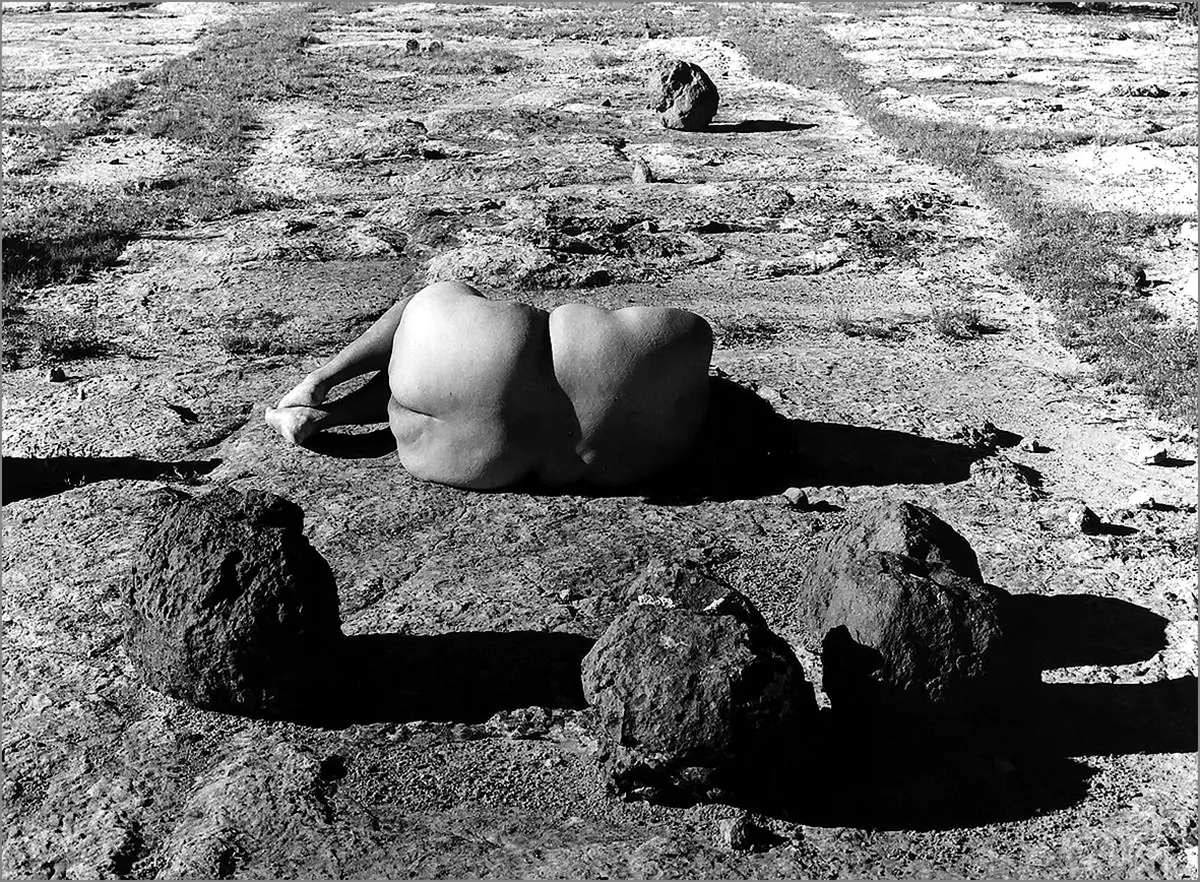
Lastly, the exhibition concludes with the incorporation of Aguilar’s photographic experiments involving her nude figure inserted in natural landscapes. Developed during the early 1990s, these images become the central focus of her final production from that decade, in series like Nature Self-Portrait (1996) and Stillness (1999). Generally black and white images, these photographs were created before the most recent series included in the show titled Grounded (2006). Her nude body wanders through different landscapes, between rocks and trees, generating contrasts between her skin and the things that surround it.
Thinking once again about the exploration of non-stereotypical images that free us from definitions about the ideal physique, Aguilar’s body is opportunely presented: obese, curvilinear, and with areas of chiaroscuro. Her skinfolds are harmoniously complemented by the leaves, sand, and even by a few other learner bodies that surround her in some of the images. That the images appear to be searching for silence and attempting to become one with nature, place her production in a different place from the affirmation and negation of verbalized identities—something generated by social studies—found in her other images.
One leaves the exhibition by Laura Aguilar with the certainty that there is still a dialog to be had between the production of chicano or “Latino art” and art created in Latin America during recent decades. A good start could be to include Aguilar’s work in more group exhibitions, even in some all the way down in the southern hemisphere of the Americas.
RAPHAEL FONSECA