CARIDAD BOTELLA
The representation of war makes it possible to focus on several aspects derived from the war itself; it is often difficult to go beyond merely sensationalistic accounts of violence or the war machine as such, the latter seen—as Goya did so masterfully and incisively in The Disasters of War—as a unitary whole that affects and is fueled by all sides of the conflict, without “good” or “bad” actors. In the end, a dead body, mutilated, hung, or thrown in a river knows no ideology of belief other than the grief of the loved ones that are left to cry for its absence. Of all the possibilities one can think of in order to bring armed conflict to the terrain of contemporary art, Juan Manuel Echavarría (1947, Medellin) has chosen the most complex: to represent the human and poetic side, the side that opens paths towards an understanding of others and a possible reconciliation with supposed rivals.
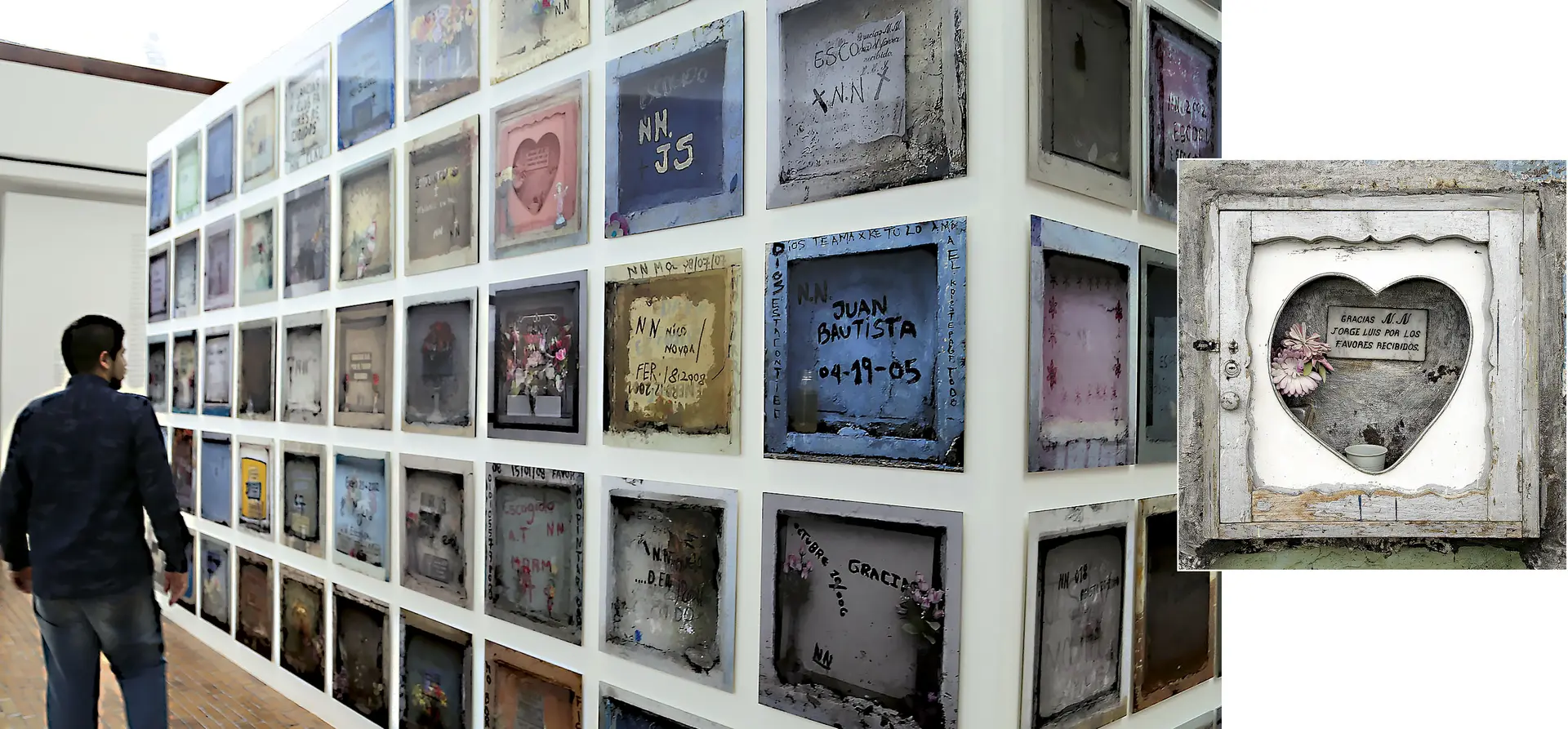
The exhibition Ríos y silencios (Rivers and Silences) gathers works from projects both concluded and ongoing, such as Réquiem NN (Requiem NN), El testigo vivo de la masacre de Las Brisas (The Living Witness to The Massacre at Las Brisas), Silencios (Silences), or ¿De qué sirve una taza? (What is a Cup Good For?), among others, created by Echavarría and in collaboration with Fernando Grisález and the Puntos de Encuentro Foundation’s team. These projects are the result of twenty years of researching and traveling through Colombian territories affected by armed conflict. A large section of the exhibition is taken over by La guerra que no hemos visto (The War We Haven’t Seen), a series of works created by former combatants from the guerillas, their paramilitary opponents, and the National Army, the result of workshops held by the Puntos de Encuentro Foundation, that were displayed back in 2009 and now return with the names of their authors properly identified and their stories told in the first person.
This exhibition presents audiences with a vision of the war in Colombia from as many points of view as voices are featured in the show. In that sense, the artist is able to have his voice be joined by others, very essential ones that intertwine to form a mosaic of perspectives. As an art exhibition, it fulfills the difficult task of touching the soul of its visitors, opening eyes and minds to a reality that is often hidden in an urban context, a reality that the daily news doesn’t usually touch upon the human reality at the core of the violence of the armed conflict, which shifts us from the abstract into the concrete. Surprisingly, Ríos y silencios generates heartrending feelings of compassion that are born outside of any ideological or religious affiliation and appeal to the Greek etymology of the word, a reference to suffering together, a human feeling that emerges from our understanding of the suffering of others and our need to alleviate it.
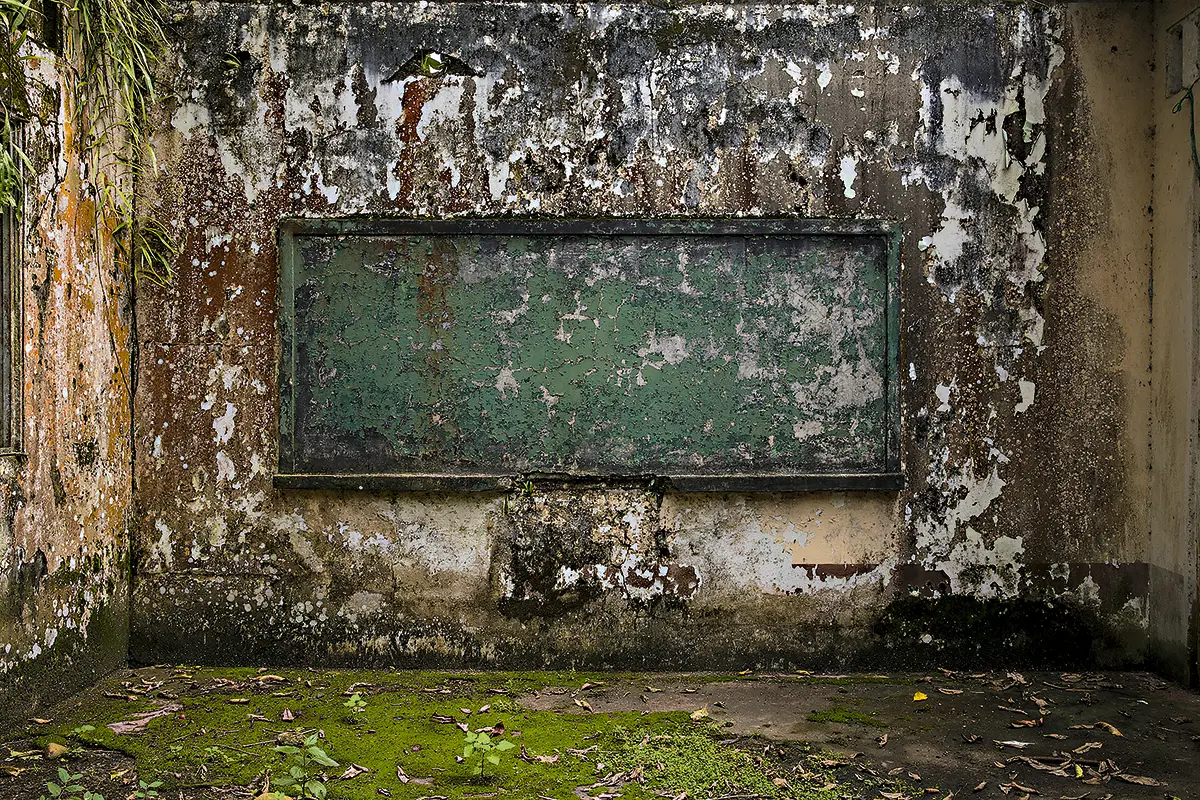
Our first encounter with the exhibition is Guerra y Pá (War and Pá), a video of two parrots who, atop a cross-shaped peg, fight for space, even though we intuit that they also love each other like a couple destined to care for and hate each other at the same time. The word guerra (war) is clearly enunciated, while pá sounds like an incomplete attempt at paz (peace), an “I want but I can’t”, like a shot of fiction. Over the years, Echavarría’s work has evolved mostly through photographic projects based on journeys, quests, discoveries made with patience, and random luck in which time moves hand in hand with finding stories, sometimes with words and sometimes wordless, yet always eloquent in their very existence. One of these stories is Silencios (Silences), a prodigious series of images of blackboards in abandoned schools that Echavarría began photographing ten years ago, after an invitation to the town of Mampuján, in the Montes de María jurisdiction, department of Bolívar. The town was memorializing its displacement by the paramilitary group Heroes of Montes de María. There Echavarría found the first of hundreds of blackboards, symbols of learning, of the innocence of children and youth, which in their state of dereliction represented the abandonment and disappearance of spaces, but above all the shift in their meaning, as a place and an object that used to represent dreams for the future came to be the site of helplessness, of a broken destiny. And even so, the images possess a sublime beauty. Perhaps this is one of the distinguishing characteristics of Echavarría’s work: he generates a symbiotic relationship between grief and sublime beauty in each one of his projects, which carve an aesthetic empathy into our consciousness, in the philosophical sense of the word. There are also stories of displacement and violence that speak through the voices of men and women in Bocas de ceniza (Ash Mouths), a video that, again, appeals to us via the affective relationship we establish with those extreme close-ups of faces singing, with the beauty of their music, until we understand the content of their songs, which are an attempt to exorcise the pain that these bodies have inside.
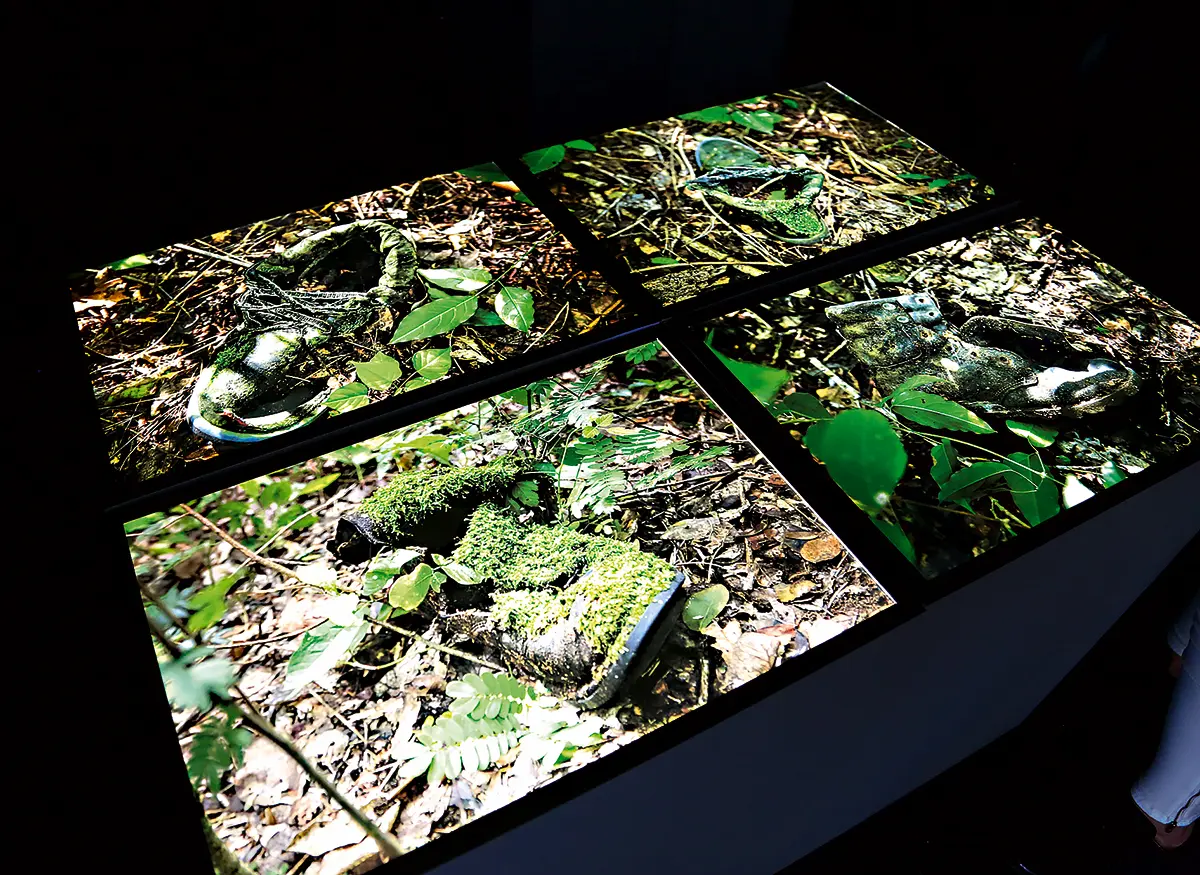
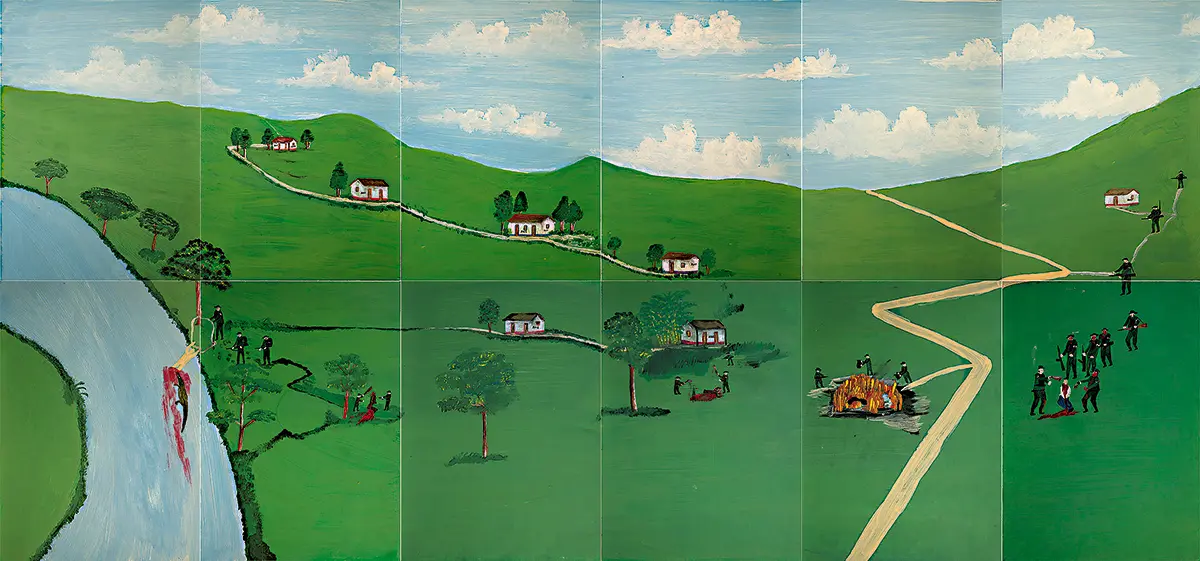
Here and there throughout the exhibition, alongside these works by Echavarría, we find paintings in a style that can be described as narrative and naïf. These large-scale boards are the result of a number of workshops held between 2007 and 2009 with former combatants from all sides of the conflict. La guerra que no hemos visto is really that, real fragments of stories told in the first person about the events that took place: stories of massacres, the loss of loved ones, killings and tortures that generate a zoom-in effect into the abstract idea of the war that generally comes to light via the mass media. One might become inured to generalities, but it is impossible to remain indifferent in the face of voices that narrate and paint such atrocities, as for example with Y nadie pregunta por ellos (And No One Asks For Them), where Carlos Mario, a former member of the United Self-Defense Forces of Colombia (AUC in its Spanish acronym), tells the stories of five comrades killed by the most arbitrary and absurd of reasons, in keeping with the unwritten laws of war. Some of these tales also have a video capsule in which we can hear a voiceover narration as aerial images of the geographical areas where the events took place to pass by. This is the case of Zereida, a former guerilla who tells the story of how, after becoming pregnant, she was forced to abort and saw the father of her unborn child killed for opposing the rule that prohibited female fighters from having babies. The camera shows us, from above, the villages, the forests, and the rivers that would become red with blood on a daily basis. Those are the rivers articulating the plea behind this exhibition: listen to the voices that come from the depths of this remote, inaccessible landscape! Talk to them! There is a first-person voice to war; we don’t often hear it, but in this exhibition Echavarría allows it to unfold without equivocation. In the same way that Guerra and Pa are a pair in conflict, an unredeemable phonetic interplay, perhaps the landscape and the death that overtakes it engages in a dance, inevitably together as they wrestle for dominance.
CARIDAD BOTELLA
Curator.