The question that José Vera-Matos poses in his most recent solo show titled “Prophecy is Memory,” centers not only on the ways in which the past acts in the present, but also on the possibility that both ends meet.
Vera-Matos addresses the history of Peru by focusing on the conquest as well as on the pre-Columbian and Spanish legacies. He approaches these themes from the perspective of the present, through design forms, modern art traditions, and the possibilities of contemporary art.
As it often occurs in his work, Vera-Matos resorts to the transcription of texts whose titles outline the thematic territory covered. The central installation of the exhibition consists of a large wooden structure in the manner of a display cabinet that shows a series of pages containing the transcription of The Conquest of America: the Question of the Other, a treatise by Bulgarian-French historian Tzvetan Todorov that approaches the conquest of the Americas as a cultural confrontation marked by misunderstandings. Each page employs a different structural layout, beginning with the Inca tocapus, checkered design patterns with geometrical forms. In this manner, writing—one of the great contributions of the conquest—is subjected to pre-Columbian design patterns. Then, the writing is adapted to geometric abstraction components and the design to eventually end once again with the tocapus. In addition, Vera-Matos incorporates elements from collage (photographs, cartoon-like speech balloons) and other graffiti-like inscriptions in order to expand the universe of the communication systems alluded to.
These resources are also employed in other textual pieces with texts from the book The Vision of the Vanquished: The Spanish Conquest of Peru Through Indian Eyes, 1530–1570, in which French historian and anthropologist Nathan Wachtel offers a vision of the conquest from the perspective of the people conquered; as well as from the treatise on style by Claude Lévi-Strauss titled The Way of the Masks, where the French anthropologist and ethnologist uses masks from North American indigenous people as an example. Through this methodology, Vera-Matos subverts the relationships based on conquest and cultural defeat by imposing the meaning of images on the logic of the texts, turning pre-modern and modern artistic forms into some sort of editorial design models.
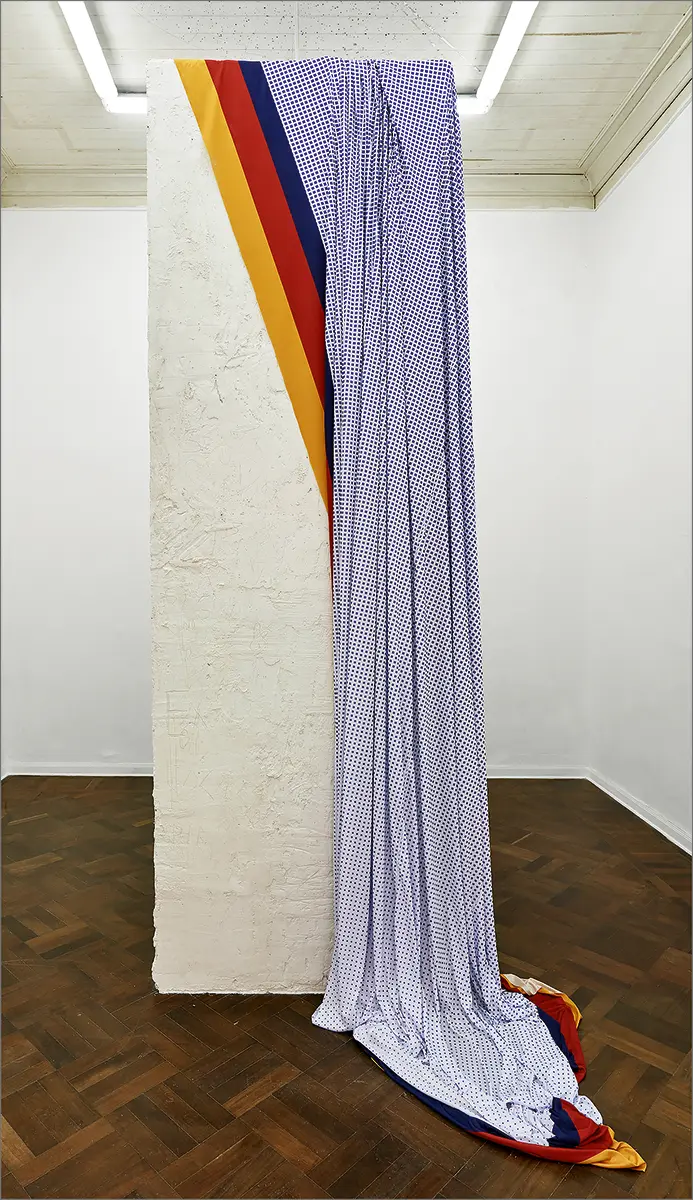
These pieces are accompanied by small drawings on graph paper that are reminiscent of scientific diagrams, musical notations, or mathematical notes and that broaden the notion of writing. This appears to be at play in two monumental sculptures. Like the exhibition, they are titled Prophecy is Memory and are formed by large rectangular structures made of concrete with inscriptions engraved on their surfaces (in the style of street graffiti, with obscene images included). These parallelepipeds are partially covered by large color fabrics with a checkered design. The colors in these fabrics were taken from posters that artist Jesús Ruiz-Durand created for the military government of General Juan Velasco-Alvarado to promote land reform (and the land expropriation and redistribution that it entailed). Such political materials of communication are transformed into an enigmatic chromatic code.
A video also titled Prophecy is Memory, approaches the question of the relationship between past and present with great clarity. The skin of a character with his torso exposed is covered with tattoo-like inscriptions. A knife pierces through the noise of the subject’s face while a crucifix decorates his forehead. On his torso, back, and arms, there are figures taken from Sechín and Chavín pre-Columbian iconography as well as emoticons, including smiling faces. The number 1942 has been also written on the subject’s chest. He observes these marks as if they had a life of their own and were having a conversation with him. He asks, responds, and argues with them in the same manner that he addresses an off-frame figure that one assumes is in the sky.
These dialogs and discussions reveal a difficult negotiation with legacies and beliefs that have been imposed on us in a more or less violent fashion—something suggested by color changes in the video, which at times displays different variations of red (the background is a green screen), but also by the figures on the skin: creatures with enormous fangs (Chavín) and decapitated heads and mutilated torsos with their entrails hanging out (Sechín). But legacies are not only imposed, they are also assumed, despite their original violence, as it occurs with language. Mouths move but instead of a single voice, there is imposing music filling the space.
With this intersection of multiple referents, José Vera-Matos proposes the need to identify and confront those legacies that have shaped us; difficult legacies that we carry under the skin and that has been all along talking to us in silence, even before we were born. We can and must respond to them.
MAX HERNÁNDEZ CALVO