During the civic-military dictatorships in the Southern Cone, the technology of extermination not only consisted of assassinations, disappearances, and torture, but also involved book burning. The erasing of the other, then, occurred in both the body and the epistemologies that disobeyed, before and during the regime, the military model, and its analog: the market. In the so-called National Reorganization Process in Argentina, for instance, where the dictatorship linguistically transformed a massacre into a patriotic duty, book burning became known as the “cultural reconstruction plan of the nation.” And, in Chile, as demonstrated in the famous scene of the documentary titled La Batalla de Chile (The Battle of Chile, 1975-1979) by Patricio Guzmán, an agent of the DINA (National Intelligence Directorate) told the man behind Guzmán’s camera not to speak with the soldiers and not to ask them why they burned books. This agent spoke English and French, and did so in a calmed manner, with a soft voice and a smile that betrayed his pleasure: his knowledge of high culture. One of the most prominent exponents of the New Latin American Cinema, Guzmán left Chile with his movie, which was not shown there until 2006.
A while ago in New York City, Jorge Tacla (Santiago, 1958) told me about a winter evening during the 1980s when he attended a screening of Guzmán’s documentary at the Film Forum. He recalled the profound feeling of affection that the long line amid the snow to buy the tickets elicited in him, describing an image that combined absence and representation, just as it occurred with the censorship and the exhibition of La Batalla de Chile. It is precisely this representation of an absence—or, in other words, of the same repetitive design to erase, burn, and disappear the books—the very thing that we are faced with in Tacla’s most recent exhibition at the Cristin Tierney Gallery. In fact, it is not strange that in his latest series Tacla focused on books, considering that two years ago he burned two of his own notebooks at the paradigmatic Pedagogical Institute of the Universidad de Chile, referencing the destruction of books during the dictatorship—a theme that he took to a “more universal” level in his current retrospective at the CorpArtes cultural center in Santiago.1 Yes, in modern space-time books, have always been hidden, as demonstrated by the famous case of La Primer Nueva Corónica y Buen Gobierno (The First New Chronicle and Good Government, 1615), a denunciation of the Andean crisis that followed the conquest, published in facsimile only until 1936.2
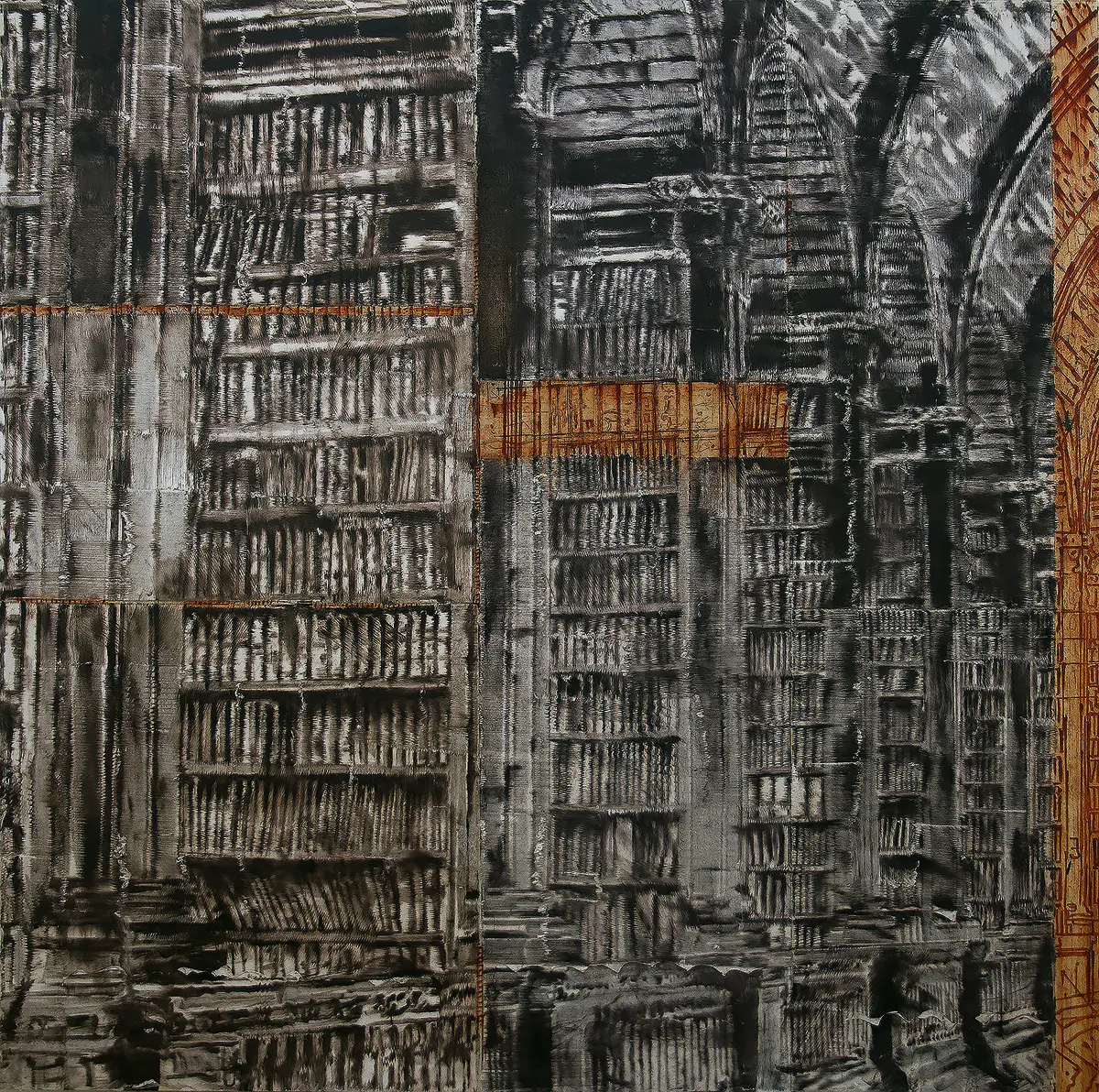
Titled Sign of Abandonment, the exhibition by Jorge Tacla at the Cristin Tierney Gallery consisted of five paintings that showed empty libraries in blue and red tones. Empty, yes, but of bodies not books. As is recurrent in his pictorial process, he transferred photojournalistic images using a combination of oil painting and cold wax, and he did so at a time when visibility and concealment coexist. In this manner, once the image has been transferred to the canvas (still wet), he drowns the image “almost completely hiding it […] in order to, like a surgeon, cut the layers and reconnect the spaces until only a very thin and vulnerable skin remains.”3 This skin, which Tacla also calls “the skeleton of architecture,” is allegorical of the visibility and concealment occurring in his libraries. As a result, form, content, and time become a single narrative: to make the absence of the body visible in spaces that, while not destroyed like the majority of his paintings, are, strangely, not habitable. Something similar occurs in the empty libraries of German photographer Candida Höfer. But in Tacla’s libraries order, orthogonality, and permanence are in themselves ambiguous concepts addressing spatialities that could eventually disappear, or that have already disappeared—like the public library in Detroit that was destroyed in 2011 following the financial crisis in that city.
That library is represented by Tacla in Señal de Abandono 24 (Sign of Abandonment 24, 2017), a vertical painting measuring 181.6 by 124.5 cm, created with blues, greys, and white paintings. Unlike Höfer’s libraries and, to a certain extent—but because of a different framing or visual field—to some of the other paintings in the exhibition—like Señal de Abandono 22 (Sign of Abandonment 22), which shows the Trinity College Library in Dublin—in Señal de Abandono 24 the floor and the stair steps resemble books, as if books and the architecture had the same materiality. Tacla seems to suggest here that the books are forced to disappear because of an economic crisis or, in other words, as a result of an economy that surveils them and other subjectivities. “It may very well be your art, but this is my wall,” remembered Tacla when I asked him about the exhibition, alluding to what Nelson Rockefeller told Diego Rivera during their famous disagreement over the content of Rivera’s mural.4 In this manner, it is not that libraries in particular and culture, in general, are being threatened by the advent of the digital era—as it has also been mistakenly and famously suggested about the photographic medium. It is rather about a much broader criticism that, through the use of concealment and visibility as aesthetic strategy reveal, always foggily, in the skin of architecture the unavoidable relationships between the market and culture, in this instance in the form of libraries.
NOTES
1. See http://www.umce.cl/index.php/noticias-dir-extension/item/1687-exposicion-tacla and http://artishockrevista.com/2017/12/12/jorge-tacla-entrevista/
2. Rolena Adorno, Guamán Poma and his illustrated chronicle from colonial Peru: From a century of scholarship to a new era of reading. Copenhagen: Museum Tusculanum Press, University of Copenhagen: Royal Library, 2001.
3. Jorge Tacla, interview by Amy Ingrid Schlegel, Ph.D., director of the Art Gallery of Tufts University, January 1, 2016, interview, document.
4. Interview with the artist. January 10, 2018.
FLORENCIA SAN MARTÍN